Skip to content
Yes, swing trading works with CFDs, but only if you treat overnight financing as a real cost and size positions before you fall in love with a chart pattern. The two things that decide whether this approach makes or loses money over a year of trades:
- Swap adds up. Every night you hold a CFD position, you pay or collect financing, and on multi-day trades that cost can quietly eat into a winning setup.
- Risk per trade stays fixed. Cap it at 1% to 2% of account equity per trade, and plan to hold positions for days, not weeks, unless the setup justifies it.
CFDs are leveraged products, and leverage cuts both ways. A string of losing swings without a sizing rule can drain an account faster than most beginners expect.
Key Takeaways
Swing trading CFDs works when traders combine rule-based setups with disciplined position sizing and factor overnight financing into every trade’s break-even math.
| Point | Details |
|---|---|
| Hold days, not months | Plan for a three to ten day hold using daily charts for bias and 4-hour charts for entries. |
| Cap risk per trade | Risk 1% to 2% of equity per trade, and size positions using dollar risk divided by stop distance. |
| Calculate swap before entry | Multiply notional value by the daily swap rate and expected nights held to know your real break-even. |
| Track setups separately | Log 30 to 50 trades per setup before deciding whether to scale it. |
| Test on Cubomarkets first | Use a demo account to check spreads, fills, and swap history before funding a live account. |
Table of Contents
- What Is Swing Trading, and Which CFD Markets Fit It Best?
- How Do Leverage, Margin, and Overnight Financing Change Swing Trades?
- Four Rule-Based Swing Setups Worth Testing on CFDs
- How Much Should You Risk Per Swing Trade?
- How Do You Calculate and Manage Swap Costs on CFDs?
- Building a Repeatable Swing Trading Routine
- What Should You Look for in a CFD Platform for Swing Trading?
- What Most Swing Trading Advice Gets Wrong About CFDs
- Test Your Swing Strategy With a Platform Built for It
- Frequently Asked Questions
- Sources
What Is Swing Trading, and Which CFD Markets Fit It Best?
Swing trading means holding a position for several days to a few weeks, aiming to capture one solid directional move rather than a dozen small ones. You’re not glued to a five-minute chart. You’re checking in once or twice a day, which is exactly why this style appeals to people who trade around a job rather than sitting at a desk full time.
Compare that to day trading: fewer trades, less screen time, but you need more patience to let a thesis play out over multiple sessions. Day traders close everything before the market shuts. Swing traders sleep on open risk, which is where CFD-specific costs enter the picture.
Not every CFD market behaves the same way for swing purposes:
- Forex pairs offer round-the-clock liquidity and tend to trend cleanly on daily charts.
- Stock indices like major benchmarks often swing on macro news and earnings cycles.
- Single-stock CFDs carry more idiosyncratic risk (and dividend/earnings gaps).
- Commodities such as gold or oil react to supply shocks and can trend for weeks.
- Crypto CFDs move fast and carry wider swap spreads, so hold times often shrink.
For chart timing, use the daily chart to set your directional bias and the 4-hour or 1-hour chart to fine-tune entries.
How Do Leverage, Margin, and Overnight Financing Change Swing Trades?
Leverage lets you control a larger position with less capital, but it also shrinks the room for error. If your stop is wide and your leverage is high, a normal pullback can trigger a margin call before your thesis even gets tested. Margin planning matters here: leave enough free margin to absorb typical volatility, not just the amount required to open the trade.
Then there’s swap, the overnight financing charge (or credit) applied for holding a CFD position past the daily cutoff. It compounds across every night you hold, which is a fundamentally different cost structure than day trading, where positions close before financing ever applies.
A few mechanics worth internalizing:
- Wider spreads and slower fills quietly erode returns across dozens of trades, even when your win rate looks fine on paper.
- Broker execution quality, not just your entry signal, decides whether a “good” setup turns into a profitable one.
- Always check a broker’s regulatory status and how transparently it publishes swap rates before funding a live account.
Four Rule-Based Swing Setups Worth Testing on CFDs
These aren’t secret formulas. They’re the kind of structured, testable setups that let you separate a real edge from a lucky streak. Test each one on a demo account first, using the daily chart for context and the 4-hour chart for timing.
- 20 EMA pullback reversion. Enter when price pulls back to the 20-period exponential moving average within an established trend, confirmed by a bullish or bearish rejection candle. Place your stop just beyond the recent swing low or high, target the prior swing extreme, and expect a hold of roughly three to seven days.
- Consolidation breakout. Wait for price to compress in a multi-week range, then confirm a breakout with a close beyond the range boundary on above-average volume. Stop goes just inside the broken level; target is measured by the range’s height projected forward. Typical hold: five to ten days.
- Fibonacci retracement entry. In a clear trend, wait for a pullback into the 50% or 61.8% retracement zone, then enter on a reversal signal. Stop sits below the 78.6% level; target the prior high or low.
- Mean reversion after an earnings gap. When a stock gaps sharply on earnings and then stalls, a reversion trade back toward the pre-gap range can work, but only with a tight stop and a short expected hold, since these moves can also just keep trending.
Pro Tip: Pick one setup, not four, and run it on a demo account for at least a month before risking real capital. Trying to master all four at once is how most beginners end up with no edge in any of them.
How Much Should You Risk Per Swing Trade?
Position sizing is the difference between a bad trade and a bad month. The formula is simple: dollar risk divided by stop distance in price terms equals your position size.
- Set your dollar risk. Cap it at 1% to 2% of account equity per trade.
- Measure stop distance. Use either a multiple of the Average True Range (commonly 1.5x to 2x ATR) or the most recent swing low/high, whichever gives a more logical stop.
- Calculate size. Dollar risk ÷ stop distance = position size in units or lots.
- Cap portfolio heat. Keep total risk across all open swings at 3% to 5% of equity, so five loss-cutting stops in a row can’t wipe out a month of gains.
- Add a time stop. If a setup hasn’t moved in your favor within its expected window (say, ten trading days for a breakout trade), close it regardless of price.
Worked example: On a $10,000 account risking 1.5%, your dollar risk is $150. If your stop is 30 pips away on a forex CFD worth $1 per pip per lot, that’s 0.5 lots. Now add an expected swap cost of roughly $8 over a five-day hold. Your real risk budget for price movement drops to about $142, which should nudge your position size down slightly rather than get ignored.
How Do You Calculate and Manage Swap Costs on CFDs?
Swap is calculated as notional value times the daily swap rate times the number of nights held. That formula belongs in your break-even math, not as an afterthought after the trade closes.

Say you hold a $20,000 notional forex position with a daily swap rate of $2.50 per day for five nights. That’s $12.50 in financing, which is trivial against a $300 profit target but starts to matter if your typical target is closer to $50.
Swap becomes a material portion of risk once a planned hold stretches past about a week, so treat it as recurring friction, not a rounding error. Practical mitigations:
- Favor instruments with historically lower swap rates for your trading direction.
- Shorten your average hold time when swap rates spike.
- Check a broker’s published swap history on a demo account before trading it live.
- Consider a swap-free account structure if one is available, weighing any tradeoff in spread or eligibility.
Building a Repeatable Swing Trading Routine
A routine turns swing trading from guesswork into a testable process.
- Evening scan. Set directional bias on the daily chart, then narrow entries on the 4-hour chart. Build a watchlist of five to ten setups that meet your criteria.
- Pre-trade checklist. Confirm trend direction, entry trigger, stop level, expected swap cost, and correlation with other open positions before you click buy or sell.
- Order execution. Use limit entries or bracket orders where available, and have a plan for weekend gaps or scheduled news events that could blow through your stop.
- Post-trade journal. Log the setup type, risk-to-reward ratio, actual outcome, slippage, and swap paid. Tracking 30 to 50 trades per setup is what tells you whether it actually has an edge.
Pro Tip: Journal the trades you didn’t take too. Skipped setups that would have worked are just as valuable for spotting hesitation patterns as the ones you actually placed.
What Should You Look for in a CFD Platform for Swing Trading?
Execution speed, tight spreads, and transparent swap disclosure decide whether your edge survives contact with real market conditions.
Platform quality changes real outcomes, which is exactly the gap Cubomarkets is built to close: spreads starting at 0.0 pips, zero commission, and execution built for speed, backed by over 3 million executed orders. Before funding a live account:
- Open a demo account and review the platform’s swap history for the instruments you plan to trade.
- Run sample trades to measure actual fill quality against the quoted spread.
- Check that withdrawals and deposits process without unexplained delays.
What Most Swing Trading Advice Gets Wrong About CFDs
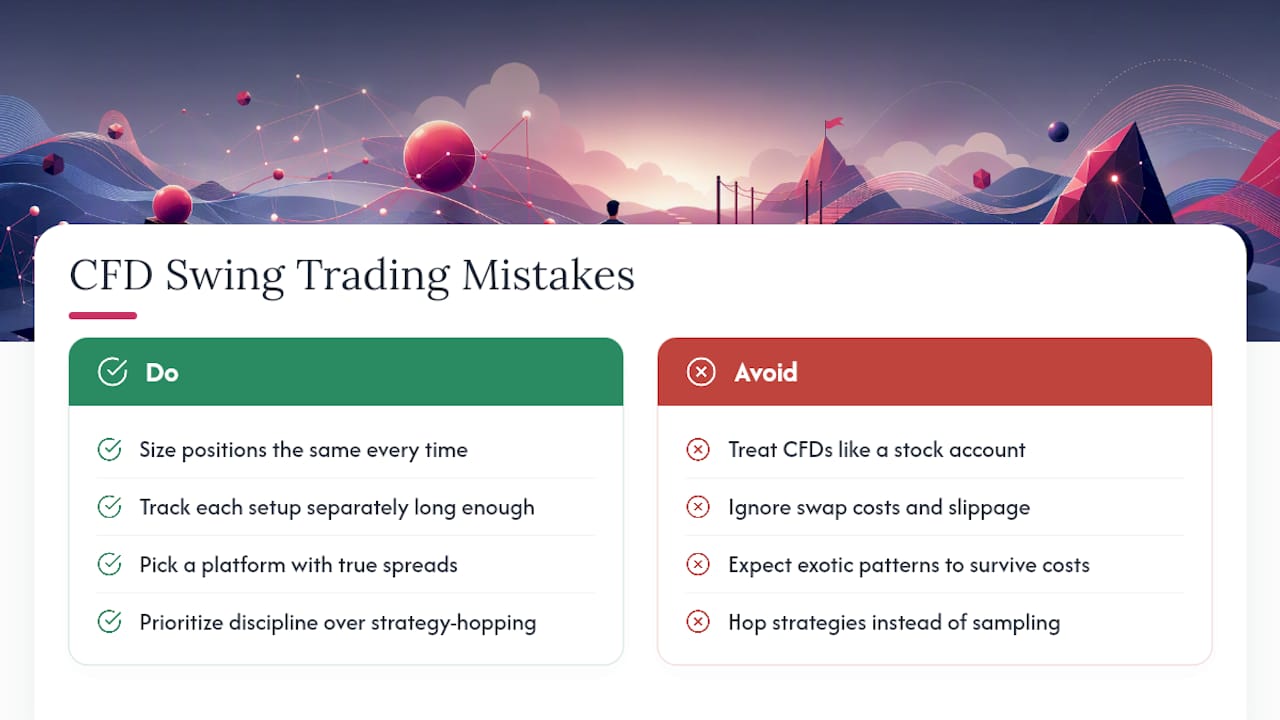
Most swing trading content treats CFDs like a stock account with extra leverage bolted on. It isn’t. The financing mechanics change the math, and ignoring that is probably the single biggest reason retail swing traders underperform their own backtests.
Here’s the uncomfortable part: a strategy that looks great on a spreadsheet often quietly loses its edge once you fold in real swap costs and realistic slippage. That doesn’t mean swing trading CFDs is a bad idea. It means the setups that survive contact with real costs are usually the boring ones, trend pullbacks and clean breakouts, not the exotic patterns that look impressive on a highlight reel.
What actually separates traders who make this work from those who don’t isn’t a smarter indicator. It’s whether they size positions the same way every single time, track each setup separately long enough to know if it has real expectancy, and pick a platform where the spread they see is the spread they get. Prioritize that discipline over strategy-hopping, and the rest becomes a matter of patience and sample size.
Test Your Swing Strategy With a Platform Built for It
Every setup in this guide depends on execution you can trust, tight spreads, honest swap disclosure, and fills that match what you saw on the chart. Cubomarkets gives swing traders that foundation: spreads starting at 0.0 pips, zero commission, and fast order execution across forex, indices, commodities, stocks, and crypto CFDs, all from one account.

If you’re ready to test the setups covered here, start on a demo account through Cubo Markets, review the swap history on the instruments you plan to trade, and run a handful of sample trades to check fill quality before committing real capital. When you’re comfortable with the numbers, opening a trading account takes just a few minutes.
Frequently Asked Questions
Is swing trading CFDs profitable for beginners?
It can be, but only with disciplined position sizing and a tested setup. Beginners who skip risk rules or ignore swap costs tend to underperform their own backtests.
How long should a CFD swing trade stay open?
Most swing trades run several days, though a strong trend-following breakout can justify holding longer.
Does swap apply on weekends?
Many brokers charge triple swap on Wednesdays to account for weekend financing, so check your broker’s specific policy before holding positions into a weekend.
What’s the minimum account size for swing trading CFDs?
There’s no fixed minimum, but meaningful diversification across a few setups often requires a few thousand dollars in account equity to size positions without over-leveraging.
Can you swing trade CFDs on crypto?
Yes, though crypto CFDs often carry wider swap rates and higher volatility, which usually means shorter hold times and tighter position sizing.
This article is general information, not a substitute for advice from a qualified financial advisor. Consult a qualified financial professional about your own circumstances before acting on anything here.
Sources
- Day Trading vs. Swing Trading: Pros, Cons, and Differences | Investopedia
- Swing Trading on the CFD market – CFD Info
- Swing Trading: Trend Following & Swap Management | BYDFI
- 5 Swing Trading Strategies With Exact Entry and Exit Rules (2026) | TradeZella