Skip to content
A stock CFD is a contract between you and a broker that pays out the difference in a share’s price between opening and closing the trade, without ever putting the stock in your name. You never touch the actual shares. The main trade-off is simple: leverage lets you control a bigger position with less cash upfront, but it also means losses can exceed a small move in the wrong direction, and financing charges eat into anything held longer than a few days. Broker disclosures across the industry commonly show that 64% to 70% of retail accounts lose money trading CFDs, which tells you this isn’t a shortcut to easy profit.
Who does this actually suit? Short-term traders comfortable with volatility, people who want exposure to a stock’s price movement without the capital required to buy shares outright, and anyone hedging an existing portfolio. It’s a poor fit for buy-and-hold investors chasing dividends and long-term compounding.
- Start on a demo account before risking real capital, especially if you’re new to leveraged products.
- Set a hard risk limit (often 1% to 2% of account equity per trade) before you open a position.
- Check the broker’s margin and financing terms for the specific stock CFD you’re trading, since these vary by instrument and by broker.
Retail-loss stat: Industry disclosures consistently cite roughly 64% to 70% of retail CFD accounts losing money, a figure regulators require brokers to publish precisely because leverage cuts both ways.
Table of Contents
- What Is a Stock CFD and How Does the Contract Work?
- CFD Trading Essentials: Long, Short, Leverage, and Margin
- Costs and Fees for Stock CFDs: Commissions, Spreads, and Financing
- Risks, Regulatory Protections, and Counterparty Considerations
- How to Trade a Stock CFD, Step by Step
- Common Stock CFD Strategies and When Each One Fits
- CFDs vs. Owning Stocks: Which One Actually Fits You?
- What Cubo Markets Offers Active Stock CFD Traders
- What Actually Matters When You Trade Stock CFDs
- Where to Learn More About Stock CFD Mechanics
- The Honest Take on Stock CFD Trading
- Trade Stock CFDs With Transparent Costs on Cubo Markets
- Frequently Asked Questions
- Sources
What Is a Stock CFD and How Does the Contract Work?
A stock CFD, short for contract for difference, is a bilateral agreement: you and your broker agree to exchange the difference in a stock’s price from the moment you open the position to the moment you close it. You’re not buying shares of Apple or any other company. You’re agreeing to a cash settlement based on how Apple’s share price moves. That distinction is the entire product, and it explains almost everything else in this guide, from why you don’t get voting rights to why dividends work differently.
Here’s how the numbers actually break down:
- Notional exposure. Say you want exposure to 100 shares of a stock trading at $50. Your notional position size is $5,000.
- Margin required. Under European margin frameworks, major stocks often require around 20% margin, meaning 5x leverage. On a $5,000 position, that’s $1,000 posted as margin.
- Price movement and payout. If the stock rises to $52, your position gains $200 (100 shares × $2), a 20% return on your $1,000 margin. If it falls to $48, you lose $200, also 20% of your margin, but now you’re closer to a margin call.
The broker sets the CFD price by referencing the underlying market price, typically the exchange’s live quote, plus its own spread. That’s why CFD pricing tracks the real stock almost tick for tick, with the small gap being the broker’s built-in cost.
One thing worth flagging early: regulatory treatment isn’t uniform globally. Europe operates under MiFID II and ESMA rules, which cap leverage and mandate specific investor protections. Other jurisdictions handle CFDs differently, and the U.S. bars retail CFD trading altogether. Where you’re trading from changes the rules you’re playing under.
CFD Trading Essentials: Long, Short, Leverage, and Margin
Going long on a stock CFD means you’re betting the price rises. Buy a CFD on a stock at $100, it climbs to $108, you close out and pocket the $8 per share difference, multiplied by your position size. Going short works the opposite way: you sell a CFD at $100 expecting a drop, and if the stock falls to $92, you close the position and collect that $8 spread. You never need to borrow shares to short a CFD the way you would with traditional short selling. The broker handles that mechanically.
Leverage is where the essentials get sharper. A 5x leverage ratio (roughly 20% margin) means a 4% move in the underlying stock produces a 20% swing in your account equity. That cuts both directions.
- Margin calls happen when your account equity falls below the broker’s maintenance threshold, and the broker will ask you to deposit more funds or close part of the position.
- Forced closeouts occur automatically if you don’t respond, and brokers typically close positions before your account goes negative.
- ESMA-regulated brokers must offer negative-balance protection to retail clients, meaning you can’t lose more than what’s in your account, even during a sharp gap in price.
Position sizing is the practical skill that separates traders who survive from those who blow up an account in a week. A common rule: risk no more than 1% to 2% of total account equity on any single trade. If you have a $10,000 account and you’re risking 1%, that’s $100 of acceptable loss on the trade, which then dictates how many CFD units you can buy given your stop-loss distance.
Pro Tip: Calculate your position size backward from your stop-loss, not forward from how much margin you can afford. Just because you can afford a $5,000 position doesn’t mean your risk tolerance supports it.
Costs and Fees for Stock CFDs: Commissions, Spreads, and Financing
Every cost line here chips away at your return, and stock CFDs tend to carry more distinct fee types than something like forex CFDs, which are often spread-only.
- Commission. Stock CFDs typically charge an explicit commission as a percentage of trade value, often charged separately on both the open and close of a position.
- Spread. The gap between the bid and ask price. For major US stocks, retail CFD spreads commonly range from 0.05% to 0.20% depending on the broker and liquidity.
- Overnight financing (swap). Hold a leveraged long position past market close and you’ll pay financing on the notional value you don’t own, calculated as a benchmark rate plus the broker’s markup.
- FX conversion. If you’re trading a stock CFD denominated in a currency different from your account base currency, expect a conversion fee on top.
Here’s a worked example. Entry commission: $5. Exit commission: $5. Add the spread cost on entry, and your total drag before the stock even moves is somewhere near $24 to $30, all coming out of whatever profit the trade generates.
Statistic callout: Financing costs accumulate daily on leveraged positions, and a multi-week hold can rack up several percentage points in charges that quietly erode net returns, particularly on positions that aren’t moving fast enough to outrun the fees.
When comparing brokers, check the all-in cost: commission rate, typical spread on the specific stocks you trade, the financing rate formula (not just “competitive rates”), and whether FX conversion applies to your account currency.
Risks, Regulatory Protections, and Counterparty Considerations
Leverage amplifies both directions, and that’s the risk most beginners underestimate until it happens to them.
- Broker counterparty risk exists because a CFD is a contract with your broker, not an exchange-cleared instrument, so the broker’s financial stability matters.
- Execution risk and slippage show up during volatile news events, when your stop-loss might fill at a worse price than intended.
- Order-type limits mean guaranteed stops (which eliminate slippage) usually cost extra, while standard stops don’t guarantee the exact fill price.
ESMA’s retail protections for CFDs include leverage caps that scale with asset volatility, mandatory risk warnings displayed by brokers, and negative-balance protection so retail traders can’t owe more than their account holds. These rules exist because regulators observed how often leveraged retail accounts ended up underwater.
CFDs also aren’t available everywhere. The U.S. prohibits retail CFD trading entirely, while Europe and many other regions permit it under regulatory frameworks like MiFID II. Investor compensation schemes in regulated jurisdictions typically cover a portion of client funds if a broker becomes insolvent, though the exact coverage varies by regulator and country.
How to Trade a Stock CFD, Step by Step
Getting from curiosity to your first trade should follow a specific order, and skipping steps is how people lose money faster than they expected.
- Open a demo account first. Practice the mechanics, including how margin calculations actually display on the platform, before funding anything real.
- Complete identity verification (KYC) and fund your live account, choosing your account currency carefully if you’ll be trading stocks priced in a foreign currency.
- Select the stock CFD and set direction. Decide long or short, then calculate position size using your risk percentage and the distance to your stop-loss.
- Choose your order type. A market order fills immediately at current price; a limit order waits for your target price. Set a stop-loss and take-profit before you submit, not after.
- Estimate the all-in cost (commission, spread, expected financing if you’re holding overnight) so you know your real breakeven point, not just the entry price.
- Monitor and manage. Track financing accrual daily on positions held longer than a session, and close according to the rules you set before entering, not based on how you feel watching the chart.
Before any of this, run pre-trade checks: is there an earnings announcement coming up that could gap the price? Is a dividend date approaching that will trigger a dividend equivalent adjustment? Are you trading during normal market hours when liquidity is highest?
Pro Tip: Write your exit plan, both stop-loss and take-profit, on paper or in a notes app before you open the trade. Traders who decide exits in real time almost always second-guess themselves at the worst possible moment.
Common Stock CFD Strategies and When Each One Fits
Different strategies suit different trading styles, and matching the right one to your schedule and risk tolerance matters more than picking whichever sounds most exciting.
Day trading and scalping rely on tight timeframes, often minutes to hours, and demand low spreads and fast execution because you’re making many trades and small cost differences compound quickly. If your broker’s execution lags during volatile periods, this strategy suffers first.
Swing trading holds positions for days to weeks based on a trend or technical setup. Financing costs matter more here since you’re paying overnight charges for the duration of the hold, so the position needs to move enough to outrun those fees.

Pair trading and relative-value plays involve going long one stock CFD and short a related one, betting on the spread between them rather than the direction of the broader market. CFDs make this operationally simple since you can open both legs quickly without borrowing shares for the short side.
Hedging an existing portfolio with short stock CFDs lets you offset downside risk on shares you already own without selling them, useful around earnings season or macro uncertainty when you want protection without triggering a taxable sale. Common CFD strategies also include news trading and technical setups, but strategy choice ultimately determines whether financing drag helps or hurts you. Short-duration approaches sidestep most financing costs; longer holds need to budget for them explicitly.
CFDs vs. Owning Stocks: Which One Actually Fits You?
The core difference is ownership. Buy shares and you own a piece of the company, with voting rights and a genuine dividend payment. Trade a stock CFD and you own nothing; you’re speculating on price movement through a contract.
- Dividends work differently. Long CFD holders often receive a dividend equivalent credited by the broker, while short holders are typically charged that same amount, and the exact timing and amount depend entirely on the broker’s policy, not a shareholder right.
- Voting rights don’t exist with CFDs. You can’t vote on company matters no matter how large your notional position is.
- Costs diverge based on holding period. For short-term trades, CFD spreads and commissions can be cheaper than brokerage fees on small stock purchases. For long-term holding, financing charges on CFDs accumulate and usually make direct share ownership the cheaper route.
- Tax and reporting treatment differs by country and by instrument type, and this is genuinely one area where you should talk to a local tax adviser rather than rely on a general guide, since CFD gains are often taxed differently from capital gains on shares.
The decision rule is straightforward: if you’re trading a view over days or weeks and want leveraged, capital-efficient exposure, a stock CFD usually makes sense. If you’re building a long-term position and want dividends, voting rights, and lower ongoing costs, buying the shares directly is almost always the better fit.
What Cubo Markets Offers Active Stock CFD Traders
Execution quality and cost transparency separate a usable CFD platform from a frustrating one, and this is where the mechanics discussed above become concrete rather than theoretical.
- Multi-asset access across forex, indices, commodities, stocks, and crypto CFDs means you can build pair trades or hedges across asset classes without switching platforms.
- Spreads starting at 0.0 pips with zero commission on eligible instruments directly addresses the cost stack broken down earlier in this guide.
- Real-time analytics and advanced charting support the pre-trade checks and position monitoring covered in the trading checklist.
- Over 3 million executed orders processed on the platform, a scale indicator relevant to anyone evaluating execution reliability before funding an account.
| Feature | Relevance to stock CFD traders |
|---|---|
| Fast order execution | Reduces slippage risk during volatile price moves |
| Multi-asset platform | Supports hedging and pair trades across correlated instruments |
| Transparent low-cost pricing | Makes the cost calculations in this guide easier to verify upfront |
What Actually Matters When You Trade Stock CFDs
The single most important skill in stock CFD trading is position sizing tied to a stop-loss, not picking the “right” direction on a trade.
| Point | Details |
|---|---|
| Leverage cuts both ways | A 5x position turns a 4% price move into a 20% swing in account equity. |
| Financing drags on long holds | Overnight charges accumulate daily and can erode multi-week gains significantly. |
| Costs stack beyond the spread | Commission, spread, financing, and FX conversion all reduce net returns. |
| ESMA protections exist for a reason | Leverage caps and negative-balance protection reflect real, documented retail losses. |
| Cubo Markets fits active traders | Zero-commission pricing and multi-asset access suit short-term, cost-sensitive strategies. |
Where to Learn More About Stock CFD Mechanics
For deeper mechanics, read Investopedia’s CFD explainer and the Derivatives Journal breakdown of CFD stock costs. For strategy frameworks, see CFD trading strategies. For regulatory detail specific to your country, consult a licensed tax or financial adviser, since EU rules don’t apply uniformly outside Europe.
The Honest Take on Stock CFD Trading
Most beginner guides oversell the leverage angle and undersell the arithmetic of holding costs. The real skill in stock CFD trading isn’t predicting direction. It’s controlling position size relative to a stop-loss and knowing exactly what financing and commissions will cost before you open the trade, not after you close it at a loss.
Conventional advice tends to treat CFDs as a simplified version of stock investing. They’re not. They’re a short-term precision tool that happens to reference the same price as the stock. Treat a CFD like a long-term investment and the financing charges will quietly outpace whatever edge you thought you had.
Start with the demo account, get the position-sizing math automatic, and only then move to live trading with strict risk percentages. The traders who last are the ones who treat cost calculation as seriously as they treat their entry signal.
Trade Stock CFDs With Transparent Costs on Cubo Markets
Every cost breakdown in this guide, commission, spread, financing, only matters if your broker actually delivers on the numbers it advertises. Cubo Markets is built around that gap: spreads starting at 0.0 pips with zero commission on eligible instruments, fast order execution that limits slippage during the volatile moments this guide flagged as risky, and instant deposits and withdrawals so your capital isn’t stuck when you need to act.

The platform gives you access to stock CFDs alongside forex, commodities, and crypto CFDs, plus support for MetaTrader 5 if you prefer running your own indicators and automated strategies. Real-time analytics help with the pre-trade checks covered in the trading checklist above, from liquidity windows to price behavior around earnings.
If the cost breakdowns and risk management steps in this guide made sense to you, the next move is straightforward: open a trading account with Cubo Markets and test the platform’s execution speed on a demo before committing real capital.
Frequently Asked Questions
Is stock CFD trading legal in Europe?
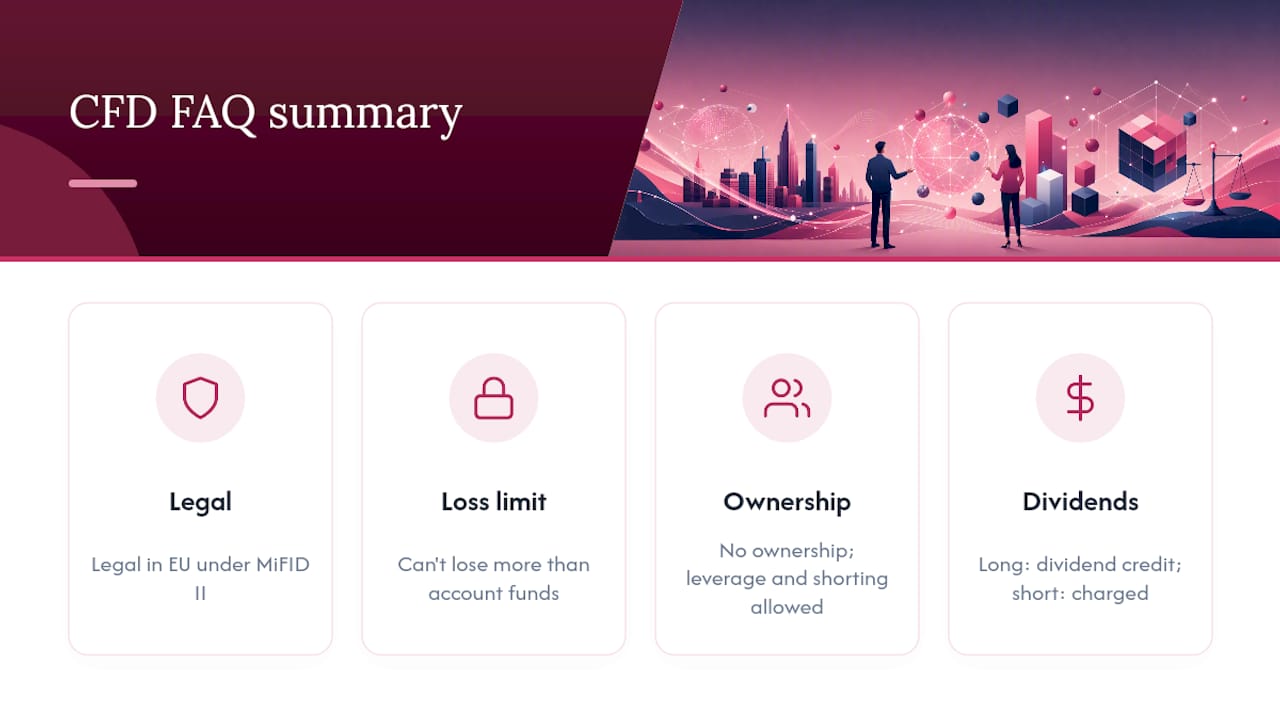
Yes. CFDs are legal and regulated across the EU under frameworks like MiFID II, which impose leverage caps and mandatory investor protections for retail traders.
Can I lose more money than I deposit trading stock CFDs?
Under ESMA rules, regulated brokers must offer negative-balance protection to retail clients, meaning you can’t lose more than the funds in your account, even during a sharp price gap.
How is stock CFD trading different from day trading real shares?
CFDs let you go long or short with leverage and without owning the underlying shares, while trading real stocks means you own the asset outright, receive actual dividends, and typically need more capital for the same size position.
Do stock CFDs pay dividends?
Long CFD positions often receive a dividend equivalent credited by the broker, while short positions are usually charged that amount. This varies by broker and isn’t a shareholder right.
What’s a realistic starting account size for stock CFD trading?
This article is general information, not a substitute for advice from a qualified financial advisor. Consult a qualified financial professional about your own circumstances before acting on anything here.
Sources
- CFD Stocks: Mechanics, Costs, and Use Cases for International Traders
- Markets in Financial Instruments Directive II (MiFID II) — European Commission