Skip to content
CFDs don’t transfer share ownership, but brokers reflect dividends as cash adjustments on the ex-date. Long positions get credited, usually net of withholding tax, while short positions get charged the equivalent amount. There’s no dividend “payment” in the shareholder sense, no voting rights, and no tax voucher from the company. The adjustment lands in your account balance, moves your available margin, and needs to be tracked separately from ordinary trading gains for tax purposes.
TL;DR:
- The ex-dividend date is critical for CFD traders; holding positions before this date ensures receipt of the dividend adjustment, but cutoff times vary by broker.
- Dividend adjustments are calculated by applying withholding tax to the gross dividend and differ for long and short positions, affecting your account balance accordingly.
- Corporate events like splits, spin-offs, and buybacks trigger specific adjustments, which can involve contract size changes, cash equivalents, or position closures.
- The cash adjustment from dividends is not a payment but an economic reflection, which must be reported for tax purposes, considering withholding tax and jurisdictional rules.
- Monitoring earnings reports is vital as their unpredictable swings outweigh the stable, predictable impact of dividend adjustments on CFD positions.
Table of Contents
- How Corporate Dates Decide Your Stock CFD Dividends
- How Brokers Calculate Dividend Adjustments On CFDs
- What Splits, Spin-Offs, And Buybacks Do To Your CFD
- Do You Owe Tax On CFD Dividend Adjustments?
- Margin, Financing, And Why Earnings Day Matters More
- Two Worked Examples: Long And Short Through An Ex-Date
- Where Cubo Fits Into This Picture
- See Corporate-Action Handling For Yourself
- Sources
- FAQ
How Corporate Dates Decide Your Stock CFD Dividends
Four dates control everything about how stock CFD dividends actually land in your account, and mixing them up is the single most common mistake new CFD traders make.
- Declaration date: the day the company’s board announces the dividend amount and the key dates that follow.
- Ex-dividend date: the first day the stock trades without the right to the upcoming dividend. This is the date your broker uses to decide who gets adjusted.
- Record date: the date the company checks its books to determine registered shareholders. It typically falls one business day after the ex-date.
- Pay date: when the company actually distributes the dividend to shareholders on record, often weeks after the ex-date.
For CFD purposes, the ex-date is what matters. If you hold a long CFD position at the close of trading the day before the ex-date (or, depending on the broker, at market open on the ex-date itself), you’re in line for the adjustment. Cut your position an hour too early and you might miss it entirely, since brokers apply strict cutoff times that don’t always match exchange conventions exactly.
The catch is that brokers don’t all define the cutoff identically. Some snapshot positions at the prior day’s close; others use the ex-date’s opening print. Before holding a stock CFD through an announced dividend, check the instrument’s specification sheet and any corporate-action notice your broker publishes, since broker documentation explicitly states dividends are booked on the ex-date and paid according to each provider’s own schedule.
How Brokers Calculate Dividend Adjustments On CFDs
The math behind dividend CFDs follows a consistent pattern, even though the final number depends on your broker’s specific policy.
- Start with the gross dividend per share as declared by the company.
- Multiply by your position size (shares equivalent) to get the total gross dividend exposure.
- Apply withholding tax if the underlying stock is foreign or otherwise subject to source-country tax. Rates vary by jurisdiction and by any tax treaty between the source country and your country of residence.
- Credit the net amount to long positions. Short positions get charged the full gross amount, not the net figure, because the short seller is effectively compensating the market for the dividend the lender of shares would have received.
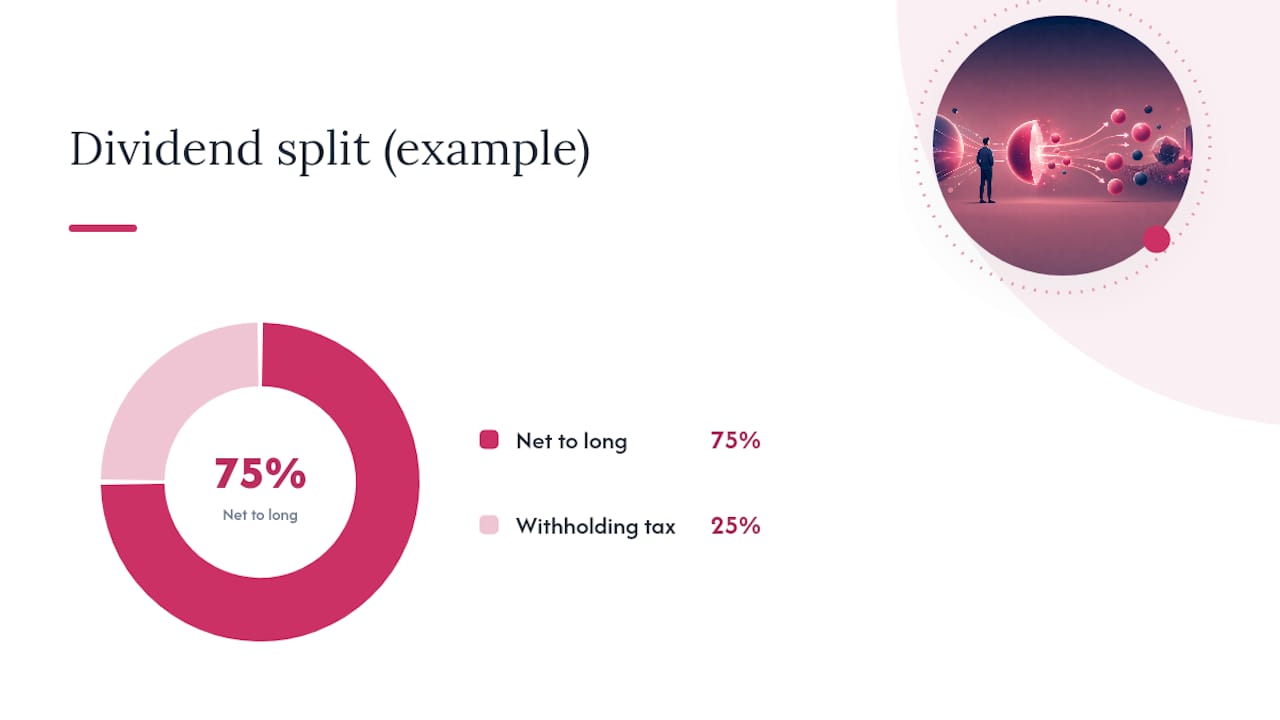
Withholding tax rates on foreign dividends commonly vary depending on the source country and any applicable tax treaty, which means the net credit a long position receives can differ meaningfully from the headline dividend figure quoted in financial news. A €1.00 per share dividend on a stock subject to 25% withholding nets out to €0.75 per share credited, while a short position on the same stock is typically debited the full €1.00.
Some brokers credit longs at a flat net rate regardless of your tax residency; others adjust based on the specific treaty rate. Currency conversion and small administrative fees can shift the final number further. This is exactly the kind of detail broker corporate-action pages exist to clarify, and the policy usually sits in the instrument specification alongside contract size and margin requirements.
What Splits, Spin-Offs, And Buybacks Do To Your CFD
Dividends aren’t the only corporate event that reshapes a stock CFD position. Splits, spin-offs, and buybacks each trigger a different kind of adjustment.
- Stock splits usually adjust your contract size or quantity proportionally, so a 2for1 split doubles your position size while halving the reference price, keeping notional exposure unchanged.
- Spin-offs can go either way: some brokers issue a cash adjustment approximating the value of the new entity, while others attempt to open a corresponding position in the spun-off company if it’s tradable.
- Rights issues typically get handled as cash adjustments reflecting the theoretical value of the right, since most CFD providers won’t let you exercise subscription rights directly.
- Buybacks rarely trigger a direct adjustment to open positions, but they can affect the float and, over time, the share price the CFD tracks.
In rarer cases, a broker may simply close out and reopen a position around a complex corporate event rather than attempt a proportional adjustment. Watching your broker’s corporate-action calendar before earnings or annual meeting season saves you from an unpleasant surprise in your account statement.
Do You Owe Tax On CFD Dividend Adjustments?
The cash adjustment you see from stock trading dividends on a CFD is not the same thing, legally, as a dividend payment. That distinction matters for how you report it.
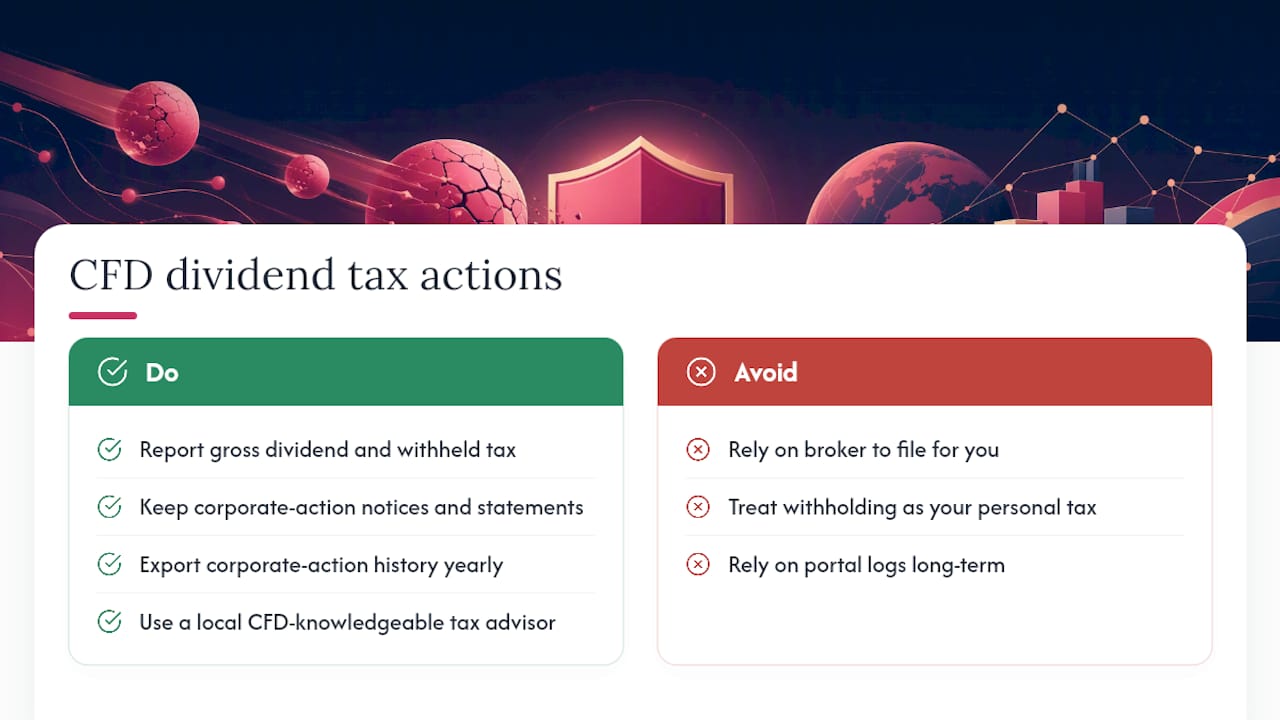
Withholding tax applied by the broker covers source-country tax obligations on the underlying stock’s dividend, not your personal income tax liability where you live. A long position credited net of withholding still generated taxable income in most jurisdictions, and that gross figure, along with the tax already withheld, needs to show up on your own tax return. Brokers generally don’t file this on your behalf.
Keep every corporate-action notice and instrument-level statement your broker issues. These documents show the gross dividend amount, the withholding rate applied, and the net credit or debit posted to your account, which is exactly what you’ll need if a tax authority asks you to substantiate a reclaim or a reported figure. Reporting rules and reclaim procedures differ by country, so a local tax advisor familiar with CFD instruments in your jurisdiction is worth the consultation fee.
Pro Tip: Export your account’s corporate-action history at the end of each tax year rather than trying to reconstruct it later. Broker portals often only retain detailed transaction logs for a limited rolling period.
Margin, Financing, And Why Earnings Day Matters More
A dividend adjustment changes your account’s cash balance on the ex-date, which in turn shifts your available margin, sometimes by enough to matter if you’re running positions close to your margin limit. A large net debit on a short position, for instance, can tighten your buffer right when you least expect it.
Overnight financing charges keep accruing on open stock CFD positions regardless of dividend timing, so don’t assume the ex-date adjustment replaces or offsets your swap costs. The two are unrelated line items on your statement.
Here’s the part traders chasing dividend CFDs often underweight: the mechanical price drop on an ex-date is small, predictable, and already priced into the adjustment. Earnings reports are a different animal entirely. Earnings season regularly produces far larger and less predictable price swings than any dividend event, which means your risk management energy is better spent there.
- Check the earnings calendar alongside the dividend calendar before holding through either event.
- Widen or tighten stops based on the stock’s historical earnings-day volatility, not its dividend yield.
- Size positions down heading into earnings if you’re also carrying dividend-related exposure.
- Review your broker’s instrument notes for both event types in one pass.
Pro Tip: If a stock reports earnings within days of its ex-dividend date, treat the whole window as a volatility event, not a routine dividend adjustment.
Two Worked Examples: Long And Short Through An Ex-Date
Numbers make this concrete.
- Long position, 1,000 shares equivalent. Gross dividend exposure is 1,000 × €0.50 = €500. After 25% withholding, the net credit to your account is €375. Your cash balance rises by €375 on the ex-date, and your position’s reference price typically opens lower by roughly the gross dividend amount to reflect the payout.
- Short position, 500 shares equivalent. Gross dividend exposure is 500 × €0.50 = €250. Short positions are charged the full gross amount, so your account is debited €250, with no withholding relief applied.
Withholding tax on foreign dividend income typically falls between 15% and 30%, so run your own numbers using the exact rate quoted in your broker’s instrument specification rather than assuming a flat figure. Currency conversion adds another variable if the stock trades in a currency different from your account’s base currency, and some CFD tickers on public data feeds simply show dividend fields as not available, which is one more reason to pull the exact figure from your broker’s platform rather than a generic quote page.
Where Cubo Fits Into This Picture
Cubo covers stock CFDs alongside forex, indices, commodities, and crypto, with instrument specs that lay out contract size, margin, and corporate-action treatment for each listed stock. Execution speed matters here too: getting filled promptly around an ex-date adjustment, without slippage distorting your entry or exit, is part of why traders care about order execution quality in the first place. Our published AML policy and due diligence framework are part of how the platform documents its own operating standards for verification.
— Cubo
See Corporate-Action Handling For Yourself
Reading about dividend adjustments only gets you so far. The real test is watching how a platform actually handles an ex-date credit or debit on a live instrument, and Cubomarkets gives you a demo environment where you can hold a stock CFD position through a real corporate action without risking capital first.

Cubomarkets covers stock CFDs alongside forex, indices, commodities, and crypto, with instrument specification pages that spell out contract size, margin requirements, and how corporate actions like dividends and splits get applied to open positions. Spreads start at 0.0 pips with zero commission, and execution is built to minimize the slippage that can quietly erode returns around volatile events like ex-dividend dates or earnings releases. Before you hold a position through an announced dividend, pull up the instrument’s specs and check the corporate-action calendar so you know exactly what adjustment to expect. When you’re ready to see it firsthand, open a trading account and test the mechanics on a real stock CFD.
Sources
For broker-specific policy language, see Dukascopy’s dividend adjustment page and Interactive Brokers’ corporate actions guide. Always confirm the exact policy with your own broker’s instrument specs before trading.
This article is general information, not a substitute for advice from a qualified financial advisor. Consult a qualified financial professional about your own circumstances before acting on anything here.
FAQ
Does A CFD Pay Dividends?
A CFD itself pays no dividend since it confers no share ownership, but brokers apply a cash adjustment on the ex-date that mirrors the dividend’s economic effect, crediting long positions and charging short ones.
How Can I Make $1,000 A Month In Dividends?
Generating $1,000 monthly in dividend income from actual dividend-paying stocks generally requires a substantial invested capital base sized to the stock’s dividend yield; CFDs don’t compound this way since they carry financing costs and no ownership stake, so most traders use dividend CFDs for short-term positioning around ex-dates rather than long-term income generation.
What Is A CFD Stock?
A stock CFD is a contract for difference that lets you speculate on a company’s share price movement without owning the underlying shares, while still triggering broker-applied cash adjustments tied to real corporate events like dividends and splits.
How Much Money Do I Need To Make $10,000 A Month In Dividends?
Reaching high levels of monthly dividend income from direct stock ownership typically demands a large diversified portfolio, since even solid dividend yields require substantial capital to generate consistent payout, and CFD trading isn’t structured to replace that kind of long-term income strategy.
Is The Dividend Adjustment The Same As The Ex-Date Price Drop?
The cash adjustment and the price drop are related but distinct. The stock’s reference price typically opens lower on the ex-date by roughly the dividend amount, and the broker separately posts the cash credit or debit to reflect that same economic event on your position.