Skip to content
Real-time market data is the live stream of prices, volumes, and quotes as trades happen, typically delivered within milliseconds to a few seconds of the actual event. It serves algorithmic traders who need tick-by-tick precision, active traders running dashboards, and analysts tracking positions across asset classes. Providers deliver it through streaming connections or snapshot requests, and the choice between the two comes down to a tradeoff between latency and cost.
TL;DR:
- Real-time data speed varies from tick-level updates for algorithmic trading to minute-level data suitable for retail dashboards, with asset coverage differing across asset classes.
- Streaming via WebSockets is ideal for continuous reactions like order book monitoring, while REST snapshots suit periodic checks, and normalized feeds are preferred for automation and AI applications.
- Latency involves exchange processing, network transit, and system delays, making co-location and audit logs crucial for high-frequency strategies, with data quality being as important as speed.
- Pricing heavily depends on user classification, with professional entitlements costing significantly more due to licensing, and costs for full coverage and low latency can reach enterprise-level expenditures.
- Cloud-based delivery and standardized messaging formats are making real-time market data more accessible, enabling casual and AI traders to access live feeds with more flexible, often pay-per-query, pricing.
Table of Contents
- What Does “Real-Time” Actually Mean in Market Data?
- How Do You Actually Receive Live Trading Data?
- Why Do Latency and Data Quality Matter So Much?
- What Does Real-Time Data Cost, and Why Do Prices Vary So Much?
- How Do You Choose the Right Real-Time Data Provider?
- How Does a Trading Platform Actually Put Real-Time Feeds to Work?
- Where Is Real-Time Market Data Headed?
- Get Started With Multi-Asset Real-Time Access
- Where to Verify the Technical Details
- Sources
- FAQ
What Does “Real-Time” Actually Mean in Market Data?
“Real-time” is not one fixed speed. It is a spectrum, and where a feed sits on that spectrum determines whether it works for your strategy or just looks impressive in a marketing brochure.
At the fastest end sits tick-level data: every single trade, every bid and ask update, timestamped to the millisecond or microsecond. This is what powers algorithmic execution, where a few milliseconds of delay can mean filling at a worse price than a competing algorithm. One level down, you get sub-second or one-second aggregated bars, which bundle activity into small time windows. These are common in professional trading terminals and are usually fast enough for discretionary trading decisions. Then there’s minute-level data, which is standard for retail dashboards, portfolio trackers, and most charting tools where a 60-second lag changes nothing material.
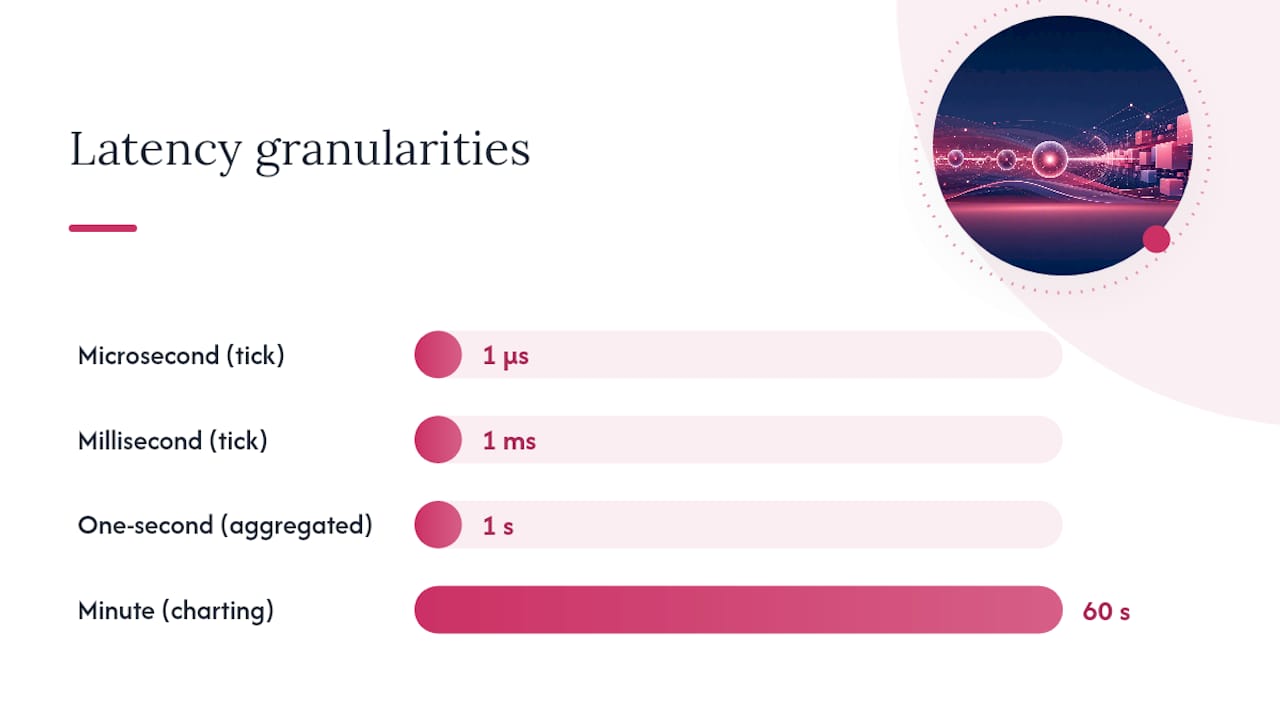
Real-time feeds carry more than just a price. Depending on the provider, a message might include the last trade price and size, the current bid and ask with their respective sizes, cumulative daily volume, and sometimes market depth showing multiple price levels on both sides of the book. Data providers explain that real-time spans multiple granularities, and matching the granularity to your actual use case matters more than chasing the lowest possible latency.
Asset class coverage varies quite a bit once you move past U.S. large-cap equities. Here’s the general landscape:
- Equities and ETFs: Broad real-time coverage across major exchanges, though smaller or foreign listings sometimes lag.
- Indices: Usually available in real time, though some index calculations only refresh every few seconds rather than continuously.
- Forex: Real-time by nature since it trades over the counter around the clock, but pricing varies by liquidity provider.
- Cryptocurrency: Near-instant updates are standard since crypto exchanges stream data continuously, with fewer regulatory gates than equities.
- Commodities: Real-time futures pricing is common, but spot commodity prices sometimes update on a delay depending on the source.
- Bonds: Often the weakest link. Fixed income trades over the counter with far less transparency, so “real-time” bond data frequently means indicative pricing rather than an actual executed trade.
- Derivatives: Options and futures typically get real-time feeds from the exchanges that list them, though depth of book access often costs extra.
Consolidated tapes, like those used in U.S. equities, combine data from every exchange trading a given stock into one unified feed. Exchange-only feeds show you just that venue’s activity, which is faster but incomplete if the stock trades across multiple markets. Enterprise-grade services address this by consolidating millions of instruments across exchanges into low-latency feeds, which is exactly why that tier costs what it does.
How Do You Actually Receive Live Trading Data?
Two delivery methods dominate: streaming and snapshots, and picking the wrong one for your use case creates problems you won’t notice until your system is under load.
Streaming, almost always built on WebSockets, keeps a persistent connection open and pushes new data to you the moment it happens. This is the right choice for anything that needs to react continuously: algorithmic execution, live order books, or a dashboard that updates without the user hitting refresh. WebSockets have become the practical standard for persistent real-time streams, while REST APIs remain the standard for point-in-time snapshots and historical pulls.
REST snapshots work differently. You send a request, you get the current state back, and the connection closes. This fits use cases where you only need a price check every few seconds or minutes, such as a portfolio valuation tool or a periodic risk report. Running a snapshot loop that polls every 200 milliseconds to simulate streaming is a common beginner mistake. It wastes bandwidth and usually hits rate limits fast.
Beyond the API layer, there’s a distinction between proprietary exchange feeds and normalized, vendor-delivered feeds. Exchange feeds are raw and fast but come in whatever format that specific exchange uses. Vendors that normalize this data reformat it into a consistent structure across every source, which is what most trading systems actually need. Normalized real-time data has become the backbone for AI-driven and automated finance precisely because inconsistent raw formats break automated pipelines.
A few developer-side details separate a smooth integration from a painful one:
- Check whether the SDK supports your language natively or if you’re stuck parsing raw WebSocket frames yourself.
- Understand your rate limits before you build, not after your app gets throttled during market open.
- Confirm exactly which entitlements your subscription includes, since “real-time” on one symbol tier can mean “delayed 15 minutes” on another.
Pro Tip: Test your data feed’s behavior during the first and last five minutes of the trading session. Volume spikes at the open and close are where thin connections and slow snapshot loops fail first, and that’s exactly when accurate data matters most.
Why Do Latency and Data Quality Matter So Much?
Latency is the time between an event happening at the exchange and that data arriving on your screen or in your algorithm. It sounds simple until you try to measure it, because latency actually breaks into three separate segments: exchange processing time, network transit time, and your own system’s processing time before the data becomes usable.
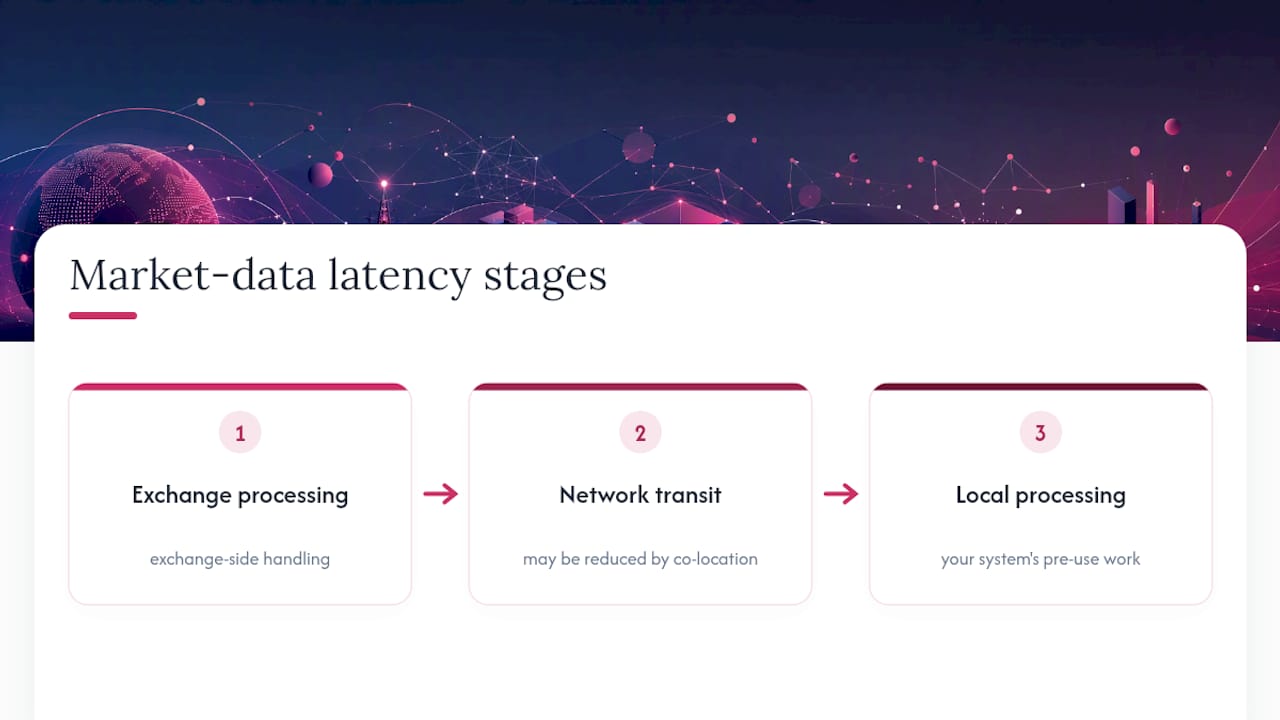
For a retail dashboard, a few hundred milliseconds of lag is invisible to the human eye. For an algorithmic strategy competing on speed, that same lag is the difference between a filled order and a missed one. This is why high-frequency trading firms pay for co-location, physically placing their servers inside or next to the exchange’s data center to shave off the network transit portion of latency almost entirely.
Data quality is the other half of the equation, and it gets far less attention than raw speed. Every real-time message should carry a reliable timestamp and, ideally, a sequence number so your system can detect gaps. If your feed drops even one tick during a volatile move and doesn’t flag it, a moving average or a momentum indicator built on that feed will calculate a value that’s silently wrong.
A quick way to think about the tradeoff: enterprise providers often run two pipelines in parallel: a stripped-down, low-latency path for execution decisions, and a separate normalized pipeline optimized for historical accuracy and replay. That separation exists because the fastest possible path and the most complete, auditable path are rarely the same path.
A practical example: if your feed misses three ticks during a fast sell-off and your system interpolates or skips them silently, a 20-period moving average calculated on that data will be measurably off from what actually happened at the exchange, and any signal generated from it inherits that error. Audit-grade history, where every tick is logged with its original timestamp and sequence number, is what lets you go back and verify whether a bad trade came from a strategy flaw or a data problem.
What Does Real-Time Data Cost, and Why Do Prices Vary So Much?
Pricing for live market data follows a layered structure, and the biggest cost jump usually isn’t about speed. It’s about your entitlement classification.
Most exchanges require you to declare whether you’re a professional or non-professional user, and this single distinction can multiply your cost several times over. A non-professional is generally someone consuming data for personal trading decisions, not redistributing it or using it in a commercial capacity. Professional entitlements, required for asset managers, prop desks, or anyone building a commercial product on top of the data, carry exchange fees that dwarf retail pricing because exchanges license the redistribution rights differently.
Beyond that classification, providers structure pricing a few common ways:
- Flat subscription tiers, where you pay monthly for a bundle of symbols or an entire exchange’s real-time feed.
- Per-symbol pricing, common for professional terminals where you only pay for the specific tickers you actually watch.
- Per-query or micropayment models, an emerging approach where you pay small amounts per data pull instead of committing to a subscription. Some providers now let users pay per query without managing API keys or subscriptions, which fits occasional users and AI agents that only need data intermittently rather than continuously.
- Tiered latency plans, where faster access sits behind a higher-priced tier while slower, delayed data comes cheap or free.
Budgeting for real-time data gets complicated fast once you move beyond a handful of symbols. A retail trader watching 20 stocks on a delayed-to-real-time upgrade might pay a modest monthly exchange fee. A quant fund wanting full-tape coverage across every U.S. equity, plus options depth, plus co-location to minimize network latency, can see costs climb into five or six figures a month once exchange fees, vendor markup, and infrastructure are combined. The jump isn’t linear. Full-tape coverage and co-location are the two line items that turn a modest data budget into an enterprise one.
How Do You Choose the Right Real-Time Data Provider?
Start with your actual latency requirement, not the fastest number a sales page advertises. An algorithmic strategy trading on 50-millisecond edges needs a fundamentally different provider than a dashboard refreshing once a second, and paying for the former when you only need the latter wastes money without improving your results.
Work through these criteria before you sign anything:
- Required latency: What’s your actual tolerance, measured in milliseconds or seconds, for your specific use case?
- Asset coverage: Does the provider cover every asset class and exchange you trade, including any smaller or foreign listings you might expand into?
- Delivery format: Do you need WebSocket streaming, REST snapshots, or both, and does their SDK support your development stack?
- Entitlements: Are you classified correctly as professional or non-professional, and does that classification match your actual use case?
- Reliability and uptime: What’s their published uptime history, and what happens to your system when their feed drops during a volatile session?
- Support and documentation: Can a developer actually get a test connection running from their docs alone, or does it require a sales call first?
- Total cost at scale: What does the bill look like at 10 symbols, 100 symbols, and full-tape coverage, not just the entry-tier price?
Once you’ve narrowed your options, ask providers direct questions rather than trusting a features page:
- What’s your published SLA for uptime and latency, and is it contractually backed or just a marketing claim?
- Is co-location available, and what’s the actual round-trip time from that facility to the exchange?
- Where do your timestamps originate, at the exchange or at your own ingestion point?
- Can I get an audit log showing sequence numbers and timestamps for a specific trading session?
Watch for a few red flags that tend to predict trouble down the line. Opaque pricing that only appears after a sales call usually means the real cost is higher than advertised. A provider that can’t produce an audit trail on request likely doesn’t have one to give you. Thin documentation that assumes you’ll “figure it out” is a preview of what support will be like once you’re a paying customer. And any provider unwilling to discuss co-location or SLAs in concrete terms is telling you, indirectly, that they don’t operate at that level.
Pro Tip: Ask for a live test connection before committing to an annual contract. A provider confident in their feed will let you watch it handle a real trading session, gaps and all, before you pay for a year upfront.
How Does a Trading Platform Actually Put Real-Time Feeds to Work?
Behind any usable trading platform sits a pipeline most traders never see: ingestion, normalization, and distribution. Raw data arrives from multiple exchanges and liquidity sources in whatever format each one uses. A normalization layer converts all of it into a consistent internal structure, and a distribution layer pushes that clean data out to the charts, order books, and execution engines that traders actually interact with.
Cubomarkets runs on this same architecture across its multi-asset lineup, covering forex, indices, commodities, stocks, and crypto. Feeding real-time analytics and fast execution off one unified pipeline, rather than bolting separate systems together per asset class, is what keeps pricing and charting consistent whether you’re watching gold or Bitcoin.
The operational priorities that matter most in this kind of setup:
- Execution speed fast enough that the price you see is close to the price you get.
- Spreads and cost structures that stay transparent rather than shifting once you’ve committed capital.
- Minimizing slippage between the quote a trader sees and the fill they receive.
- Analytics that update live rather than on a delayed refresh cycle, so chart-based decisions reflect current conditions.
Cubomarkets has processed a large volume of executed orders, a scale that reflects sustained reliance on its execution and data infrastructure holding up under real trading volume, not just theoretical throughput.
Where Is Real-Time Market Data Headed?
Cloud-native delivery is quietly becoming the default, and it’s lowering the barrier to entry that used to require racks of hardware near an exchange. A retail-scale developer can now spin up a real-time feed connection in an afternoon instead of negotiating a colocation contract.
Standardization is following a similar path. ISO 20022’s growing adoption in instant cash reporting shows how a common message format speeds up integration for treasury and banking systems, and that same logic is bleeding into market data more broadly: fewer proprietary formats, more interoperable pipelines.
The pricing model shift may end up mattering just as much as the technology. Micropayment and per-query access could pull casual users and AI-driven trading agents away from subscription lock-in entirely, since neither needs a continuous feed running around the clock. That’s a real change in who can afford live data, not just how fast it arrives.
— Cubo
Get Started With Multi-Asset Real-Time Access
Choosing a data provider matters, but for most active traders the more practical question is where you actually place trades once you’ve got reliable data in front of you. Some trading platforms offer multi-asset access—including forex, indices, commodities, stocks, and crypto—on a single platform, sometimes with competitive spreads and commission structures.
If you’re weighing a new broker for its data and execution quality together, the practical move is to test it firsthand rather than take a features page at its word. Open a demo account to see how the live pricing and charting behave under real market conditions, or explore the trading accounts page to compare account types before funding one. For traders focused specifically on currency pairs, the forex section shows how spreads and execution speed hold up during active sessions.
Where to Verify the Technical Details
For specifications and pricing beyond what any single article can cover, go straight to primary sources: exchange product pages for entitlement rules, SWIFT’s ISO 20022 documentation for standardized reporting formats, and enterprise vendor white papers like Bloomberg’s real-time feed catalog for infrastructure benchmarks.
This article is general information, not a substitute for advice from a qualified financial advisor. Consult a qualified financial professional about your own circumstances before acting on anything here.
Sources
- What is real-time stock market data? — FinancialModelingPrep
- Bloomberg Professional Services — Real-Time Market Data Feed
- Massive — Stock market API and streaming
FAQ
What Is Real-Time Market Data?
Real-time market data is live pricing, volume, and quote information delivered within milliseconds to a few seconds of the actual trade or quote event, as opposed to delayed data that lags 15 minutes or more.
Where Can I Get Real-Time Market Data?
You can get it through exchange-direct feeds, enterprise data vendors, or a trading platform like Cubomarkets that streams live pricing and analytics directly into its charting and execution tools across forex, indices, commodities, stocks, and crypto.
How Do I Get Real-Time Data Into a Charting Platform?
Most charting platforms connect to real-time data through a WebSocket stream or a broker’s live feed integration. The exact setup depends on whether your broker or data provider supports direct API access or requires a separate data subscription layered on top.
Where Can I Get Live Stock Market Data?
Live stock data comes from exchange-licensed vendors, financial data APIs, or brokerage platforms that bundle real-time equity pricing into their trading interface, though access typically requires a professional or non-professional entitlement depending on your intended use.
Why Does Real-Time Data Cost More for Professional Users?
Exchanges charge higher licensing fees to professional users because that classification typically involves commercial use or redistribution, which carries different licensing terms than personal, non-commercial trading decisions.