Skip to content
Leverage is a ratio that multiplies your exposure to the market; margin is the actual cash your broker sets aside as collateral to let you use it. Leverage decides how big a position you can control, but the size you actually choose is what determines your dollar risk.
TL;DR:
- Using maximum leverage, such as 500:1, significantly lowers your margin requirement but greatly increases the risk of account blowup if trades go against you.
- Effective leverage, calculated as total position exposure divided by account equity, should be kept around 1:10 or lower to prevent reckless overtrading.
- Margin levels approaching 100% trigger margin calls, while levels near 50% lead to automatic position liquidations, so monitoring margin level is crucial.
- Spreads and overnight financing costs grow proportionally with position size, amplifying losses during volatile market conditions and holding periods.
- Regulatory leverage caps set a minimum margin requirement but do not prevent traders from overexposing themselves through poor position sizing and risk management.
Table of Contents
- Leverage vs Margin: What Leverage Actually Means
- What Is Margin in CFD and Forex Trading?
- Margin Terminology You’ll See on Every Trading Platform
- Worked Examples: 20x, 1:30, and 500:1 Leverage in Practice
- ESMA Leverage Caps and Smarter Position Sizing
- The Hidden Costs of Trading on Leverage
- Using Leverage and Margin Responsibly on Cubomarkets
- Leverage vs Margin: Your Pre-Trade Checklist
- Why Most Leverage Advice Gets the Order Backward
- Sources
Leverage vs Margin: What Leverage Actually Means
Both describe the same thing: how many units of market exposure one unit of your own capital can control. At 1:30 leverage, every unit of your capital lets you control a larger multiple of position value. A broker advertising “500:1” is saying the same thing at a more extreme scale, $1 controlling $500 of exposure, a ratio mostly reserved for markets outside strict retail regulation.
Here’s a short example. If you have a certain amount in your account with 1:30 leverage, you can open a position worth multiple times your capital using that account., assuming you have no other trades open. It does not mean you should. Leverage sets the ceiling on what you’re permitted to trade, not a target you’re supposed to hit every time you click “buy.”
That distinction trips up more beginners than any other concept in trading. A few things worth locking in early:
- Leverage is not money, and it is not a fee. It’s permission to control more exposure than your cash alone would allow.
- Higher leverage doesn’t mean higher expected profit. It means the same percentage move in price now translates into a bigger dollar swing, in either direction.
- The ratio your broker advertises is a maximum, and using the full amount on every trade is one of the fastest ways to blow up a small account.
What Is Margin in CFD and Forex Trading?
Margin is the actual sum your broker locks up from your account balance the moment you open a leveraged position. Unlike leverage, which is abstract, margin is a real number that disappears from your available balance until you close the trade. The formula is simple: required margin equals position value multiplied by the margin percentage.
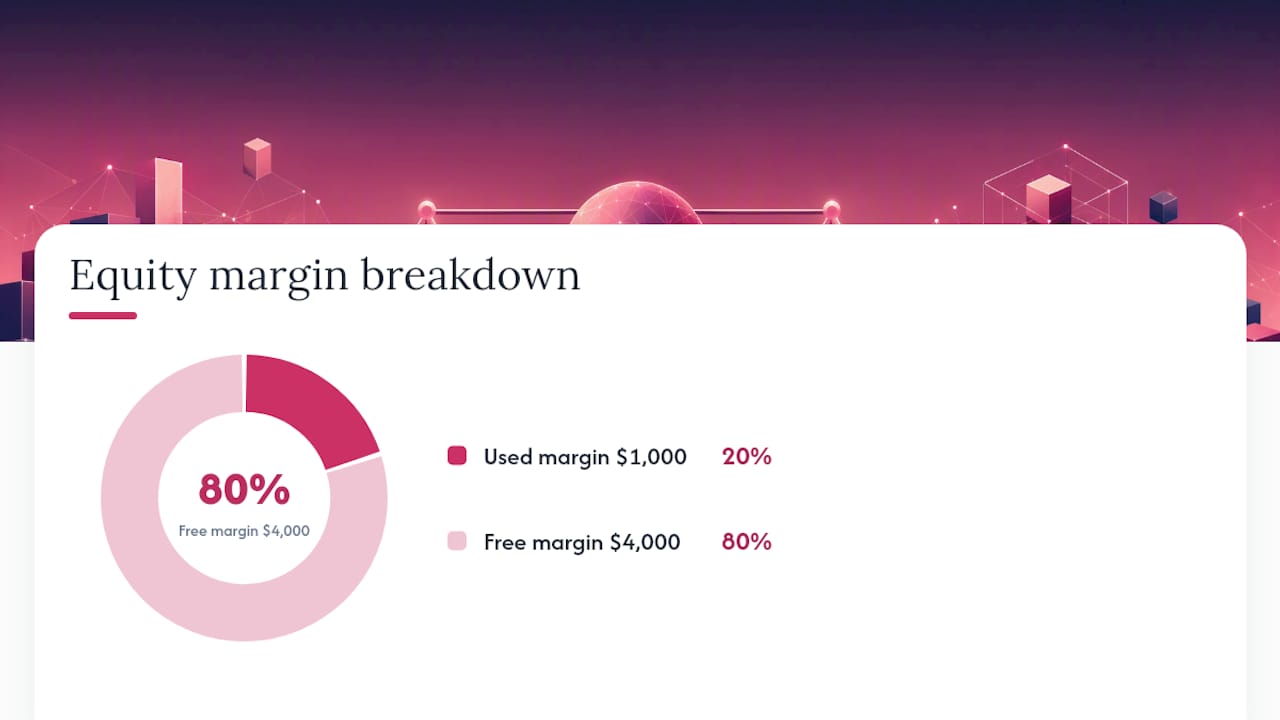
At 1:30 leverage, the margin percentage is the inverse ratio, so required margin equals a small percentage of the position value. That $1,000 is now tied up, unavailable for new trades, until you close the position and it’s released back to your balance.
This is where the terminology starts to matter for actually managing an account:
- Used margin is the total amount currently locked across all your open positions.
- Free margin is what’s left over and available for new trades, calculated as Equity minus Used Margin, a formula spelled out clearly in Babypips’ free margin explainer.
- If you have $5,000 equity and $1,000 tied up in used margin, your free margin is $4,000, the buffer that absorbs floating losses before your broker forces anything.
Margin isn’t a cost you pay. It’s collateral you get back, assuming the trade doesn’t move so far against you that the broker steps in first.
Margin Terminology You’ll See on Every Trading Platform
Every MetaTrader 5 or WebTrader dashboard displays the same handful of numbers, and knowing what they mean is the difference between reacting calmly and panicking during a drawdown.
- Balance is your account value with no open positions, the number after your last closed trade settled.
- Equity is your balance adjusted in real time for the floating profit or loss on any open positions. Equity moves every second the market moves; balance doesn’t move until you close something.
- Margin level is the single most important number for risk monitoring, calculated as Equity ÷ Used Margin × 100%. A higher margin level means your equity is several times your locked collateral, giving comfortable breathing room. A margin level near 100% means equity is close to what’s tied up in open trades.
- Margin call typically triggers around the 100% margin level mark, a warning that you’re close to the edge, common across many retail broker specifications as described by Forex-basics.
- Stop-out is the forced liquidation point, often set near 50% margin level depending on the broker, where the platform starts closing positions automatically to protect both you and the broker from a negative balance.
Check your own broker’s exact margin call and stop-out percentages in the account specification. They vary, and assuming a number without checking is a mistake worth avoiding entirely.
Worked Examples: 20x, 1:30, and 500:1 Leverage in Practice
Numbers make this concrete faster than definitions do. Here’s how three common leverage levels play out on a standard one standard lot ($100,000 notional) EUR/USD trade.
The pip value doesn’t change, still around $10 per pip, but your capital efficiency is different: you’re putting up more collateral for the identical exposure compared to 1:30.
At 500:1 (0.2% margin, a ratio forex-basics.com confirms follows the same inverse formula), that $100,000 position needs just $200 in margin. This is where accounts get dangerous fast: the pip value is unchanged at roughly $10, but the tiny margin requirement tempts traders to open far larger positions than their account can absorb a losing streak on.
Pro Tip: Always calculate effective leverage, not just headline leverage, before sizing a trade. Effective leverage is your total notional exposure divided by your account equity. BrokerAnalysis recommends keeping effective leverage around 1:10 or lower regardless of what your account technically allows.
That gap between headline and effective leverage is where most account blowups actually happen. They just keep adding positions until the math catches up with them.
ESMA Leverage Caps and Smarter Position Sizing
Regulators didn’t cap retail leverage arbitrarily. The European Securities and Markets Authority set limits in 2018 after watching retail accounts get wiped out at ratios like 200:1 and higher. Those caps translate directly into minimum margin requirements you’ll see on any regulated platform:
- Major currency pairs: 1:30 maximum, meaning 3.33% minimum margin
- Minor pairs, gold, and major indices: 1:20 maximum, meaning 5% minimum margin
- Other commodities and additional indices: lower caps still, pushing margin requirements higher
- Cryptocurrency CFDs: often capped as low as 1:2, meaning 50% margin, reflecting how much more volatile crypto is compared to major currency pairs
The caps set the ceiling. What you actually do below that ceiling is where risk management lives. A widely cited rule among professional traders is to risk no more than 1% of account equity on any single trade, sizing the position from your stop-loss distance first and calculating required margin second, a sequence ForexTradeLab’s beginner guidance recommends over picking a leverage ratio and working backward.
Behavioral risk compounds the arithmetic risk. Traders given access to higher maximum leverage tend to oversize positions, chase losses with revenge trades, and hold onto losers longer than their own plan allows. Add slippage on stop-loss orders during fast-moving news events, and a position that looked fine on paper can close at a materially worse price than expected.
- It is recommended to keep effective leverage low regardless of the maximum your account technically allows.
- Size positions from your stop-loss distance and dollar risk tolerance, not from the leverage ratio available.
- Treat every margin call as a signal to close or reduce exposure, not a countdown to ride out.
The Hidden Costs of Trading on Leverage
Leverage doesn’t just amplify your potential gains and losses. It amplifies the costs sitting underneath every trade, and those costs scale with position size whether the trade wins or not.
Spread cost is the most obvious one: the gap between bid and ask price applies per unit of position size, so a larger leveraged position pays a proportionally larger dollar spread on entry and exit. Overnight financing, often called swap or rollover, works the same way. It’s charged on the full notional value of your position, not your margin, meaning a highly leveraged trade held overnight accrues financing costs on exposure many times larger than your actual cash outlay, a scaling effect BrokerAnalysis points out directly.
- Spreads widen your breakeven point on every trade, and the effect grows with position size.
- Swap charges accumulate daily on the full notional, which matters more the longer you hold a leveraged position.
- Slippage on stop-loss orders during volatile markets can turn a planned loss into a noticeably larger one, especially on oversized positions.
Using Leverage and Margin Responsibly on Cubomarkets
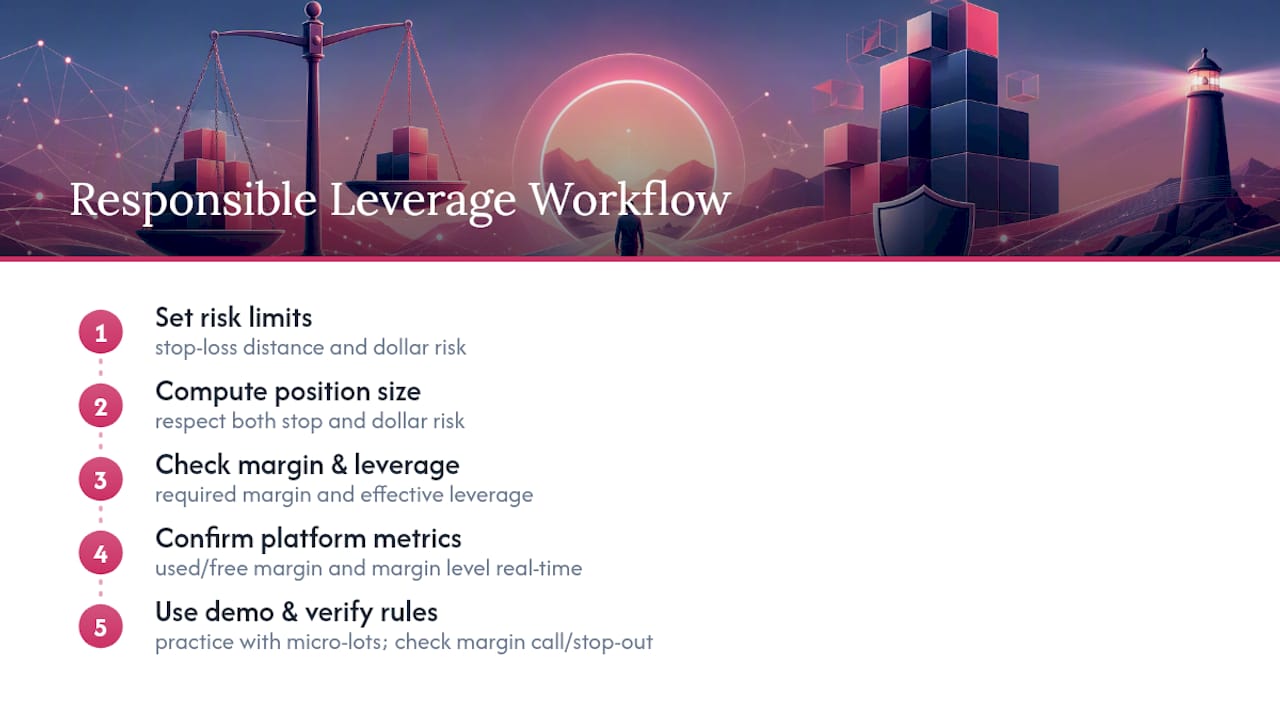
Every rule above is only useful if you actually apply it before clicking the trade button, not after. Start with your stop-loss distance and your dollar risk tolerance, calculate the position size that respects both, and only then check what margin that position requires and what effective leverage it puts you at.
Cubomarkets’ MetaTrader 5 and WebTrader platforms display used margin, free margin, and margin level in real time, so you’re never guessing where you stand relative to a margin call. Fast order execution matters here too: in a fast-moving market, the gap between your intended stop price and your actual fill is where leveraged accounts lose more than they planned for, and execution speed is one of the few variables a broker directly controls.
If you’re still building comfort with the arithmetic, demo accounts and micro-lot sizing let you practice the exact calculations in this article, required margin, free margin, effective leverage, without risking real capital. Before placing your first leveraged trade, check your account’s specific margin call and stop-out percentages in the Cubomarkets trading accounts specification rather than assuming they match a number you read somewhere else.
Leverage vs Margin: Your Pre-Trade Checklist
Leverage is the ratio that sets your ceiling. Margin is the actual collateral your broker locks to let you use it. The two connect through one formula worth memorizing: margin percentage equals 1 divided by leverage.
Before opening any leveraged position, run through this:
- Calculate required margin for the position size you’re considering, not just the maximum your leverage allows.
- Work out your effective leverage across all open positions, total notional divided by account equity, and keep it well below your broker’s headline maximum.
- Size the trade from your stop-loss distance and cash risk, aiming to risk roughly 1% of equity per trade.
- Confirm your broker’s specific margin call and stop-out thresholds in the account specification.
- Practice the math on a demo account or with micro lots until the numbers feel automatic, not stressful.
Leverage gives you capacity. What you do with that capacity is entirely up to your own sizing discipline.
Why Most Leverage Advice Gets the Order Backward
Most explainers treat leverage as the starting point, walking readers through ratios and then, almost as an afterthought, mentioning that margin is the collateral involved. That order is backward. Margin is the number that actually moves your account balance. Leverage is just the ceiling describing how much margin-backed exposure you’re allowed to take on.
The overrated piece of conventional wisdom is “choose lower leverage and you’ll be safer.” Leverage ratio matters far less than effective leverage and position size, two things entirely within your control regardless of what your broker’s maximum happens to be. A trader on a 1:30 capped account can still overexpose themselves by opening five oversized positions at once. A trader with access to 500:1 can trade conservatively and never come close to that ceiling.
What deserves priority is arithmetic literacy before trade entry: knowing your required margin, your free margin buffer, and your effective leverage before you click confirm. Regulatory caps like ESMA’s are a floor for consumer protection, not a substitute for your own sizing discipline. That distinction is where actual account survival gets decided.
— Cubo
Sources
- Forex-basics
- Forex Leverage Explained: Risks, Limits… | BrokerAnalysis
- Babypips
- Best Leverage for Trading Forex 2026: Broker Guide