Skip to content
Most traders don’t need it, and the ones who think they do usually haven’t done the math on how fast it can end an account. If you’re weighing high leverage forex accounts against standard retail options, the direct answer is this: stick with Tier-1 regulated retail accounts capped at 1:30 on major pairs unless you have a documented track record and genuinely need the capital efficiency that professional or offshore accounts provide.
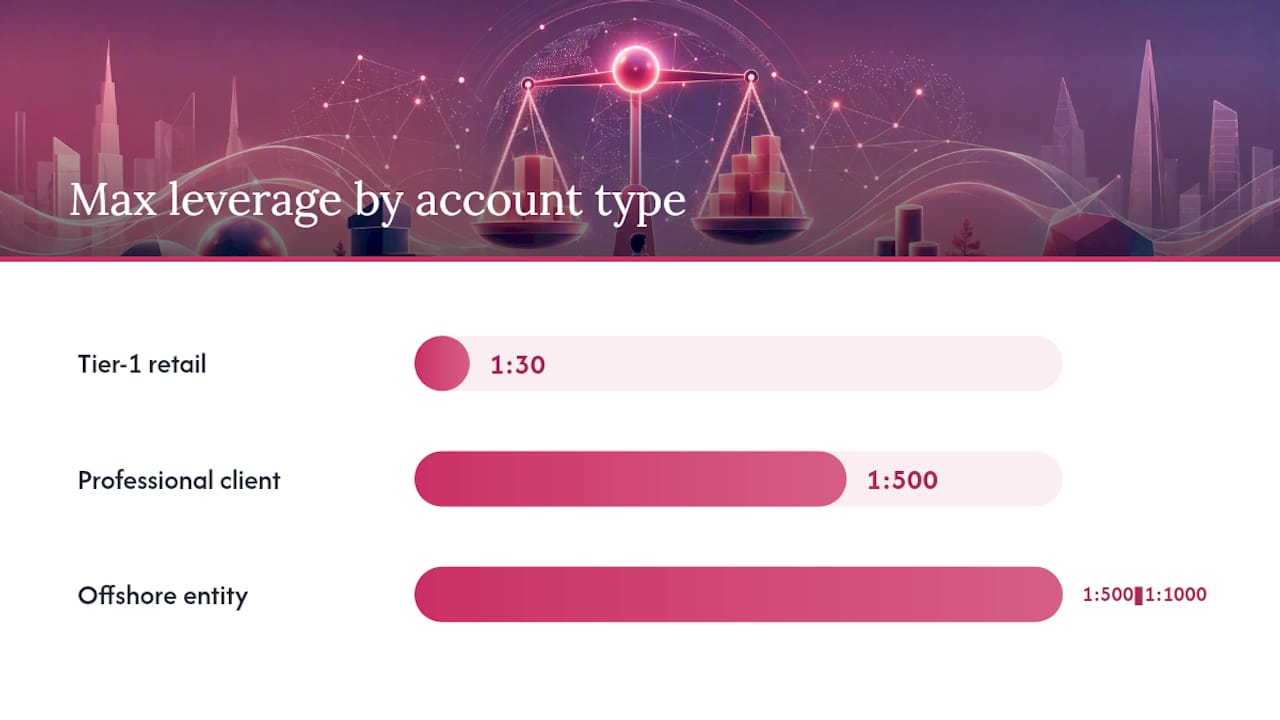
For most traders, three routes exist. Tier-1 regulated retail (the default, capped at 1:30 on majors under FCA and ESMA rules) suits anyone still building consistency. Elective professional status unlocks higher caps for traders who can prove trading experience, portfolio size, or financial-sector employment. Offshore or non-EU entities offer headline leverage of 1:500 or higher but strip out negative-balance protection and compensation schemes.
Here’s the shortlist worth actually considering:
- Cubo Markets — flexible account types with published leverage specs per client category, fast execution, and multi-asset access spanning Forex, indices, commodities, and crypto CFDs.
- Tier-1 regulated brokers — the safest default for building a track record under strict retail caps.
- Professional-client route — for traders who qualify and want higher leverage without leaving regulated protection entirely.
- Offshore high-leverage entities — specialist tools for experienced traders who understand the trade-off and don’t need investor-compensation coverage.
The core risk math doesn’t change no matter which route you pick. At 1:100 leverage, a 1% adverse market move wipes out 100% of the margin committed to that position. Push that to 1:500, and a 0.2% move does the same damage. The CFTC caps US retail majors at 1:50, while EU, UK, and Australian regulators hold the line at 1:30. Offshore entities routinely advertise 1:500 or more. Higher numbers aren’t better. They’re just less forgiving.
Key Takeaways
Position sizing and effective leverage, not the broker’s headline maximum, determine whether a high-leverage account builds your account or ends it.
| Point | Details |
|---|---|
| Default to Tier-1 caps | Most traders should stay within 1:30 retail limits until they have a documented 60 to 90 day track record. |
| Effective leverage matters most | Keep actual exposure near 1:5 to 1:10 regardless of the broker’s maximum leverage setting. |
| Size from your stop, not your leverage | Use account equity, risk percent, and stop distance to calculate position size every time. |
| Verify the entity before the leverage | Check the regulator’s public register to confirm which legal entity actually holds your account. |
| Cubo Markets fits the staged approach | Flexible account types, published leverage specs, and fast execution support traders at every stage. |
Where to Verify Leverage Rules and Broker Regulation
- FCA guidance explains why retail leverage caps exist and how misuse of high leverage was documented before the rules took effect.
- SEC resources cover the margin mechanics behind how leverage amplifies both gains and losses.
- The CFTC public comments portal holds the public record of regulatory debate on leverage and retail protections.
- CySEC’s entity listings let you confirm which legal entity actually holds a broker’s license.
Table of Contents
- What Is High Leverage Forex and How Does the Comparison Break Down?
- How Do You Choose a High-Leverage Broker Without Getting Burned?
- Position Sizing Beats Headline Leverage Every Time
- How Long Does It Take to Get a High-Leverage Account Running?
- Trade Multiple Assets With Transparent Leverage Specs
- Frequently Asked Questions
- Sources
What Is High Leverage Forex and How Does the Comparison Break Down?
High leverage forex trading means controlling a position far larger than your account equity, using borrowed capital from the broker to amplify exposure. The mechanics are simple, but the account routes that deliver it vary enormously in regulation, protection, and practical suitability.
Rather than naming brand after brand, it’s more useful to compare the actual account categories traders choose between. Every broker, including Cubo Markets, falls into one of these buckets depending on the entity a client is onboarded under.
| Account Route | Max Leverage | Regulation / Entity | Platforms | Typical Spreads/Fees | Min. Deposit | Execution Type | Best For |
|---|---|---|---|---|---|---|---|
| Tier-1 regulated retail | 1:30 (majors) | FCA, CySEC, or equivalent EU/UK entity | MT4/MT5, WebTrader | Variable, often starting around 1 pip | Typically $50 | STP/ECN with retail protections | Beginners, capital preservation |
| Professional-client route | Often around 1:500 | Same regulated entity, elective reclassification | MT4/MT5, WebTrader | Similar to retail tier, sometimes tighter | Varies by broker qualification rules | ECN, faster fills, less protection | Experienced traders who qualify and document it |
| Offshore high-leverage entity | 1:500–1:1000+ | Non-EU/EU entity, lighter oversight | MT4/MT5, proprietary platforms | Can be tighter, but disclosure varies | Often $0–$100 | Market maker or ECN, variable slippage | Specialists who accept reduced protections |
| Cubo Markets (client) | Flexible by account type | Published specs per client classification | MT5, WebTrader | Spreads from 0.0 pips, zero commission | Flexible account tiers | Fast execution, low slippage | Traders wanting transparency and execution speed across asset classes |
A few practical notes sit underneath that table. Tier-1 regulated retail accounts almost always come with negative-balance protection and access to an investor-compensation scheme, which means you can’t lose more than you deposit even in a flash-crash scenario. That protection disappears, or gets watered down, once you cross into professional or offshore territory.
The professional-client route sounds appealing because it keeps you inside a regulated entity while unlocking higher caps. But qualifying isn’t a formality. Brokers typically require two of three tests: relevant trading experience over the past year, a portfolio exceeding a set threshold, or professional experience in the financial sector. Miss all three, and you stay retail.
Offshore entities trade regulatory friction for capital efficiency. You can access 1:500 or higher headline leverage with a lower minimum deposit, but you’re accepting weaker dispute resolution and, in many cases, no compensation scheme if the broker fails. This is a trade professional traders make deliberately, not a shortcut for beginners chasing bigger position sizes.
When comparing entities, the methodology is straightforward: check the regulator’s published cap for that client type, confirm the broker’s actual entity registration (not just its marketing brand), and read the account specs directly rather than trusting a comparison chart from a site with an affiliate incentive. You can verify entity-level regulation yourself. The CySEC entity listing is a useful example of how to confirm which legal entity actually holds the license behind a broker’s website.
Execution quality matters as much as the leverage number. A broker offering 1:500 with wide, unpredictable spreads and slow fills can cost you more through slippage than a Tier-1 account with 1:30 and tight, consistent pricing. Cubo Markets positions itself on the execution side of that equation, with spreads starting at 0.0 pips and zero commission across its Forex and multi-asset offering, which matters more to your actual returns than the headline leverage figure ever will.
How Do You Choose a High-Leverage Broker Without Getting Burned?
Start with the entity, not the leverage number. Every legitimate broker publishes which regulator licenses which legal entity, and which client types get access to which leverage tier. If that information is buried, vague, or contradicted by the sales team, that’s your first red flag.
Run through this checklist before opening any high-leverage account:
- Confirm the regulator and entity name match what’s on the regulator’s own public register.
- Check the published maximum leverage per client type (retail, professional, offshore), not just the headline number in the ad.
- Verify negative-balance protection is explicitly stated in the account terms.
- Understand the margin-call and stop-out percentages before you fund the account.
- Identify the execution model (ECN, STP, or market maker) and ask about typical slippage during news events.
- Confirm platform support (MT4, MT5, WebTrader) matches your trading style.
- Review swap and overnight financing charges, since these erode returns on leveraged positions held longer than a day.
- Test how responsive support is before you have real money on the line.
Once you’ve narrowed your options, take the conversation further with the broker directly. These are the questions that separate a transparent operation from one hoping you won’t ask:
- What is the maximum leverage available under each client classification you offer, and how is that documented?
- What specific criteria do I need to meet to qualify for professional-client status?
- Can leverage be adjusted per instrument, or is it a blanket account setting?
- Is negative-balance protection guaranteed contractually, or is it discretionary?
- What is your stated execution model, and what’s your average slippage on major pairs during high-volatility windows?
- How long does account verification typically take before high-leverage trading is enabled?
Watch for red flags that should stop an application cold. Marketing that leads with an ultra-high leverage number (1:2000 or higher) without any mention of regulation is one. Missing or vague regulatory disclosure on the website’s footer is another. So is unclear language around stop-out mechanics, no explicit negative-balance protection, or commission structures that require a phone call to explain.
Pro Tip: Call or message support with one of the questions above before you fund anything. A broker that answers clearly and quickly is telling you something about how they’ll handle your withdrawal request later.
On the regulatory side, the pattern across major jurisdictions is consistent. The FCA and equivalent EU regulators cap retail leverage at 1:30 on major currency pairs, a rule introduced after data showed most retail accounts using higher leverage ultimately lost money. The CFTC sets US retail caps at 1:50 for majors. Offshore entities, operating outside these frameworks, often advertise 1:500 or beyond. Professional classification and offshore registration are the two legal paths around the retail cap, and both come with reduced consumer protections that you should weigh against the capital efficiency you’re gaining.
Position Sizing Beats Headline Leverage Every Time
Here’s the distinction that separates traders who survive from traders who don’t: effective leverage versus broker maximum leverage. Your broker might offer 1:500, but that number is a ceiling, not a target. Effective leverage is your actual total position value divided by your account equity, and professional traders generally keep that figure closer to 1:1 through 1:10 regardless of what the broker allows.

The formula that should drive every trade you place is:
Position size = (account equity × risk percent) ÷ (stop distance in pips × pip value)
Notice what’s missing from that equation: the broker’s maximum leverage. It doesn’t appear because it shouldn’t be driving your position size at all.
Example one: the account-wiping trade. You have $1,000 and open a position using 1:500 leverage, controlling a $500,000 notional position on a major pair. A routine 20-pip adverse move, nothing unusual in a normal trading session, can wipe out the entire account. This isn’t a tail-risk scenario. It’s Tuesday afternoon.
Example two: the same account, sized correctly. You risk 1% of that $1,000 account ($10) on a trade with a 20-pip stop. That position size works out to roughly 0.05 lots on a standard pair, which puts your effective leverage somewhere between 1:5 and 1:10 even though your broker’s maximum is 1:500. A 20-pip move against you costs $10. You take the next trade.
- Calculate risk percent first (1 to 2% of equity per trade is the standard practice among disciplined traders).
- Set your stop-loss distance based on market structure, not on how much leverage is available.
- Back into your position size using the formula above.
- Check that your resulting effective leverage sits well below the broker’s maximum, ideally single digits.
Pro Tip: Trade a cent account or demo for 60 to 90 days at your intended risk percent before scaling up. If you can’t hold discipline on small size, more leverage won’t fix that. It just makes the mistake more expensive.
How Long Does It Take to Get a High-Leverage Account Running?
The timeline depends entirely on which route you’re taking, and it’s worth knowing before you start the paperwork.
Opening a standard Tier-1 retail account is fast. Most brokers, including Cubo Markets, verify identity and address documents within a day or two, and you can be funded and trading within 24 to 48 hours of submitting a valid ID and proof of address.
Professional-client reclassification takes longer because it requires documentation, not just identity verification. Expect to submit evidence across the qualifying tests (trading statements showing significant transaction volume, portfolio valuations, or employment records from a financial-sector role). Brokers typically review this within a few business days to two weeks, depending on how complete your initial submission is.

Offshore entity onboarding varies the most. Some offshore brokers move as fast as Tier-1 accounts since compliance requirements are lighter. Others take longer if enhanced due diligence applies to your country of residence or funding source.
The practical staged approach: demo test your strategy for a few weeks, open a small live account under standard retail caps for 60 to 90 days to prove discipline, then apply for professional or offshore access only once you have documented results showing you don’t need the extra leverage to trade profitably. That sequence takes longer than jumping straight to a high-leverage account, but it’s the difference between qualifying with evidence and qualifying with hope.
Who Should Actually Use High Leverage, and Who Shouldn’t?
The honest take: most retail traders asking about high leverage forex accounts are solving the wrong problem. Undercapitalized accounts don’t need more leverage. They need more capital or smaller position sizes, and no broker’s maximum leverage setting fixes that math.
High leverage earns its place for a narrower group: experienced scalpers who need to free up margin across several simultaneous positions, and traders running documented hedging strategies where capital efficiency genuinely matters. Everyone else should spend 60 to 90 days trading at 1 to 2% risk per trade on a standard account, keeping records of every trade and every rule broken before even considering the professional or offshore route.
Pro Tip: Before applying for higher leverage, write down your last 30 trades. If your risk-per-trade average is anywhere above 2%, that’s the problem to fix first, not your leverage cap.
Cubo Markets fits traders at either stage of that journey, since its account types scale with experience while keeping execution speed and cost structure consistent across the board.
Trade Multiple Assets With Transparent Leverage Specs
Cubo Markets gives you published leverage specifications by account type instead of a single headline number buried in fine print, so you know exactly what you’re qualifying for before you fund anything.

The platform supports MetaTrader 5 and WebTrader, with spreads starting at 0.0 pips and zero commission across Forex, indices, commodities, stocks, and crypto CFDs. Execution speed is the differentiator that matters more than the leverage figure itself. Cubo Markets has processed over 3 million executed orders, and deposits and withdrawals move without the delays that push traders toward brokers who don’t back up their marketing with actual infrastructure.
If you’ve been trading demo accounts or a small live account and want to scale into an account type that matches your risk profile without switching platforms every time your strategy evolves, open a trading account and review the flexible tiers available. You can start with a demo, prove your approach, and move up when the numbers back you up.
Frequently Asked Questions
What’s the highest forex leverage available?
Offshore entities commonly advertise 1:500 to 1:1000, and some go higher. Tier-1 regulated brokers cap retail accounts at 1:30 on major pairs under FCA and ESMA rules, with the CFTC setting US retail caps at 1:50.
Is 1:1000 leverage risky?
Yes, and not marginally. At that ratio, a market move of well under half a percent can erase your entire margin on a position. It’s a tool for traders who size positions independently of the leverage ceiling, not a setting to trade at face value.
Which brokers offer 1:500 leverage?
Availability depends on entity type rather than brand. Tier-1 regulated brokers offer 1:500 or higher only to clients who qualify for professional classification. Offshore entities offer it more broadly, but without the negative-balance protection and compensation schemes that come with regulated retail accounts.
Is high leverage forex trading suitable for beginners?
Generally not. Beginners benefit far more from standard retail caps while they build consistency, since the protections built into those accounts (negative-balance protection, compensation schemes) buy room to make mistakes without losing everything.
How does leverage differ from margin?
Leverage is the ratio between your position size and your capital. Margin is the actual amount of capital the broker requires you to hold as collateral for that position. Higher leverage means lower margin requirements for the same position size, which is exactly what makes it both efficient and dangerous.
This article is general information, not a substitute for advice from a qualified financial advisor. Consult a qualified financial professional about your own circumstances before acting on anything here.
Sources
- U.S. Securities and Exchange Commission (SEC)
- Financial Conduct Authority (FCA)
- CFTC public comments portal
- Cyprus Securities and Exchange Commission — entity listing