Skip to content
Forex CFD trading means speculating on currency price movements through a contract for difference instead of buying actual currency. You never own euros or yen; you’re betting on whether the price goes up or down, and you get paid (or you pay) the difference. It suits people comfortable with volatility and small starting capital, but it’s a poor fit if you can’t stomach fast losses. The math backs up the caution here: most retail CFD accounts lose money, and the product carries a high risk rating under standardized EU disclosure documents like the Key Information Document, which rates forex CFDs 7 out of 7 on the summary risk indicator.
Key Takeaways
Forex CFD trading lets you speculate on currency pairs with leverage and no ownership of the underlying asset, but high leverage plus retail-loss statistics mean risk management determines survival more than strategy does.
| Point | Details |
|---|---|
| CFDs mirror, not own | You trade the price difference on a currency pair without holding actual currency. |
| Leverage cuts both ways | A 30:1 cap on majors under ESMA rules still means small moves swing your account fast. |
| Costs compound over time | Spread, swap, and occasional commission erode profits more on longer holds. |
| Demo before live, always | Weeks of demo trading build the habits that determine live account survival. |
| Cubo Markets bridges demo to live | Free demo access, MetaTrader 5 support, and 0.0 pip spreads ease the transition to funded trading. |
This article is general information, not a substitute for advice from a qualified financial advisor. Consult a qualified financial professional about your own circumstances before acting on anything here.
Table of Contents
- What Is Forex CFD Trading, Exactly?
- How Does Forex CFD Trading Actually Work?
- What Does a Real Forex CFD Trade Look Like?
- What Are the Real Costs of Trading Forex CFDs?
- What Risks Come With Forex CFD Trading?
- How Do You Start Trading Forex CFDs?
- Is Forex CFD Trading Right for You?
- What Regulations Protect Forex CFD Traders?
- How Cubo Markets Supports New Forex CFD Traders
- Sources
What Is Forex CFD Trading, Exactly?
A forex CFD is a derivative contract between you and your broker. You agree to exchange the difference in a currency pair’s price between the moment you open the trade and the moment you close it. No physical currency changes hands, no wire transfer, no bank account in a foreign denomination. That’s the core distinction from spot forex, where you’re trading the actual underlying currency for delivery, even if that delivery is largely theoretical for most retail spot traders too.
The practical difference between forex CFD and spot forex mostly comes down to the legal wrapper and how brokers structure the product, not the price you see on the chart. A few terms you’ll need before anything else makes sense:
- Base currency: the first currency in a pair (EUR in EUR/USD).
- Quote currency: the second currency, which tells you the price of one unit of the base (USD in EUR/USD).
- Pip: the smallest standard price move, usually the fourth decimal place in a pair.
- Lot: a standardized trade size, typically 100,000 units of the base currency for a standard lot.
- Notional value: the total value of the position you control, not the cash you put down.
How Does Forex CFD Trading Actually Work?
Every CFD position is either long (you profit if the price rises) or short (you profit if it falls), and both directions close out in cash. There’s no borrowing shares, no locating inventory, no restrictions that exist in equity short selling. You click sell, and if the price drops, you’re in profit.

Leverage is what makes CFDs attractive and dangerous in the same breath. A broker might let you control a $100,000 position while only setting aside $1,000 to $3,000 of your own money as margin, depending on the leverage ratio and the pair. That leverage cuts both ways: a 1% move in your favor on a leveraged position can multiply your account balance’s percentage gain many times over, and a 1% move against you does the same in reverse.
Pricing runs on a bid/ask spread. The bid is what you’d get if you sold right now; the ask is what you’d pay to buy. The gap between them is the spread, and it’s baked into your entry cost before the market even moves. Profit and loss on a closed position comes down to a simple formula: pip movement multiplied by contract size, adjusted for the exchange rate of the quote currency.
Leverage caps vary sharply by regulatory jurisdiction:
| Jurisdiction | Typical retail leverage cap on major pairs | Cap on minor pairs |
|---|---|---|
| EU (ESMA rules) | 30:1 | 30:1 |
| UK (FCA) | 30:1 | 30:1 |
| Australia (ASIC) | 30:1 | 30:1 |
| Offshore/unregulated brokers | Often 100:1 or higher | Varies widely |
These caps exist because regulators found that uncapped leverage correlated with outsized retail losses, and offshore brokers offering triple-digit leverage aren’t doing you a favor.
What Does a Real Forex CFD Trade Look Like?
Numbers make this concrete faster than definitions do. Say you decide to go long on EUR/USD at 1.0800, trading one standard lot (100,000 units) with 30:1 leverage.
- Margin required: a fraction of the notional value held as margin based on leverage.
- Price moves to 1.0850 (a pip gain). On a standard lot, each pip has a certain value, so you make a profit based on pip movement.
- Price instead drops to 1.0750 (a pip loss). Correspondingly, you incur a loss proportional to pip movement and margin.
If you hold that position overnight, a swap fee applies, either credited or debited depending on the interest rate differential between the euro and the dollar. Hold it through several rollovers and that swap cost, combined with the spread you paid on entry, starts eating into a winning trade or deepening a losing one.
Pro Tip: Before you click “buy,” check your free margin, not just your available balance. Free margin is what’s left to absorb losses after your current positions are accounted for, and it’s the number that determines whether you get margin-called.
What Are the Real Costs of Trading Forex CFDs?
Three cost lines show up on nearly every forex CFD trade, and beginners consistently underestimate how much they add up over a month of active trading.
- Spread: the gap between bid and ask, paid the instant you open a position, tighter on majors like EUR/USD and wider on exotic pairs.
- Commission: some account types charge a flat per-lot commission on top of a tighter spread, rather than folding the cost entirely into the spread.
- Overnight financing (swap): a daily charge or credit for holding a leveraged position past the broker’s rollover cutoff, usually tripled on Wednesdays to account for the weekend.
- Currency conversion and withdrawal fees: relevant if your account currency differs from the pairs you trade or if your broker charges for certain payment methods.
An intraday scalper who opens and closes within hours pays the spread once and nothing in swap. Someone holding the same EUR/USD position for two weeks pays that same spread plus roughly ten to fourteen days of swap, which can turn a marginally profitable trade into a breakeven one. Retail-loss disclosures exist precisely because these accumulated costs, combined with leverage, are what erode most retail accounts over time.
What Risks Come With Forex CFD Trading?
Leverage is the headline risk, but it’s not the only one. Overnight gaps can blow past your stop-loss level when markets reopen after a weekend or a major news event, filling you at a worse price than you planned for. Liquidity can thin out during off-hours trading, widening spreads exactly when you need a clean exit. Slippage means your order fills at a slightly different price than requested, usually small, occasionally not. And your broker itself is a counterparty. If it’s poorly capitalized or unregulated, that’s a risk layered on top of the market risk.
Managing this isn’t complicated, but it requires discipline most beginners skip in their first month:
- Use a stop-loss on every position, no exceptions, set before you enter the trade rather than after.
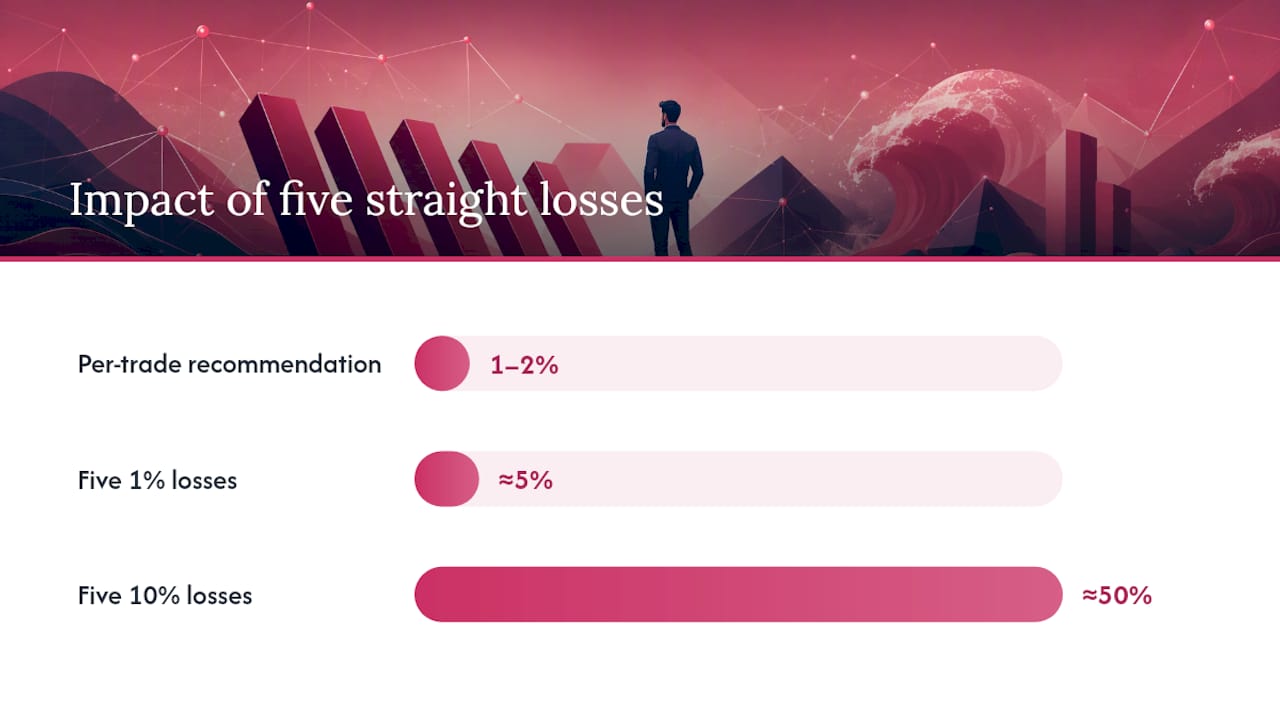
- Size positions around a fixed percentage of your equity, commonly 1% to 2% per trade, rather than a fixed dollar amount that ignores account size.
- Cap your effective leverage well below the maximum your broker allows, even if regulation permits more.
- Run new strategies on a demo account for weeks before risking real capital.
- Keep a trading journal logging entry logic, exit logic, and emotional state, then review it weekly.
The KID for forex CFDs states plainly that losses can exceed your posted margin under some conditions, which is exactly why negative balance protection matters when you’re choosing a broker.
Pro Tip: The 1% rule sounds conservative until you do the math on a losing streak. Five straight 1% losses only cost you about 5% of your account; five straight 10% losses cost you nearly half.
How Do You Start Trading Forex CFDs?
Getting from zero to your first live trade follows a fairly standard sequence, and skipping steps is where most beginners get hurt.
- Learn the basics: pip values, margin, order types, and how leverage actually compounds risk.
- Open a demo account and trade it like real money for several weeks minimum.
- Choose an account type that matches your strategy, whether that’s a standard spread account or a raw-spread-plus-commission account.
- Fund the account with an amount you can genuinely afford to lose.
- Place small live trades first, well below what your margin technically allows.
- Scale size gradually as your win rate and discipline prove consistent.
On the platform side, you’ll be working with charting tools, market and limit orders, stop-loss and take-profit levels, and often trailing stops that lock in gains as a trade moves favorably.
- Start with market orders for simplicity, then graduate to limit orders for precision entries.
- Set a stop-loss on every trade before you set anything else.
- Keep initial position sizes small enough that a full stop-out barely dents your account.
Pro Tip: Never skip the demo phase just because it feels slow. The habits you build there, right or wrong, are the habits you’ll trade with live.
Is Forex CFD Trading Right for You?
Ask yourself four questions honestly. Can you tolerate watching a position lose 5% to 10% of your capital in minutes without panic-closing it? Do you have time to monitor trades or set proper stops if you can’t watch constantly? Is your trading capital money you can afford to lose entirely? Do you understand margin calls, or would that term have confused you before this article?
Before funding a live account, confirm you’ve traded profitably (or at least sensibly) on demo for weeks, you have a written risk plan, and you’ve tested your broker’s withdrawal process with a small amount. A common mismatch: traders with only a few hundred dollars reaching for maximum leverage to make trades feel meaningful. That combination turns ordinary volatility into account-ending risk.
What Regulations Protect Forex CFD Traders?
In the European Union, MiFID II and ESMA product intervention rules cap retail leverage, mandate standardized risk disclosures like the KID, and require negative balance protection so you can’t lose more than your account balance. The UK’s FCA and Australia’s ASIC apply broadly similar frameworks independently.
Before funding any broker, check a short list:
- Confirm the license status with the relevant regulator’s public register, not just a badge on the website.
- Verify client funds are held in segregated accounts, separate from the broker’s operating capital.
- Confirm negative balance protection applies to your account type.
- Check whether a compensation scheme covers you if the broker becomes insolvent.
Worth noting: CFDs are common in the EU, UK, and most of the world, but U.S. retail traders generally access currency markets through spot forex under different rules, since CFDs aren’t offered to U.S. retail clients.
A Beginner’s Learning Curve, Honestly Assessed
Most new traders lose money in their first few months for the same reason: they size positions like they’re already skilled. The fix isn’t a better indicator. It’s smaller size, a written rule set, and a demo account used long enough to feel boring. Keep a simple journal and review it every week; patterns in your mistakes show up faster than you’d expect.
How Cubo Markets Supports New Forex CFD Traders
Cubo Markets gives you a genuine demo-to-live path instead of pushing you straight into a funded account: practice with real market pricing on a free demo, then move to live trading only when you’re ready, on the same MetaTrader 5 environment you already trained on.

The platform runs on spreads starting at 0.0 pips with zero commission on standard accounts, fast order execution designed to cut slippage, and instant deposits and withdrawals so your capital isn’t stuck in limbo. Charting tools and real-time analytics come built in, which matters more than it sounds like when you’re still learning to read price action. Beyond forex, the same account gives you access to commodities and crypto CFDs if you want to diversify once you’re comfortable. Explore the available account types and open a demo account to test your strategy with zero financial risk before you commit real capital.
Sources
- Markets in Financial Instruments Directive II (MiFID II) – European Commission
- Contract for difference — Wikipedia
- CFD Trading Forex: How Forex CFDs Work 2026 — BrokerChampion
- Key Information Document – CFD on a Forex Instrument — FBS (KID)