Skip to content
Copy trading means automatically mirroring the trades of another investor with your own funds. The reliable version of this isn’t picking one hot trader and hoping. It’s spreading your capital across several vetted traders, sizing each position conservatively, and setting mechanical stop and unfollow rules before you commit real money. The sections below cover how to screen traders, size your allocations, and configure your platform to make that approach work.
TL;DR:
- Beginners should focus on copying traders with at least six months of verified performance and low max drawdowns to reduce risk of sudden losses.
- Fixed-ratio copying generally provides better exposure control than fixed-amount mode, especially for inexperienced traders.
- Allocate no more than 5-10% to aggressive traders and regularly review their KPIs every 30 days to prevent strategy drift.
- Set strict unfollow rules for drawdowns, strategy changes, and follower growth to protect capital during adverse market conditions.
- Conduct a 30 to 90-day pilot on a demo or small live account before scaling up, ensuring strategies hold up across different market cycles.
Table of Contents
- What copy trading strategy types should beginners know?
- Copy trading methods and settings you need to understand
- How do you pick the right trader to copy?
- How much should you allocate to each trader?
- What risk rules keep copy trading from going wrong?
- How do you set up a 30 to 90 day copy trading pilot?
- How Cubo Markets supports disciplined copy trading
- What is copy trading and how does it actually work?
- How do market conditions change copy trading outcomes?
- Do you owe taxes on copy trading profits?
- What do successful copy trading strategies look like across asset classes?
- Copy trading vs traditional trading: what’s the real difference?
- What should beginners realistically expect from their first pilot?
- Ready to test these strategies with real market conditions?
- Sources
What copy trading strategy types should beginners know?
Not every copied trader trades the same way, and treating them all alike is how beginners get burned. Strategies generally fall into three risk buckets, and knowing which one you’re looking at before you hit “copy” matters more than almost anything else in this guide.

Conservative strategies favor capital preservation. Expect fewer trades per week and slower, steadier equity curves.
Balanced strategies sit in the middle. They mix asset classes, tolerate drawdowns in the 15% to 25% range, and trade with moderate frequency, often several times a week across forex, commodities, or large-cap stocks.
Aggressive strategies chase growth and accept bigger swings. These traders might scalp crypto or trade high-leverage positions with significant drawdowns. Returns can be sharp, but so are the losses when a streak breaks.
For beginners, the practical move is this:
- Start with a mix weighted toward conservative and balanced traders, constituting a majority of your allocated capital.
- Add one or two aggressive traders with small position sizes to learn how volatility actually feels with real money at stake.
- Match your mix to your time horizon: if you’ll need the capital within a year, skip aggressive entirely.
- Reassess your mix after your first full market cycle, not after one good week.
The instinct to chase whoever posted the best return last month is exactly what gets new copiers into trouble. Pick your risk bucket first, then look for traders inside it.
Copy trading methods and settings you need to understand
Most platforms give you two core copy modes, and the difference changes your entire exposure profile.
- Fixed-amount copying allocates a set dollar amount to every trade the leader opens, regardless of your account size relative to theirs. It’s predictable but can misalign your risk if the leader scales position sizes as their account grows.
- Fixed-ratio copying mirrors the leader’s trades as a proportion of your capital relative to theirs. This keeps your exposure roughly aligned with the trader’s own risk-taking, which is usually the better default for beginners.
- Turn on “don’t copy existing positions” when you start following someone. You have no idea how long that trader has held those positions or where their entry price sits, so inheriting an open trade means inheriting risk you can’t evaluate.
- Set a stop-loss overlay or portfolio-level stop at the account level, separate from whatever stops the trader themselves uses. This is your safety net if their risk management fails.
- Understand the profit-share model before copying. Many top traders charge a performance fee, often 10% to 30% of profits generated on copied capital. Small percentages compound over time, and profit-share arrangements meaningfully reduce your net returns even when the underlying strategy performs well.
None of these settings are optional extras. They’re the difference between copy trading as a controlled strategy and copy trading as a bet you can’t fully see.
How do you pick the right trader to copy?
Picking a trader by scrolling a leaderboard and copying whoever’s on top is the single fastest way to lose money in this game. A proper screening process runs on numbers, not vibes, and the numbers that matter are specific.
Focus on these KPIs when building your shortlist:
- Verified track record length: look for at least six months, ideally a full year, of documented trading. Anything shorter hasn’t been tested across different market conditions.
- Maximum drawdown: the largest peak-to-trough decline. A trader with a very high max drawdown can wipe out years of gains in one bad stretch.
- Sharpe ratio: measures return relative to volatility. Higher is generally better, and it separates traders who took smart risk from traders who got lucky.
- Win rate: useful, but only alongside average win/loss size. A 40% win rate can still be profitable if winners are large and losers are cut short.
- Average holding time: traders who scalp in seconds create execution disadvantages for followers, since your fills lag theirs. Traders with multi-hour or multi-day holding periods give you a fairer shot at similar execution.
- Copiers’ earnings: many platforms show what actual copiers made, not just the leader’s own posted return. This figure is often a better filter than raw ROI, since it strips out the effect of the leader trading with far more capital or leverage than you’d use.
If a trader fails two or more of these, drop them from the shortlist.
Watch for red flags, too. Strategy drift, where a trader’s style suddenly shifts from conservative forex swings to aggressive crypto leverage, is a warning sign. So is an unusually high profit-share percentage stacked on top of already elevated risk, a sudden mismatch between claimed and verified performance, or a copier base that’s grown so large the trader’s execution quality starts slipping.
Pro Tip: Re-run your KPI check every 30 days, even on traders performing well. A trader who looked disciplined in March can shift into recency-chasing behavior by June, and the earlier you catch drift, the less it costs you.
How much should you allocate to each trader?
Most experienced copiers land on a core-satellite structure, running several traders at once. Fewer than four leaves you overexposed to any single trader’s bad month. More than eight makes monitoring genuinely difficult, since disciplined allocation across a limited roster of traders is one of the four pillars separating consistent copiers from everyone else.
Within that structure, allocation size per trader should scale with conviction and risk profile, not enthusiasm. A workable range looks like this:
- Conservative, long-track-record traders: a moderate percentage of your copy trading capital each.
- Balanced traders: a smaller percentage each.
- Aggressive or newer traders: 5% to 10% each, capped regardless of how good early results look.
The intuition behind this mirrors what’s known as half-Kelly or quarter-Kelly sizing in betting and portfolio theory. Full-Kelly sizing, which bets the mathematically optimal fraction of capital on a favorable edge, produces brutal swings in practice because real-world edges are never as certain as the math assumes. Cutting that sizing in half, or to a quarter, sacrifices some theoretical growth in exchange for a much smoother ride. Translated into practical terms: never let one trader’s allocation reach a size where their worst historical drawdown would meaningfully damage your total account.
It’s recommended to rebalance on a set schedule rather than reacting to short-term swings.
- Review allocations regularly, but only make changes if a trader’s KPIs have genuinely shifted.
- Increase allocation to a trader gradually, in increments of 5% or so, only after they’ve cleared a second full evaluation period at their current settings.
- Trim or cut allocation immediately if a trader breaches your predefined drawdown limit, regardless of how close to recovery their positions look.
- Keep a cash buffer of an appropriate uncommitted amount, so you can add to a strong new trader without unwinding an existing position under pressure.
What risk rules keep copy trading from going wrong?
The traders you copy will eventually have a bad stretch. What separates copiers who protect their capital from those who don’t is whether they set rules before that happens, not during it.
Three unfollow triggers should be locked in from day one:
- Drawdown breach from peak: if a trader’s equity curve falls more than a set percentage from its highest point since you started copying, unfollow automatically rather than waiting to see if they recover.
- Strategy drift: if a trader’s holding times, instruments, or leverage shift meaningfully from what you originally screened for, treat that as a different trader and re-evaluate from scratch.
- Copier count growth: a trader whose follower base has exploded may face execution slippage that degrades performance for everyone. Mechanical unfollow rules tied to drawdown, drift, and copier growth remove the guesswork from that decision.
Set a portfolio-level daily loss limit too, something like 3% to 5% of total copy trading capital, that pauses new copying activity for the day if breached. This catches correlated losses across multiple traders that no single unfollow rule would flag.
On cadence: review individual trader KPIs and drawdown levels monthly. Reserve quarterly reviews for bigger decisions, rebalancing allocations across your whole roster, cutting underperformers, and adding new candidates from your screening list. Good practice treats copy trading as active oversight, not a set-and-forget system, which means these reviews aren’t optional housekeeping.
Pro Tip: Write your unfollow rules down before you start copying, not after a trader starts losing. Rules decided in the heat of a drawdown almost always get bent to justify staying in one more week.
How do you set up a 30 to 90 day copy trading pilot?
Before committing serious capital, run a structured pilot. This is where beginners either build good habits or set themselves up to chase losses later.
- Start on a demo account if your platform offers one, and if not, fund a live account with only the capital you’re prepared to treat as a real test, not your full intended allocation.
- Deposit a partial amount, roughly 20% to 30% of what you’d eventually commit, and split it across your initial four to eight trader shortlist.
- Configure the essentials before your first trade copies: fixed-ratio mode over fixed-amount for most beginners, a stop-loss overlay at the account level, “don’t copy existing positions” switched on, and a capped maximum leverage setting well below the platform’s ceiling.
- Run the pilot for 30 to 90 days. This window is long enough to see traders behave across at least one meaningful volatility swing, which is exactly what a partial-allocation pilot period is designed to reveal before you commit more.
- Compare realized results against your KPI expectations, not against how it felt day to day, and only scale allocation to traders who held up to their screened profile.
How Cubo Markets supports disciplined copy trading
The rules above only work if your platform actually lets you enforce them. Cubomarkets gives copiers fast order execution and spreads starting at 0.0 pips with zero commission, which matters directly: slower fills or wider spreads quietly erode the same net returns that profit-share fees already cut into. Multi-asset access across forex, indices, commodities, stocks, and crypto CFDs means your four-to-eight trader roster isn’t boxed into one market.
With over 3 million executed orders processed, Cubomarkets has the infrastructure to support stop-loss overlays, fixed-ratio settings, and real-time analytics, the exact controls this guide recommends configuring before your pilot begins.
What is copy trading and how does it actually work?
Copy trading lets you automatically replicate the live trades of another investor using your own account. When the trader you follow opens a position, your account opens a proportional version of it based on the funds you’ve allocated. Close it, and yours closes too, without you touching a chart.
The mechanics run through the platform’s execution engine. You allocate a set amount of capital to a trader, choose a copy mode (fixed-amount or fixed-ratio), and from that point every trade the leader makes gets mirrored in near real time. Copies scale to the size of your allocated funds, so a trader risking $50,000 per position and a copier risking $500 both see proportional exposure, not identical dollar amounts.
Regulatory treatment matters here too. Under frameworks like MiFID in Europe, copy and mirror trading arrangements are generally classified as automated execution, which carries investor protection implications and is part of why platforms differ in how they handle minimums and leader fund movements.
You retain control throughout. Most platforms let you disconnect or unfollow a trader instantly, adjust your allocated amount, or override individual trades with your own stop-loss. That’s the real distinction between copy trading and blind fund management: you’re not handing over custody of your capital, you’re authorizing a specific, revocable mirroring relationship.
How do market conditions change copy trading outcomes?
A trader’s strategy that looks brilliant in a trending market can fall apart the moment volatility regimes shift, and this is where a lot of copiers get caught off guard.
In strongly trending markets, whether that’s a multi-month rally in equities or a sustained forex trend, momentum-based and trend-following traders tend to shine. Their win rates look great, drawdowns stay shallow, and it’s easy to mistake a favorable environment for genuine skill.
Range-bound or choppy markets punish that same style. A trend follower who kept winning for six months can suddenly rack up a string of losses when price stops trending and starts whipsawing. Mean-reversion traders, who buy dips and sell rallies, tend to do better in these conditions but struggle badly when a real trend takes hold and keeps running against them.
High-volatility events, unexpected rate decisions, geopolitical shocks, sudden crypto liquidations, are where aggressive and high-leverage strategies show their true risk. Drawdowns that looked theoretical on a backtest become real losses in your account within hours.
This is precisely why the KPI screening covered earlier matters more than a single strong month of returns. A trader’s Sharpe ratio and max drawdown, ideally measured across at least one full market cycle including a downturn, tell you how they perform when conditions turn against them, not just when the wind is at their back. If you’ve only watched a trader during a bull run, you haven’t actually seen their risk management yet.
Do you owe taxes on copy trading profits?
Profits from copy trading are generally treated the same way as profits from any other trading activity you execute yourself, since you’re the account holder realizing the gains, not the trader you’re copying.
That typically means gains get classified under capital gains or trading income rules depending on your country’s tax framework, your holding periods, and whether trading counts as a hobby, investment activity, or a business under local law. Frequency matters in many jurisdictions: a high volume of short-term trades copied from an aggressive trader may be taxed differently than long-held positions mirrored from a conservative one.
Losses matter for your tax picture too. In many tax systems, realized losses from copied trades can offset gains elsewhere in your portfolio, which is one more reason to track every closed position rather than only watching your running account balance.
Because copy trading operates through your own account and your own realized trades, the profit-share fees paid to the trader you copy may also factor into your taxable calculation as a cost of generating that income, depending on how your jurisdiction treats trading-related fees. None of this is standardized globally, and the rules that apply depend entirely on where you’re tax resident. Talk to a tax professional familiar with trading income in your specific jurisdiction before assuming any of this applies cleanly to your situation, since getting it wrong on paper is a far more expensive mistake than getting it wrong on a trade.
What do successful copy trading strategies look like across asset classes?
Different asset classes reward different copied strategies, and seeing how that plays out makes the earlier risk-bucket framework easier to apply.
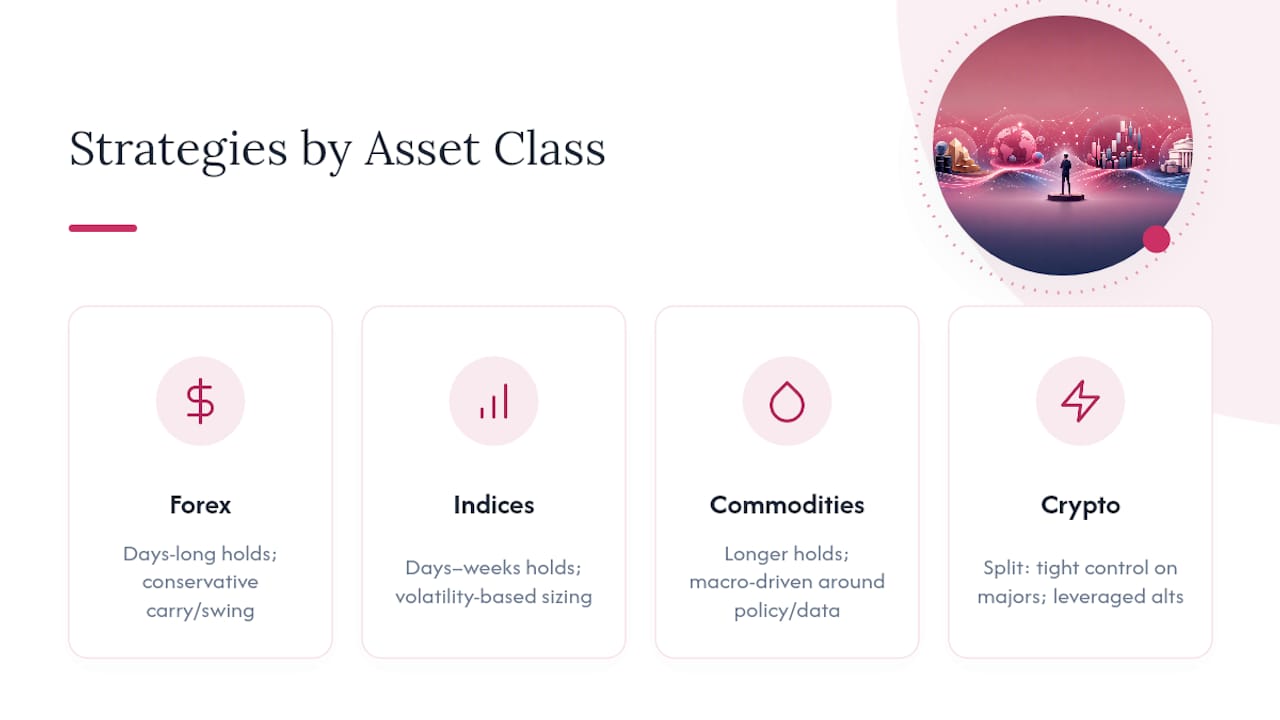
In forex, conservative copiers often follow traders running carry or swing strategies on major pairs like EUR/USD or GBP/USD, holding positions for days rather than minutes. These strategies tend to post modest but steady returns, with drawdowns kept tight through disciplined position sizing, which suits copiers prioritizing capital preservation over rapid growth.
In indices and stocks, balanced strategies frequently center on swing trades around earnings cycles or macro catalysts, holding positions for several days to weeks. This asset class rewards traders who size positions based on volatility rather than conviction alone, since index-level moves can be sharp but usually mean-revert over time.
In commodities, particularly gold, successful copied strategies often lean on macro-driven positioning around inflation data or central bank decisions rather than short-term technical signals. Holding periods tend to run longer, which plays to the earlier point about avoiding traders whose edge depends on execution speed you can’t match as a follower.
In cryptocurrency, the split between conservative and aggressive strategies is starkest. Some copied traders run tight risk controls on major coins like Bitcoin and Ethereum, while others chase leveraged moves on smaller altcoins with drawdowns that dwarf anything seen in forex or stocks. This is the asset class where the KPI screening matters most, because the gap between a disciplined crypto trader and a reckless one shows up fastest in a bad week.
Copy trading vs traditional trading: what’s the real difference?
Traditional self-directed trading requires you to research markets, build a strategy, execute trades, and manage risk entirely on your own judgment in real time. Copy trading outsources the execution and, to a large degree, the strategy decisions to someone else, while you retain control over allocation, risk limits, and the choice of who to follow.
The time commitment differs sharply. Traditional trading demands ongoing market analysis, sometimes hours a day depending on your style. Copy trading shifts your time investment toward periodic screening and monthly or quarterly review cycles instead of constant market-watching, which is part of why it appeals to people without the hours to spend at a screen.
The skill requirement shifts too, but it doesn’t disappear. You no longer need to master technical analysis or build your own trading system, but you do need the discipline to screen traders on real KPIs, size allocations sensibly, and enforce unfollow rules, exactly the skills covered throughout this guide.
Risk profiles diverge as well. In traditional trading, you own every decision and every mistake is directly yours to diagnose. In copy trading, your risk is partly your own allocation choices and partly the risk embedded in someone else’s strategy, which is why the due diligence on trader selection matters as much as, if not more than, any single trade you’d make yourself.
Neither approach eliminates risk. Copy trading simply relocates where the skill requirement sits, from strategy execution to trader evaluation and portfolio discipline.
What should beginners realistically expect from their first pilot?
Give your first pilot a full three to six months before judging it. Shorter windows almost always mean you’re reacting to one good or bad stretch rather than a real pattern. Recency bias is the most common trap: bumping allocation toward whoever’s hot this week and cutting whoever just had a rough one, which is the opposite of the discipline this guide has been building toward. Three habits separate consistent copiers from everyone else: they size positions before emotion enters the picture, they check KPIs on a schedule rather than after a scary headline, and they let mechanical unfollow rules do the hard work instead of hoping for a rebound.
— Cubo
Ready to test these strategies with real market conditions?
Everything in this guide, KPI screening, allocation caps, mechanical stop rules, only works as well as the platform running it. Cubomarkets gives you spreads starting at 0.0 pips with zero commission and fast order execution, so the returns you’re calculating on paper aren’t quietly eaten by slippage or delayed fills before they reach your account.

Cubomarkets has processed over 3 million executed orders across forex, indices, commodities, stocks, and crypto, giving you the multi-asset range to build the four-to-eight trader roster this guide recommends without switching platforms. Open a demo or live trading account and configure your fixed-ratio settings, stop-loss overlay, and “don’t copy existing positions” toggle before your 30-day pilot starts. If you’re curious how instant withdrawals actually work once your pilot turns profitable, it’s worth reading through common withdrawal misconceptions before you fund your account.
Sources
For readers who want to go deeper on the mechanics and KPIs covered here: Wikipedia’s overview of copy trading covers how proportional copying and platform regulation work; DayTrading.com’s KPI breakdown explains why copier earnings beat raw ROI as a filter; and the strategy frameworks from BestCopyTrading and CopyPipe detail allocation and unfollow-rule discipline in more depth.
This article is general information, not a substitute for advice from a qualified financial advisor. Consult a qualified financial professional about your own circumstances before acting on anything here.