Skip to content
CFD hedging means opening an opposing or correlated position to offset the risk sitting in an existing trade or portfolio. Traders use it around earnings releases, central bank decisions, or when a long-term holding faces short-term volatility they don’t want to sell into. It works, but it isn’t free: spreads, swap charges, and capped upside all come with the trade, and gapping or counterparty risk can undercut the protection when markets move fast.
TL;DR:
- Hedging costs include spreads, swap charges, and potential gaps, which can erode effectiveness if market moves occur quickly or over extended periods.
- Correlation between instruments can shift during volatility spikes, making static correlation readings unreliable for long-term hedging strategies.
- Proper hedge sizing depends on acceptable risk levels, with most traders risking 1-2% of their account and using volatility-based stop placements like ATR multiples.
- Gapping risk and counterparty exposure can cause hedge failures, especially during events with rapid market moves or weekend gaps, highlighting the need for guaranteed stops.
- Hedging is most cost-effective and appropriate for bounded, short-term risks such as earnings reports or rate announcements, not for long-term protection.
Table of Contents
- What Are CFD Hedging Strategies and How Do They Work?
- Which CFD Hedging Techniques Do Traders Actually Use?
- How Do You Size and Execute a CFD Hedge?
- What Do Hedges With CFDs Cost, and Where Do They Fail?
- What Do Worked CFD Hedge Examples Look Like?
- How Do Platform Features Affect Hedge Performance?
- When Is Hedging Worth It, and When Should You Just Ride It Out?
- Put These CFD Hedging Strategies to Work on Cubomarkets
- Sources
- FAQ
What Are CFD Hedging Strategies and How Do They Work?
A hedge isn’t a bet on direction. It’s insurance against one. Speculation aims to profit from a price move; hedging aims to neutralize a move that’s already working against you, or one you fear is coming. The objective matters because it changes how you size the position, how long you hold it, and when you close it.
Correlation is the mechanism that makes hedging possible. Two instruments move together, or move in opposite directions, closely enough that a position in one offsets a position in the other. A quick way to check this is a rolling correlation coefficient (Pearson’s r) over the last 20 to 60 trading days between your holding and your proposed hedge instrument. Anything above 0.7 (or below negative 0.7 for inverse relationships) is usually tradable, but correlations shift, especially during volatility spikes, so don’t treat one reading as permanent.
Before placing any hedge, run a few checks on your provider:
- Does the broker disclose its hedging policy and how it manages counterparty exposure on the other side of your trade?
- Are guaranteed stop-losses available, and what do they cost?
- What are the swap rates on the specific instruments you’re pairing, since asymmetric financing costs can quietly erode a hedge?
- Is execution speed fast enough to open the offsetting leg before the market moves further?
Core risk-management practices built around stop-loss discipline, diversification, and disciplined position sizing apply just as much to hedges as to directional trades. A hedge that isn’t sized correctly can create a second risk problem instead of solving the first.
Which CFD Hedging Techniques Do Traders Actually Use?
Different hedges suit different problems. Here’s how the main ones work and when each earns its cost.
- Short CFD against a long underlying. If you hold shares in a company and expect near-term weakness, but don’t want to trigger a taxable sale, open a short CFD of equal notional value on the same stock. Gains on the short offset losses on the shares, dollar for dollar, while you hold both. Close the short once the risk window passes. Cost: spread on entry and exit, plus any swap if held overnight.
- Index or sector CFD hedges. A portfolio spread across ten or fifteen names in the same sector is easier to hedge with one short index CFD than with ten separate short positions. Index CFDs concentrate liquidity and typically carry tighter spreads than a basket of individual shorts, which makes them the more cost-effective route for basket exposure.
- Forex opposite-pair hedges. If you’re long EUR/USD and worried about a Federal Reserve announcement, a short position of similar size on the same pair neutralizes directional exposure during the event window. Traders also use correlated-pair hedges, like offsetting AUD/USD exposure with NZD/USD, when a direct opposite position isn’t practical.
- Volatility hedges. Going long a volatility proxy such as a VIX-linked CFD can offset broad equity risk when markets turn choppy, since volatility products tend to spike when stock indices fall. The limitation is that these instruments often carry high financing costs and don’t track the underlying index precisely over multi-day periods, so they’re better suited to short, event-driven windows than long-term protection.
- Pairs trading. Instead of hedging a single position, you go long one stock and short a correlated peer, betting on relative performance rather than market direction. This isolates company-specific risk from sector or market-wide moves.
- Options and CFD hybrids. Some traders combine a CFD position with an options collar for asymmetric protection. Many CFD providers don’t offer listed options directly, so this often means running the options leg through a separate broker, which adds complexity and a second set of costs to track.
Pro Tip: Before you open any hedge, write down the exit condition first, whether it’s a date, a price level, or an event outcome. A hedge without a predefined unwind point tends to become a permanent, cost-draining position instead of a temporary one.
How Do You Size and Execute a CFD Hedge?
Sizing a hedge starts with a number: how much of your account are you willing to put at risk if the hedge itself moves against you? Structured risk frameworks calculate position size by dividing the acceptable monetary loss by the stop distance in price terms, then converting that into units or contracts.
Here’s the formula in practice: if you’re willing to risk $200 on a hedge, and your stop is 50 points away from entry, you divide $200 by 50 to get a position size of 4 units per point (or per pip, depending on the instrument). Many traders cap this risk at 1% to 2% of account equity per position, a range echoed across standard CFD risk-management guidance.
A few execution rules keep hedges from becoming their own liability:
- Place stops based on volatility, not round numbers. A common method uses a multiple of the Average True Range (ATR), such as 1.5x or 2x ATR, so the stop sits outside normal noise.
- Use trailing stops on hedges meant to run longer than a single session, so profit locks in if the move accelerates in your favor.
- Watch margin usage. A hedge still consumes margin even though it offsets directional risk, and stacking multiple hedges on top of existing positions can push an account toward a close-out level faster than expected.
- Check the hedge daily at minimum, more often around scheduled events, since correlation and volatility both shift quickly.
Drawdown discipline matters here too: reducing effective leverage below the platform’s maximum and pausing or resizing after a defined loss threshold keeps a hedging program from compounding into a bigger problem than the one it was meant to solve.
What Do Hedges With CFDs Cost, and Where Do They Fail?
Every hedge carries a price tag before it ever does its job. The spread on entry and exit is the most visible cost, and it applies twice, once to open the hedge and once to close it. Hold the position overnight and swap or rollover charges start accumulating, which can turn a short-term hedge into a drag on returns if the risk event takes longer to resolve than planned.
Two failure points deserve specific attention:
- Gapping. Markets can jump past a stop level entirely during news events or after a weekend, and structural CFD risks including gapping mean your position can close at a price materially worse than intended. Standard stops don’t protect against this; only guaranteed stops do, and those come at a premium.
- Counterparty and provider risk. Since a CFD is a contract with your broker rather than direct ownership of the underlying asset, regulatory guidance on CFD trading stresses reading the provider’s disclosure statement and understanding how it hedges its own book before you rely on any stop order working as expected.
Behavioral mistakes cause just as much damage as cost structure. Over-hedging, layering multiple offsetting positions until the net exposure barely resembles the original risk, just multiplies spread and swap costs for no added protection. Re-hedging too frequently after every small price wiggle does the same. And treating a correlation reading from three months ago as gospel, when it’s since broken down, leaves you exposed exactly when you thought you were covered.
Pro Tip: If a hedge is costing more in spread and swap over a month than the loss it’s protecting against would realistically cost, close it. A hedge that bleeds slowly is still a loss, just a quieter one.
What Do Worked CFD Hedge Examples Look Like?
Numbers make this concrete. Here are three simplified setups.
- Equity hedge. You hold 500 shares of a stock trading at $80 ($40,000 exposure) ahead of an earnings report. You open a short CFD on the same stock for 500 units. If the stock drops $5 after earnings, your short CFD gains roughly $2,500, offsetting the paper loss on your shares. Close the short once the earnings reaction settles, typically within a day or two.
- Index hedge. Your portfolio of technology stocks totals $60,000 and correlates closely with a tech-heavy index. You short index CFDs equivalent to $60,000 notional ahead of a Federal Reserve rate decision, then close the short once the announcement passes and volatility subsides.
- Currency hedge. A US-based trader holding a European stock CFD has implicit EUR/USD exposure. Shorting an equivalent notional amount of EUR/USD offsets currency risk on the position, independent of how the underlying stock performs.
How Do Platform Features Affect Hedge Performance?
Execution speed, quoted spreads, and swap transparency all directly affect whether a hedge does its job. Platform-level factors like these determine whether you can open an offsetting position before a price gap widens, and whether overnight financing quietly erodes a multi-day hedge. Cubomarkets supports Forex, indices, commodities, stocks, and crypto CFDs from a single account, which matters when a hedge needs a correlated instrument in a different asset class. Before relying on any provider for hedging, confirm its policy on guaranteed stops and how it discloses counterparty arrangements.
When Is Hedging Worth It, and When Should You Just Ride It Out?
Hedging earns its cost around specific, bounded risk: an earnings date, a rate decision, a holding you can’t exit cleanly. Outside those windows, the spread and swap you pay often outweigh the volatility you’re avoiding. Review every open hedge on a fixed schedule and close it the moment its original purpose has passed. Test the mechanics on a demo account before running it live.
— Cubo
Put These CFD Hedging Strategies to Work on Cubomarkets
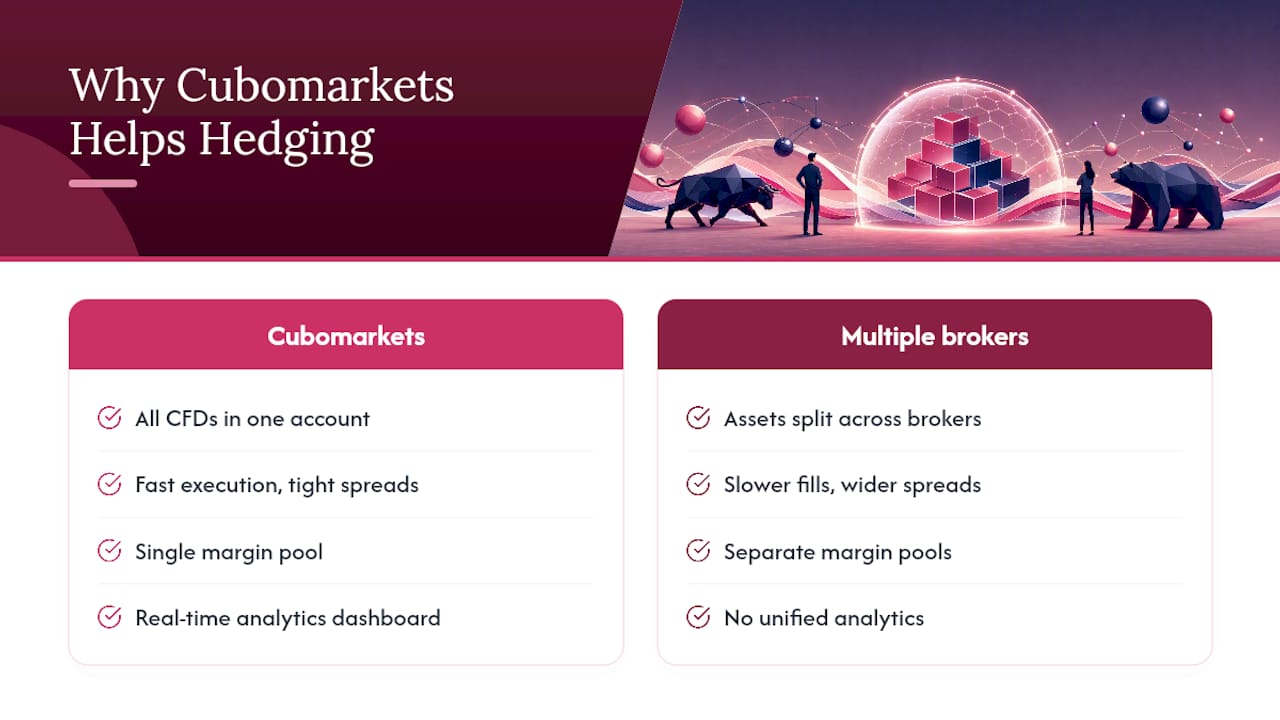
Cubomarkets gives you one account to run every hedge covered above, since Forex, indices, commodities, stocks, and crypto CFDs all sit on the same platform instead of scattered across separate brokers with separate margin pools.

That matters for hedging specifically. Pairing a long stock CFD with a short index CFD, or offsetting currency exposure with an opposing forex position, requires fast execution and tight spreads on both legs, since a slow fill or a wide spread on the hedge side quietly erodes the protection you’re paying for. The platform runs on tight spreads and zero commission, and its real-time analytics let you track correlation and margin usage across asset classes from one dashboard rather than juggling multiple platforms.
Open a demo account to test a hedge setup with no capital at risk, or explore the Forex and commodities offerings to see which correlated instruments fit your existing exposure before you commit real funds.
This article is general information, not a substitute for advice from a qualified financial advisor. Consult a qualified financial professional about your own circumstances before acting on anything here.
Sources
- Risk management strategies in CFD trading
- CFD risk management frameworks: position sizing, leverage control and drawdown mitigation
- Thinking of trading contracts for difference (CFDs)?
FAQ
What is the most effective hedging strategy for CFDs?
There isn’t a single best method since the right choice depends on what you’re protecting. Index CFDs tend to be the most cost-effective way to hedge diversified portfolios, while a direct short CFD works better for protecting a single holding.
Is CFD trading basically gambling?
CFD trading involves genuine structural risk, including leverage, gapping, and counterparty exposure, but it differs from gambling in that disciplined position sizing, stop placement, and hedging can measurably manage that risk over time. Trading without those controls, however, carries the same odds-driven outcome as gambling.
What is the 3-5-7 rule in trading?
Definitions of this rule vary across trading communities, and it isn’t a standardized framework covered by regulatory guidance, so treat any specific version you encounter with caution rather than as an established industry standard.
Do I need options to hedge a CFD position?
No. Most CFD hedges use opposing or correlated CFD positions, such as a short index CFD against a long equity portfolio, without ever touching options. Options can add asymmetric protection but usually require a separate broker relationship if your CFD provider doesn’t offer them.