Skip to content
A micro lot equals 1,000 units of the base currency, or 0.01 on most trading platforms. It’s the right tool when you want precise risk control, a small account, or a live-market way to test a strategy without real financial pain. The catch: leverage still applies, so a “small” position can still hurt more than it looks like it should if you ignore your margin settings.
TL;DR:
- Micro lots allow traders to actively participate with minimal capital, but leverage can amplify potential losses if not managed properly.
- Pip values for micro lots are approximately $0.10 on EUR/USD and USD/JPY pairs, requiring lower margin and making small account growth achievable.
- Using micro lots enables precise position sizing, helps stay within a 1% risk per trade, and offers realistic live-market testing for automated strategies.
- Common mistakes include misentering volume size, over-leveraging, and ignoring pip value differences, which can cause bigger-than-expected losses.
- Most brokers offering micro accounts support MT4 or MT5 platforms, with low minimum deposits and clear margin information essential for responsible trading.
Table of Contents
- What Is Micro Lot Trading, Exactly?
- How Do Micro Lots Affect Pip Value?
- Why Beginners And Intermediate Traders Use Micro Lots
- How Do You Set Up Micro Lot Trading?
- What Should You Look For In A Micro Account Broker?
- Position Sizing Strategies That Fit Micro Lot Trading
- Common Mistakes And A Quick Risk Checklist
- Three Account Sizes, Three Micro Lot Scenarios
- Why Testing With Micro Lots Is A Smart First Step
- Start Small, Trade Smart With Cubo Markets
- Sources
- FAQ
What Is Micro Lot Trading, Exactly?
Forex position sizes come in four flavors, and mixing them up is one of the fastest ways a new trader blows past their own risk limit. Here’s the full breakdown:
- Standard lot = 100,000 units of the base currency
- Mini lot = 10,000 units
- Micro lot = 1,000 units
- Nano lot = 100 units (offered by some brokers, but far less common)
Retail platforms usually let you enter size as a decimal instead of forcing you to type out unit counts. On MetaTrader, “1.00” lots means one standard lot, “0.10” means one mini lot, and “0.01” means one micro lot. That decimal shorthand is where a lot of confusion starts. A trader who means to risk 1,000 units but accidentally enters “0.1” instead of “0.01” has just placed a mini lot, ten times the intended size.
Investopedia’s definition of a micro account frames the micro lot as the mechanism that made retail forex genuinely accessible: it let traders with a few hundred dollars participate in a market historically built for institutions moving standard lots. BabyPips’s lesson on lots, leverage, and profit and loss covers the same taxonomy and is worth bookmarking if you want the pip math to actually stick.
Nano lots exist but aren’t universal. If your broker doesn’t list 0.001 as a valid size, micro lots are your smallest usable unit, and that’s fine. Micro is already granular enough for almost every beginner use case.
How Do Micro Lots Affect Pip Value?
Pip value determines how much money moves in or out of your account for every one-pip price change, and it scales directly with lot size. The formula for most pairs is straightforward: pip value equals (one pip in decimal form) multiplied by the trade size in units.
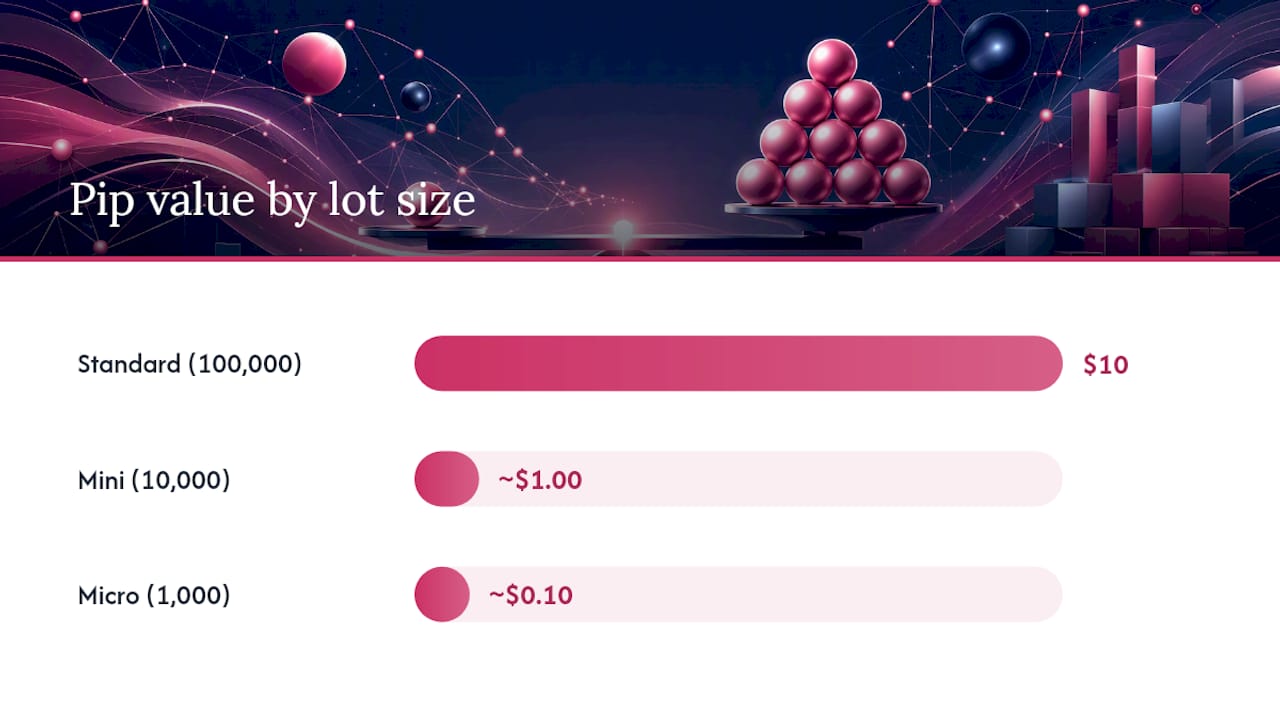
For EUR/USD, one pip is 0.0001. On a standard lot, that works out to roughly $10 per pip. Drop to a mini lot and it’s about $1 per pip. Drop again to a micro lot, and you’re looking at roughly $0.10 per pip, according to BabyPips’s pip-value breakdown. USD/JPY works a little differently because of how the pip is quoted, but the same lot-size scaling holds: micro lots produce cents-per-pip movement rather than dollars-per-pip.
Here’s what that looks like across pair and lot size:
| Pair | Lot Size | Approx. Pip Value |
|---|---|---|
| EUR/USD | Standard (100,000 units) | $10 |
| EUR/USD | Mini (10,000 units) | ~$1.00 |
| EUR/USD | Micro (1,000 units) | ~$0.10 |
| USD/JPY | Micro (1,000 units) | roughly $0.10 |
Margin works the same way it scales down too. If your broker offers 1:100 leverage, a micro lot on EUR/USD near 1.1000 requires roughly $11 of margin to open, compared to roughly $1,100 for a standard lot. That’s the whole appeal in one number: you get real market exposure and real pip movement, at a fraction of the capital commitment.
Here’s a quick walk-through of what a 30-pip move actually does to your account at different sizes:
- One standard lot, 30-pip gain: approximately $300 added to your balance.
- One mini lot, 30-pip gain: approximately $30 added.
- One micro lot, 30-pip gain: approximately $3 added.
None of those numbers care whether the trade was smart or lucky. They only reflect size. That’s exactly why beginners use micro lots: the dollar swings are small enough to survive a string of losing trades while you’re still learning to read a chart.
Why Beginners And Intermediate Traders Use Micro Lots
The case for trading micro lots comes down to control, not caution for its own sake. A few concrete advantages:
- Lower absolute exposure. A losing streak on 0.01 lots costs dollars, not hundreds of dollars, while you figure out what actually works.
- Precise position sizing. You can hit an exact 1% risk target on a $500 account in a way that’s nearly impossible with mini or standard lots alone.
- Live-market strategy testing. Running an automated strategy (an EA, or expert advisor) on a micro account exposes it to real spreads, real slippage, and real execution quirks that a backtest or demo can hide.
- Lower psychological pressure. Watching a $2 drawdown feels completely different from watching a $200 drawdown, and that difference changes how rationally you trade.
The limits are just as real. Because pip value is so small, meaningful account growth from pure micro-lot trading takes patience. Ten winning trades of 20 pips each on a single micro lot nets you around $20, before spread costs. Some brokers also restrict how micro accounts can combine with certain platform features, so it’s worth checking that before you fund one. And micro sizing doesn’t insulate you from the two things that actually blow up small accounts: high leverage and slippage during volatile news events, according to Investopedia’s coverage of micro accounts.
Pro Tip: Scale up gradually rather than jumping straight to bigger sizes once you feel confident. Trade 0.01 lots for a set number of trades, then move to 0.03 or 0.05 only after your win rate and risk discipline hold steady across at least 20 to 30 trades.
How Do You Set Up Micro Lot Trading?
Most brokers that support retail forex also support micro-sized trading, usually through a dedicated “micro” or “cent” account type, though naming conventions vary. Minimum deposits for these accounts typically start low, sometimes under $50, though many traders find $300 to $1,000 more realistic if they want to apply a proper 1% to 2% risk rule without every trade being a rounding error, per general guidance from Forex.
A sensible path from zero to a funded micro account looks like this:
- Open a demo account on your chosen platform and confirm it lets you set lot size down to 0.01.
- Practice exclusively at 0.01 lots for at least a few weeks, focusing on execution and discipline rather than profit.
- Configure stop-loss and take-profit levels on every single trade before you place it, not after.
- Move to a funded micro account once your demo results are consistent, starting with the same 0.01 sizing you practiced with.
On MT4 or MT5, placing a 0.01-lot order comes down to checking a handful of fields in the order window:
- The Volume or Lot Size field should read “0.01,” not “0.1” or “1.”
- The Stop Loss and Take Profit fields should reflect your actual risk tolerance in pips, not be left blank.
- The Type field should match your intent, market execution for an immediate fill, or a pending order if you’re waiting for a price level.
Double-check that volume field every time. It’s the single most common data-entry mistake new traders make, and it’s the one that turns a planned $3 risk into a $30 or $300 one.
What Should You Look For In A Micro Account Broker?
Not every broker that advertises “micro accounts” delivers the same experience, so a quick evaluation checklist saves you from discovering problems after you’ve already deposited.
Look for these non-negotiables first:
- True 0.01-lot support across the pairs and instruments you actually plan to trade, not just a handful of majors.
- Transparent pricing, meaning spreads and any commission are stated clearly, not buried in fine print.
- MT4 or MT5 compatibility, since most educational material, EAs, and indicators are built around those platforms.
- Clear margin and leverage rules, spelled out per account type, so you know exactly what a 0.01 lot will cost you in margin.
- Verifiable regulation, which you can often confirm through a public registry like the one CySEC maintains for investment firms if the broker operates in that jurisdiction.
Beyond the checklist basics, service quality separates a good micro-account experience from a frustrating one: execution speed under volatile conditions, a demo account you can test freely before funding anything, and deposit or withdrawal processes that don’t drag on for days.
Red flags worth walking away from include opaque fee structures that only reveal themselves after you’ve traded, no demo option at all, pip calculations that don’t match the standard math covered earlier in this guide, and a track record of slow or inconsistent trade execution. If a broker can’t clearly explain how it calculates pip value on a micro lot, that’s a problem, not a detail.
Position Sizing Strategies That Fit Micro Lot Trading
The 1% rule is the backbone of most sensible small-account trading, and micro lots are what make it mathematically workable. On a $500 account, 1% risk is $5. Spread across a 20-pip stop-loss, that works out to roughly two micro lots (0.02), assuming EUR/USD’s roughly $0.10-per-pip micro rate. Try to hit that same $5 risk target with mini lots and you’d need a stop-loss under three pips, which isn’t realistic for most strategies.
A practical way to apply this:
- Calculate your dollar risk as a fixed percentage (commonly 1% to 2%) of current account balance, not your starting balance.
- Set your stop-loss distance based on the setup and market structure, not on what “feels” safe.
- Divide your dollar risk by the pip value at your intended lot size to confirm the position matches your risk budget exactly.
- Scale in gradually if you’re testing a new strategy or EA, adding micro-lot increments rather than jumping to full size.
Micro lots are also the cleanest way to stress-test an automated strategy against live spreads and real slippage before trusting it with meaningful capital.
A simple trade journal makes all of this measurable over time. Track entry price, exit price, lot size, planned risk in dollars, actual risk taken, and the reason for the trade. Review it weekly.
Pro Tip: Add a column for slippage on entry and exit. Comparing your intended fill price to your actual fill price over 50 trades tells you more about a broker’s execution quality than any marketing page will.
Common Mistakes And A Quick Risk Checklist
The three mistakes that show up most often with new micro-lot traders: over-leveraging because the position “feels small,” ignoring pip value and assuming all lot sizes move accounts the same way, and typing the wrong volume field on MT4 or MT5 entirely by accident.
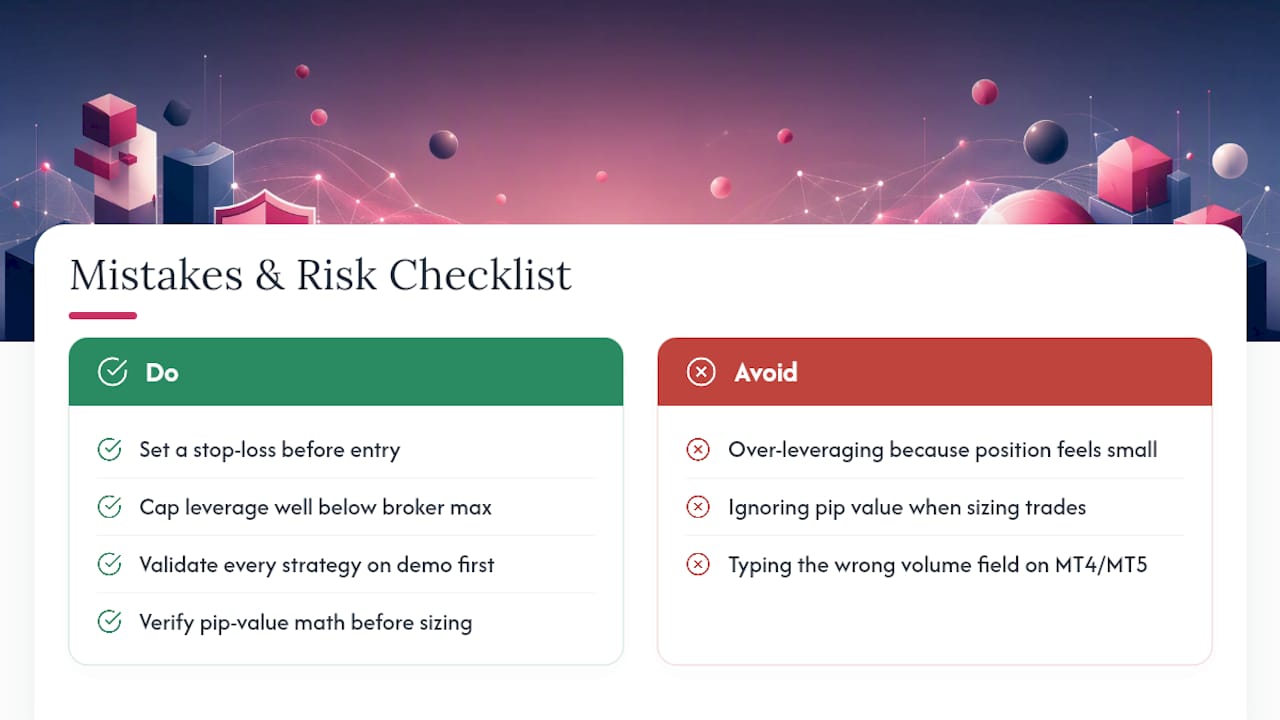
The fix is a short set of habits, not a complicated system. Set a stop-loss on every trade before you enter it. Cap your leverage well below your broker’s maximum, even if the platform allows more. Validate every new strategy on demo before it touches a funded account. And keep your profit expectations tied to what pip value actually allows. Ten winning micro-lot trades at 20 pips will not fund a lifestyle, but it will build the discipline that eventually lets you size up responsibly.
Three Account Sizes, Three Micro Lot Scenarios
The math changes meaningfully depending on how much capital you’re starting with, even though the mechanics stay identical. These scenarios assume EUR/USD, 1:100 leverage, and a 1% risk rule per trade.
On a $100 account, a 10-pip stop-loss keeps risk near $1, which is realistic but slow to grow.
Why Testing With Micro Lots Is A Smart First Step
Micro lots let you learn the market with real stakes instead of fake ones, without those stakes being large enough to derail you. That distinction between “real” and “large” is where most beginners get it backward. A demo account teaches you the platform. A funded micro account teaches you how you actually behave when your own money, however small the amount, is on the line.
This progression is supported by brokers offering fast order execution, access to multiple asset classes including forex, indices, commodities, stocks, and crypto CFDs, and both demo and micro-capable live accounts on platforms like MetaTrader 5. Test your instincts on demo first. Then move to a small live position only once your process, not just your confidence, has held up.
— Cubo
Start Small, Trade Smart With Cubo Markets
Some brokers offer real market conditions at sizes small enough to actually learn from, with tight spreads and low commissions, so a 0.01-lot trade isn’t quietly eaten alive by costs before it even has a chance to move in your favor.

Getting started takes three steps. Open a free demo and practice sizing trades at 0.01 lots until your process feels automatic. Place a handful of live 0.01-lot trades once you’re ready to test real execution and real emotion, not just chart theory. Then, when your results hold up consistently, fund a micro-capable live account and scale your position size on your own timeline, not someone else’s.
Browse the available trading accounts to see which setup fits your starting balance, or head straight to forex markets to see live spreads before you commit a dollar.
Sources
The lot-size definitions and pip-value math throughout this guide draw on Investopedia’s micro account entry and BabyPips’s lesson on lots, leverage, and profit and loss, two of the most cited educational references in retail forex. For broader broker availability, BestBrokers’s roundup of forex brokers with micro accounts is a useful starting point for cross-checking what’s on the market.
This article is general information, not a substitute for advice from a qualified financial advisor. Consult a qualified financial professional about your own circumstances before acting on anything here.
FAQ
How much is 1 micro lot in forex?
One micro lot equals 1,000 units of the base currency, which is 0.01 on most trading platforms and produces roughly $0.10 per pip on EUR/USD.
Is it possible to make $1,000 a day in forex?
It’s technically possible on very large positions or during unusually strong moves, but it’s not realistic or sustainable for a small or micro-lot account, where pip value is measured in cents to dimes rather than dollars.
How many lots is 1 mini?
One mini lot equals 10,000 units of the base currency, which is ten times the size of a micro lot and 0.10 in standard platform notation.
What lot size can I trade with $100 in forex?
A $100 account is typically limited to micro lots (0.01) with tight stop-losses, since even a single mini lot would require risking a large share of the account on one trade.
Does Cubo Markets support micro lot trading?
Yes, Cubo Markets supports micro-sized positions on MetaTrader 5 across forex, indices, commodities, stocks, and crypto CFDs, alongside a demo account for practicing 0.01-lot sizing before funding a live account.