Skip to content
Position size in lots equals your dollar risk amount divided by stop-loss pips multiplied by pip value per lot. Risk 1% to 2% of account equity per trade, never a fixed lot size, because that fraction is what keeps a losing streak from becoming a blown account. Once you know your stop distance and pip value, the math takes about ten seconds. That calculation, not your entry timing, is what decides whether your account survives a bad month.
TL;DR:
- Limiting risk to 1% to 2% per trade is essential, with fixed lot sizes risking more than that risking account blowout during losses.
- Accurate position sizing depends on current account equity, precise stop-loss pips, pip value, and proper rounding, all recalculated before each trade.
- Pip values vary across currency pairs and must be adjusted for cross pairs, JPY pairs, and gold to ensure correct lot size calculation.
- Leverage does not determine trade size, and proper sizing avoids account destruction, even with high leverage on small accounts.
- Consistently recalculating position sizes, especially during volatility spikes or changing equity, keeps risk aligned with actual account conditions.
Table of Contents
- What Is the Position Sizing Formula in Forex?
- How Do You Calculate Position Size Step by Step?
- Why Does Pip Value Change Between Currency Pairs?
- How Much Should You Risk Per Trade?
- Does High Leverage Mean You Can Trade Bigger?
- What Mistakes Wreck Position Sizing Discipline?
- What Should a Position-Size Calculator Actually Show You?
- How Cubo Markets Supports Precise Position Sizing
- Adjusting Position Size as Equity and Volatility Shift
- How Does Your Trading Style Change Position Sizing?
- How Do Correlated Pairs Affect Your Total Risk?
- Sizing Around News Events and Volatility Spikes
- Position Sizing as the Core of Money Management
- Our Take: Sizing Discipline Beats Sizing Sophistication
- Sources
What Is the Position Sizing Formula in Forex?
Every position-size calculation starts with one number: how many dollars you’re willing to lose if the trade goes wrong. That’s your risk amount, and it’s simply account equity multiplied by your risk percentage. A $10,000 account risking 1% puts $100 on the line per trade, no more.
From there, the core formula is straightforward:
Position size (lots) = Risk amount ÷ (Stop-loss pips × Pip value per lot)
Here’s how that plays out in practice:
- Account equity: $10,000, risking 1% = $100 risk amount.
- Trade: EUR/USD, stop-loss set 40 pips away from entry.
- Pip value: $10 per pip for one standard lot (100,000 units) on a USD-quoted pair.
- Calculation: $100 ÷ (40 × $10) = 0.25 lots, or 25,000 units, roughly two and a half mini lots.
That 0.25 comes out clean here, but real trades rarely round so neatly. If spread and commission push your effective stop distance from 40 pips to 42, your position size shrinks slightly too.
How Do You Calculate Position Size Step by Step?
Skip a step in this sequence and your risk percentage stops meaning anything. Run through all six every time, no shortcuts.
- Record account equity and currency. Use the live balance, not the number from three trades ago.
- Set your risk percentage and compute the dollar amount. Multiply equity by 1% (or your chosen figure) to get a hard dollar ceiling.
- Set the stop-loss from market structure and measure the pips. Base it on a swing low, a support zone, or an ATR multiple, never on what “feels right.”
- Get the pip value for the pair and account currency. This changes for cross pairs and JPY pairs. This is covered in the next section.
- Compute lots: Risk amount ÷ (stop pips × pip value), then convert to units if your platform quotes in units instead of lots.
- Round down, check the broker’s minimum lot size, and factor in spread. Rounding up, even slightly, is how traders quietly double their intended risk.
Pro Tip: Keep a simple spreadsheet with these six fields as columns. Filling it in before every trade takes under a minute and forces you to actually look at your stop distance instead of guessing.
Rounding down instead of to the nearest lot size is the rule serious traders never break, because a 0.27 lot result rounded up to 0.3 is a silent 11% increase in risk.
Why Does Pip Value Change Between Currency Pairs?
Pip value isn’t fixed.
- For USD-quoted majors like EUR/USD or GBP/USD, one standard lot runs about $10 per pip, one mini lot (0.1) runs $1, and one micro lot (0.01) runs $0.10.
- For cross pairs that don’t include USD, such as EUR/GBP, pip value needs conversion through the current exchange rate of the quote currency against your account currency.
- JPY pairs use a pip of 0.01 instead of 0.0001, so the pip value formula shifts even though the underlying math is identical.
- XAU/USD (gold) typically quotes pip value differently again, often around $1 per 0.01 lot per point move, so always confirm your broker’s contract specification before sizing a gold trade.
Two quick checks: on a standard lot of USD/JPY, a 20 pip stop with a pip value near $9 puts roughly $180 at risk, close enough to your $100 target that you’d size down to about 0.55 lots.
How Much Should You Risk Per Trade?
Risking 1% per trade is the number most professional traders converge on, with a 1% to 2% band covering nearly every reasonable trading style. Go lower and you’re barely growing; go higher and a five-trade losing streak, which happens to everyone eventually, starts doing real damage to your equity curve.
- Fixed-fractional sizing means your dollar risk shrinks automatically as your equity shrinks, which is exactly the survivability mechanism that keeps a drawdown from spiraling.
- Set stops from actual market structure (recent swing highs/lows, support and resistance, or a multiple of Average True Range) rather than an arbitrary pip count, because your stop technique directly drives your position size.
- Cap total concurrent risk, a common rule is no more than 5% to 6% of equity exposed across all open positions at once.
- Treat correlated pairs as one combined position for exposure purposes, not two separate 1% risks.
Does High Leverage Mean You Can Trade Bigger?
Leverage tells you how much capital a broker requires to open a position. It says nothing about how much you should risk, and confusing the two is how overleveraged accounts blow up.
- A $500 account with 500:1 leverage can technically open a full standard lot, but a 40-pip stop on that lot risks $400, 80% of the account on one trade.
- The same account sized correctly at 1% risk ($5) on that same 40-pip stop needs roughly 0.0125 lots, smaller than most standard-account minimums allow.
- Cent accounts and micro-lot support solve this by letting small balances hit the correct 1% figure without artificially widening stops just to make the lot size work.
- Always check your broker’s contract specs, minimum volume, and lot increment (0.01 vs. 0.1) before assuming a calculated size is actually tradable.
What Mistakes Wreck Position Sizing Discipline?
The same handful of errors show up in nearly every account review: trading a fixed lot size regardless of stop distance, rounding a calculated size up instead of down, forgetting spread and commission eat into effective risk, and never recalculating after equity moves. Each one quietly inflates real risk above the number the trader thinks they’re taking.
Run this nine-point checklist before every entry:
- Confirm current account equity.
- Confirm risk percentage for this trade.
- Calculate the dollar risk amount.
- Measure stop-loss distance in pips from structure.
- Look up pip value for this exact pair and account currency.
- Calculate lots: risk amount ÷ (pips × pip value).
- Round down to the broker’s lot increment.
- Verify the result meets the broker’s minimum volume.
- Add spread/commission and confirm total exposure still fits your cap.
Pro Tip: Log every calculated size next to your actual filled size in your trading journal. Discrepancies between the two are the fastest way to catch a rounding habit before it costs you real money.
What Should a Position-Size Calculator Actually Show You?
A trustworthy position-size calculator needs six inputs: account currency, account equity, risk percentage, stop-loss in pips, the currency pair, and spread or commission. Skip the spread field and the tool is quietly overstating your safe position size.
- Outputs should include lot size, unit size, pip value per lot, and the exact dollar amount at risk, all four, not just lots.
- Cross-check any tool against the manual example from earlier in this article: $10,000 equity, 1% risk, EUR/USD, 40-pip stop should return 0.25 lots.
- If a calculator’s output doesn’t match your manual math within rounding, don’t trust it for live trades until you find out why.
- More advanced setups integrate sizing directly into the order ticket or use a risk-manager expert advisor that blocks oversized entries automatically, though manual verification periodically still matters.
How Cubo Markets Supports Precise Position Sizing
Getting the formula right on paper matters little if execution introduces its own risk. Cubo Markets runs a multi-asset platform with spreads starting at 0.0 pips and zero commission, which matters directly for sizing because every pip of spread is a pip added to your effective stop distance.
- Tight spreads mean the gap between your calculated risk and your actual risk stays small, especially on tighter stops used by scalpers and intraday traders.
- Fast order execution and a high volume of executed orders can reduce slippage that can silently push a filled position past its intended risk band.
- Micro-lot support lets smaller accounts hit an accurate 1% risk figure instead of being forced into oversized minimum trades.
- Access through popular trading platforms can put pip value, lot size, and margin data in view at the moment of order entry, not after the fact.
Adjusting Position Size as Equity and Volatility Shift
Your account equity moves every day, and your position size should move with it. Recalculating after every closed trade, not weekly, is what keeps the percentage honest.
Volatility shifts the other half of the equation. When a pair’s average daily range widens, a stop placed at your usual pip distance from structure might now sit inside normal noise, getting hit before the trade has a real chance to work. The fix isn’t to abandon your risk percentage, it’s to widen the stop to fit the new volatility and let the position size shrink accordingly, since stop pips sit in the denominator of the formula.
Equity swings during a strong winning streak deserve the same discipline in reverse. It’s tempting to keep position sizes flat once your account has grown, but recalculating upward, in smaller, controlled increments, is what lets fixed-fractional sizing compound properly instead of leaving growth on the table.
A practical habit: recalculate risk amount and position size at the start of each trading session using that session’s actual equity figure, not a number from earlier in the week. It takes thirty seconds and prevents the slow risk creep that catches traders who “size by feel” once they’ve had a few winners in a row.
How Does Your Trading Style Change Position Sizing?
Scalpers, swing traders, and position traders are all using the same formula, but their inputs look nothing alike, and that changes the resulting lot sizes dramatically.
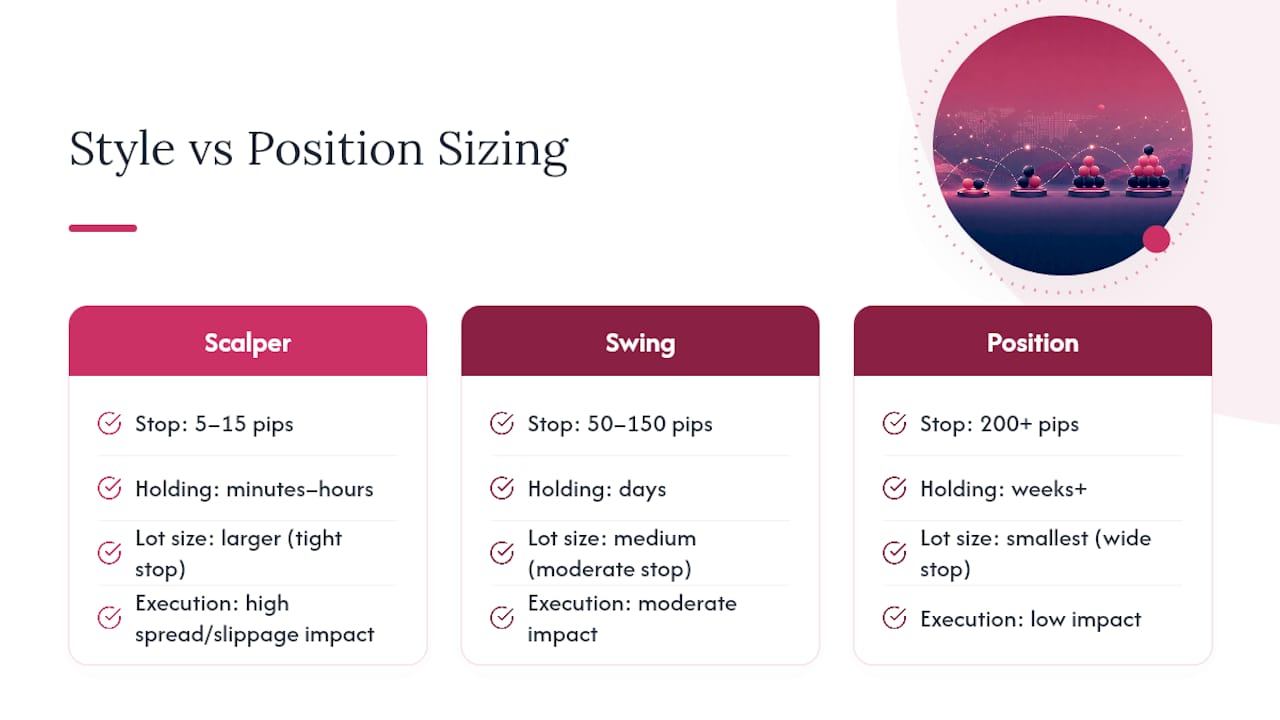
Scalpers work with tight stops, often 5 to 15 pips, targeting several trades a day. Because stop pips sit in the denominator, a tighter stop at the same dollar risk produces a larger lot size. That larger size also means spread and slippage carry proportionally more weight, which is exactly why execution speed and tight pricing matter more to a scalper than to anyone else on this list.
Swing traders hold positions for days, using stops of 50 to 150 pips based on daily chart structure.
Position traders stretch stops even further, sometimes 200 pips or more, tied to weekly structure or major support and resistance zones. What changes is stop distance and holding time, never the underlying risk discipline.
How Do Correlated Pairs Affect Your Total Risk?
Two trades that look independent on paper can be the same bet in disguise. EUR/USD and GBP/USD move together often enough that a long position in both isn’t diversification, it’s doubled exposure to a weaker dollar.
Treat correlated pairs as a single combined position when checking against your maximum portfolio exposure cap. A simple approach: group your open positions by their dominant driver, dollar strength, risk sentiment, commodity prices, and cap total risk per group rather than per individual pair.

This matters most for traders running multiple positions at once, swing and position traders especially. A scalper closing trades within minutes has less correlation exposure simply because positions don’t overlap for long.
Sizing Around News Events and Volatility Spikes
Scheduled news events, interest rate decisions, employment reports, and central bank statements can widen spreads and blow past normal stop distances in seconds. The standard fix isn’t to abandon position sizing during these windows, it’s to shrink the risk percentage or widen the stop enough to absorb the expected volatility.
Others simply stay flat through the release and re-enter once the initial spike settles, sidestepping the sizing problem entirely by avoiding the trade.
Unscheduled volatility spikes, a surprise geopolitical headline or a flash move, are harder to plan around but the same principle applies: if a pair’s typical range has visibly expanded, your stop distance and position size both need to expand with it. Keeping your risk percentage fixed while ignoring wider ranges means silently accepting a bigger true risk than your formula says you’re taking.
Position Sizing as the Core of Money Management
Position sizing isn’t a separate skill from risk management, it’s the mechanism that actually implements it. A trading plan can specify perfect entries and exits, but without a consistent sizing rule behind every trade, the plan has no way to control how much any single decision can cost.
Money management at the account level comes down to a small number of interacting rules: risk percentage per trade, maximum concurrent exposure across open positions, and how those numbers adjust for correlation and volatility, all covered in the sections above. Position sizing is the calculation that turns those rules into an actual number of lots at the moment you click buy or sell.
Traders who treat sizing as an afterthought, picking a lot size that “feels right” for the setup, are effectively trading without a risk management strategy at all, regardless of how carefully they picked the entry. The formula does the opposite: it forces every trade, win or lose, to cost the same predictable fraction of the account, which is what allows a trading edge to actually compound over time instead of getting erased by one oversized loss.
Our Take: Sizing Discipline Beats Sizing Sophistication
The math behind position sizing is genuinely simple, a formula most traders could compute by hand in under a minute. What separates accounts that survive from accounts that don’t isn’t a more advanced formula, it’s whether the trader actually runs the calculation every single time, including after a losing streak has shrunk their equity and after a winning streak has grown it.
It isn’t. The decision that matters is whether you recalculate at all, whether you round down instead of up, and whether you treat correlated pairs as combined exposure instead of separate bets. Those habits, not the exact percentage, are what determine account longevity.
If you trade on a platform where tight spreads and fast execution keep your calculated risk close to your actual risk, the formula does its job. If slippage and wide spreads routinely push your fills past your intended stop, no formula fixes that gap. Prioritize the execution environment first. The math was never the hard part.
— Cubo
This article is general information, not a substitute for advice from a qualified financial advisor. Consult a qualified financial professional about your own circumstances before acting on anything here.
Sources
- Maximize Forex Profits With Strategic Position Sizing — Investopedia
- Position Sizing Formulas | Free Beginner Forex Lesson | FX Foundations
- Position Size Calculator — BabyPips
- Position Sizing in Trading: How to Calculate & Examples — Britannica