Skip to content
Yes, brokers charge withdrawal fees sometimes, but the bigger cost often comes from the correspondent bank or payment processor sitting between you and your money. Most reputable brokers offer at least one free withdrawal method per month. Your real job is threefold: check the broker’s published fee schedule, send funds back through the same method you used to deposit, and finish KYC verification before you request a payout so nothing gets held up.
TL;DR:
- The majority of withdrawal costs come from intermediary banks, currency conversion spreads, and compliance checks, not just broker fees.
- International wire transfers often involve multiple fees from both the broker and correspondent banks, with costs ranging from $10 to over $40 and taking 2 to 5 days.
- Using local payment methods or e-wallets can significantly reduce fees and processing times, especially when they bypass correspondent banking networks.
- Planning withdrawals by matching deposit and payout methods, consolidating smaller requests, and pre-submitting verification documents can minimize delays and extra charges.
- Delays over five to ten business days with no clear reason should prompt contact with regulators and documentation collection to prevent potential fraud or mismanagement.
Table of Contents
- Understanding Withdrawal Methods and Who Actually Charges You
- Why Brokers and Banks Charge Withdrawal Fees in the First Place
- Typical Fee Ranges and Processing Times by Method
- How to Reduce or Avoid Withdrawal Fees
- Common Withdrawal Problems and When to Escalate
- How Cubo Markets Approaches Withdrawals and Compliance
- Get a Transparent Trading Setup With Cubo Markets
- Where to Verify Withdrawal Rules and File Complaints
- A Long-Term View on Withdrawal Friction
- Sources
Understanding Withdrawal Methods and Who Actually Charges You
Every withdrawal method has its own cost structure, and the broker is rarely the only party taking a cut. Here’s how the money actually moves, and who gets paid along the way.
Bank wires carry the widest range of costs because two or three parties can charge for the same transfer. Your broker might charge a flat fee of $10 to $25, but the correspondent bank that routes the international transfer often adds its own charge, sometimes deducted silently before the funds land in your account. If you’re withdrawing to a bank in a different country than your broker’s payment processor, expect a second intermediary fee on top of the broker’s own rate.
Card refunds work differently. Most brokers will only return funds to a debit or credit card up to the amount you originally deposited with that card, then route anything above that through another method. This isn’t arbitrary. It’s how anti-money laundering rules are built to work, since Banca d’Italia’s supervisory framework requires funds to return to the same payment method and beneficiary name used at deposit. Card withdrawals are frequently fee-free precisely because they’re just reversing an existing transaction rather than initiating a new payout.
E-wallets (think Skrill, Neteller, or similar processors) tend to be the fastest and cheapest option when a broker supports them. The catch is that the e-wallet provider itself usually charges a small percentage fee, and if your wallet currency doesn’t match your trading account currency, you’ll eat a conversion spread on top. Not every broker supports every e-wallet, so this option depends entirely on what’s available on your specific platform.
Crypto withdrawals add a layer most traders underestimate: the blockchain network fee. This is separate from anything the broker charges and fluctuates based on network congestion. Withdraw Bitcoin during a busy period and you might pay several times more in network fees than you would during a quiet stretch. Brokers may also apply their own processing fee on top, and if your account is denominated in fiat currency, there’s a conversion step before the crypto ever leaves the platform.
The pattern across every method is the same: brokers can only send funds back to the account, card, or wallet that funded the deposit in the first place. This single rule explains most of what looks confusing about withdrawal fees. It’s not the broker being difficult. It’s compliance architecture that exists across the entire regulated brokerage industry.
- Bank wires: broker fee plus possible correspondent bank charge on either end.
- Card refunds: often free, but capped at your original deposit amount
- E-wallets: fast, but processor fees and currency conversion apply
- Crypto: network fees vary constantly, plus a possible broker processing charge
Why Brokers and Banks Charge Withdrawal Fees in the First Place
Withdrawal fees rarely exist just to squeeze traders. Most of them trace back to real operational costs that show up somewhere in the chain, even when the broker itself doesn’t charge anything.
Correspondent banking is the biggest hidden cost. When your broker’s bank doesn’t have a direct relationship with your bank, the transfer routes through one or more intermediary banks, and each one can take a fixed processing fee. This is standard practice in international wire transfers and has nothing to do with your specific broker’s pricing philosophy.
Currency conversion is the second driver. If you fund your account in euros but withdraw in US dollars, or vice versa, someone in the chain applies an exchange rate, and that rate almost always includes a spread above the interbank rate. This spread is where a chunk of “hidden” withdrawal cost actually lives.
Compliance checks cost money too. First-withdrawal security reviews, KYC re-verification, and AML screening all require staff time and system checks on the broker’s end. Some brokers absorb this cost; others pass a portion of it along as a processing fee, particularly on larger withdrawals that trigger enhanced due diligence.
- Correspondent bank routing fees: structural, largely unavoidable on international wires
- FX conversion spreads: apply whenever withdrawal currency differs from account currency
- Compliance and KYC re-checks: especially common on first withdrawals or large amounts
- Inactivity or administrative fees: some brokers apply these at withdrawal time if an account has been dormant
Typical Fee Ranges and Processing Times by Method
Numbers vary by broker, so treat these as realistic planning ranges rather than a quote from any specific platform. Always confirm against the broker’s own published schedule before you request a payout.
Bank wires typically run $10 to $40 in flat broker fees, with correspondent bank charges adding anywhere from nothing to another $20 to $30 on international transfers. E-wallets are usually cheaper, often $0 to $10 plus a small percentage, and they tend to process faster because there’s no correspondent bank in the loop. Crypto withdrawals are the hardest to predict since network fees swing with blockchain congestion. Card returns are frequently free, but only up to your original deposit amount.
| Method | Typical fee range | Typical processing time |
|---|---|---|
| Bank wire | $10 to $40 broker fee, plus possible correspondent charges | 2 to 5 business days |
| Card refund | Often free up to deposit amount | 1 to 3 business days |
| E-wallet | $0 to $10 plus a small percentage | Same day to 1 business day |
| Crypto | Network-dependent, highly variable | Minutes to several hours, plus broker processing |
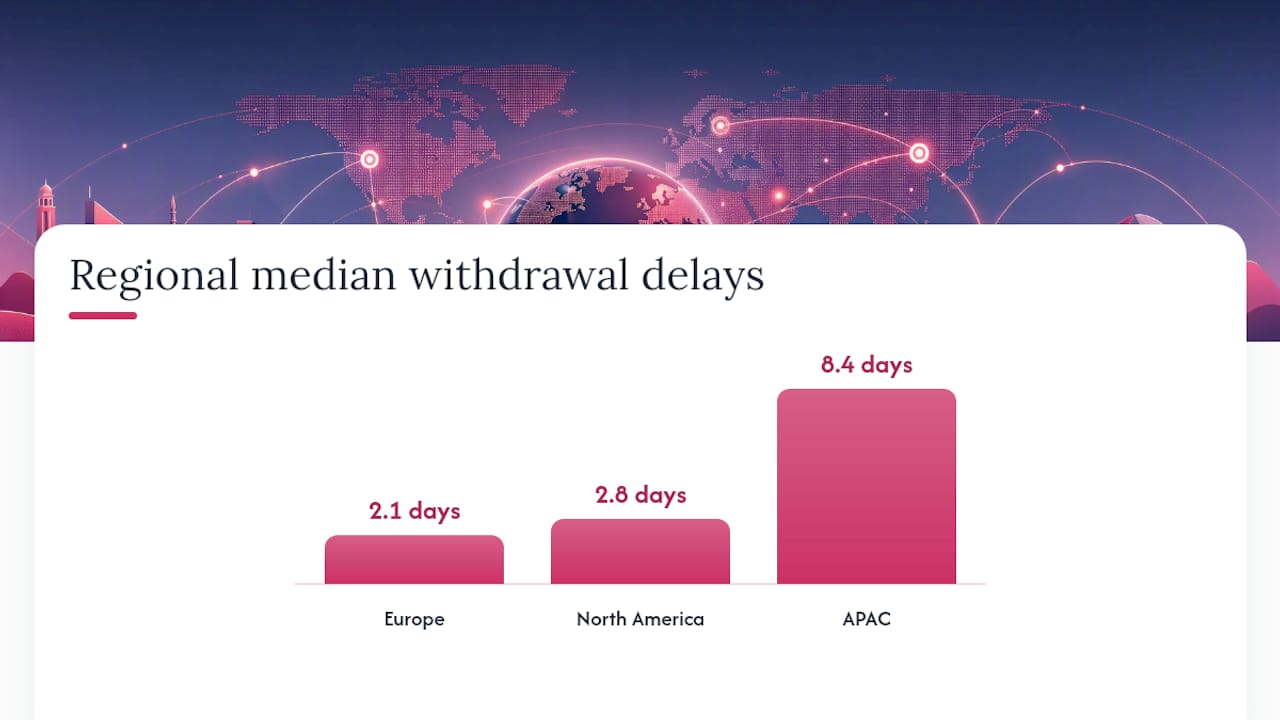
Processing speed depends heavily on who’s holding your money and how modern their infrastructure is. Retail investor complaints about withdrawal delays increased significantly between January and June 2026, according to Verivex’s analysis of trust and withdrawal friction. The same research found regional median delays of 2.1 days in Europe, 2.8 days in North America, and 8.4 days in APAC, a gap that traces largely to which custodians and payment rails brokers have adopted.
That regional spread matters more than most traders realize. Brokers running on modern custodial infrastructure and rebuilt correspondent banking relationships process withdrawals several days faster on average than platforms still relying on older payment rails. If you’re comparing brokers, the custodian behind the scenes often predicts your withdrawal experience better than the broker’s marketing copy does.
Pro Tip: Ask a prospective broker directly which custodian and payment processor they use for withdrawals. A vague answer is itself useful information.
How to Reduce or Avoid Withdrawal Fees
You have more control over withdrawal costs than most traders assume. None of these tactics require special account tiers or insider knowledge, just a bit of planning before you click “withdraw.”
- Match your withdrawal method to your original deposit method. This isn’t optional in most cases. AML rules require funds to return the way they came in, and mismatched methods are one of the fastest ways to trigger a rejection or an extended review.
- Consolidate withdrawals instead of making frequent small ones. If your broker or an intermediary bank charges a flat fee per transaction, requesting one $2,000 withdrawal costs the same flat fee as requesting four $500 withdrawals, but you only pay it once.
- Choose local rails or e-wallets when your broker supports them. These typically skip the correspondent banking chain entirely and process faster with lower fees than international wires.
- Use your monthly free-withdrawal allowance. Many brokers waive fees for a set number of withdrawals per month or offer better terms at higher account tiers. Check your account settings before assuming every withdrawal costs the same.
- Upload verification documents before you need them. Proof of identity, proof of address, and a deposit receipt matching your withdrawal request all speed up processing when submitted in advance rather than after you’ve already asked for your money.
- Time your currency conversions carefully. If you’re going to convert currency at some point anyway, doing it once, deliberately, usually beats letting multiple parties in the chain each apply their own conversion spread.
Pro Tip: If your broker and your bank both handle currency conversion on the same withdrawal, you can end up paying two separate spreads on one transaction. Withdraw in your account’s native currency when you have the option, then convert separately through your bank if needed.
Industry guidance consistently points to consolidation as one of the simplest wins available. KenMacro’s breakdown of withdrawal complaints notes that avoiding multiple small withdrawals where flat fees apply per transaction is one of the most reliable ways to cut total withdrawal costs without changing brokers or methods at all.
Common Withdrawal Problems and When to Escalate
Most withdrawal delays are boring, not sinister. Incomplete KYC documentation, bank holidays in either country, and routine routing delays through correspondent banks account for the overwhelming majority of slow payouts. KenMacro’s research found that most reported withdrawal problems trace back to operational causes like these rather than deliberate withholding.
That said, some patterns are genuine red flags, and you should treat them differently than a routine delay.
- A broker suddenly introduces a new fee after you’ve already requested a withdrawal
- Support asks you to pay a tax, fee, or “release charge” directly to them before funds are sent
- You’re asked to deposit additional funds to “unlock” or “activate” a withdrawal
- Your withdrawal method keeps changing or support gives inconsistent explanations for the delay
Legitimate brokers do not ask you to pay taxes, upgrade fees, or extra deposits to release your own money. Any of these requests should stop you from depositing anything further, immediately.
If a withdrawal sits pending for more than five to ten business days with no clear explanation, Market Due Diligence’s guidance recommends stopping further deposits, preserving every email and chat log, and requesting a written timeline from the broker. If that written timeline doesn’t materialize or the broker’s story keeps changing, contact your bank about a possible chargeback and prepare to file a complaint with the relevant financial regulator, including your account statements, deposit and withdrawal request records, and all correspondence with support.
How Cubo Markets Approaches Withdrawals and Compliance
Cubo Markets structures its withdrawal process around one principle: the payout method should match the deposit method, verified through the same customer due diligence policy that governs account onboarding. That policy lays out exactly what identity and address documentation traders need before requesting a payout, which is also detailed in the broker’s AML policy.
The practical takeaway for traders on any platform, not just this one: pre-upload certified proof of identity and address before you ever request a withdrawal, keep your deposit receipts on hand, make sure your payout name matches your deposit name exactly, and ask support for a written, timed acknowledgment the moment you submit a withdrawal request. These four steps eliminate the vast majority of first-withdrawal delays before they start.
Get a Transparent Trading Setup With Cubo Markets
If withdrawal friction is the thing pushing you to reconsider a broker, transparency on fees and execution is where Cubo Markets tries to earn that trust back. The platform’s stated priority is eliminating the delays and surprise charges that show up in complaint data across the industry.

You can review the trading accounts page to see account types and how withdrawal rails are structured before you fund anything. If crypto is part of your strategy, the crypto trading section outlines which digital assets are supported alongside standard Forex, indices, and commodities access. Before your first withdrawal on any platform, it’s worth reading through Cubo Markets’ customer due diligence policy so you know exactly what documentation to prepare ahead of time. Open a demo account, run a few trades, and test how the withdrawal process actually feels before committing real capital.
Where to Verify Withdrawal Rules and File Complaints
For anything beyond what a broker’s own fee schedule tells you, go directly to regulatory and primary sources rather than forum posts or comparison sites.
- Banca d’Italia’s anti-money laundering supervision page explains the regulatory logic behind matched-method withdrawal rules.
- Market Due Diligence’s escalation guidance walks through what evidence to gather before contacting your bank or a regulator.
- KenMacro’s guide to withdrawal complaints separates routine operational delays from genuine fraud indicators.
A Long-Term View on Withdrawal Friction
Withdrawal speed and fee transparency have quietly become one of the sharpest ways to tell brokers apart. Spreads and commissions get marketed aggressively, but how a broker treats you the moment you want your money back tells you more about its actual priorities. The custodian and payment rail behind a broker predicts your experience better than any homepage claim does.
When you’re weighing a broker, ask about custodian quality, monthly free-withdrawal limits, and method-matching rules before you fund an account, not after you’re waiting on a payout. That order of operations saves more frustration than any single fee-avoidance trick ever will.
— Cubo
This article is general information, not a substitute for advice from a qualified financial advisor. Consult a qualified financial professional about your own circumstances before acting on anything here.
Sources
- Banca d’Italia — Supervisione normativa antiriciclaggio
- Broker Withdrawal Complaints Explained (2026) – KenMacro
- Broker Withdrawal Problems: What To Do 2026 – Market Due Diligence