Skip to content
Slippage is the difference between the price you request and the price your order actually fills at. It happens on almost every trade, in every market, and it usually costs you a little money rather than saving it. You cannot eliminate slippage, but you can measure it, anticipate when it spikes, and choose order types and timing that keep it small.
TL;DR:
- Most slippage costs are small per trade but can accumulate significantly over multiple trades, especially when trading large positions or frequently.
- Slippage tends to increase during high-volatility events and when trading during thin liquidity windows, making timing crucial for cost control.
- Using limit orders, splitting large trades, and trading during peak liquidity hours can substantially reduce negative slippage.
- Market, limit, and guaranteed stop-loss orders each have trade-offs between fill certainty and price control, depending on market conditions.
- Monitoring actual execution prices relative to requested prices helps traders understand and manage their average slippage over time.
Table of Contents
- What Is Slippage in Trading? Types and Quick Examples
- What Causes Slippage in Forex, Crypto, and Stocks?
- How Do You Calculate Slippage on a Trade?
- Slippage vs. Spread: What’s the Difference?
- How to Reduce Slippage in Forex and Other Markets
- Does Slippage Work the Same Way on Every Trading Venue?
- What Execution Quality Actually Means for Your Trades
- Why Most Traders Get Slippage Backwards
- Key Takeaways on Managing Trading Slippage
- Sources
What Is Slippage in Trading? Types and Quick Examples
Slippage happens because prices move between the moment you click “buy” and the moment the exchange or broker actually fills the order. The Investopedia definition splits it into two flavors that matter for different reasons:
- Negative slippage: you pay more (or receive less) than you expected. This is the common case.
- Positive slippage: you get a better price than requested, usually during fast moves in your favor.
- Timing/latency slippage: the delay between order submission and execution lets the market move.
- Price-impact slippage: your own order size pushes the price against you as it eats through available liquidity.
Here’s a quick one: you place a market buy on gold expecting a fill at $2,650.00. By the time it executes, the price has ticked to $2,650.35. That’s $0.35 of negative slippage per unit, small on paper but real once you’re trading size or trading often.
What Causes Slippage in Forex, Crypto, and Stocks?
Slippage traces back to four overlapping problems, and diagnosing which one hit your trade tells you exactly what to fix.
- Thin order books. When there aren’t enough resting orders near your price, your order has to “walk the book,” filling against progressively worse prices until it’s complete. This is pure market impact, and it scales with your order size relative to available depth.
- Volatility spikes and news events. Central bank announcements, earnings releases, and macro surprises can thin out liquidity in seconds as market makers pull quotes. The Borsa Italiana glossary identifies high volatility and low liquidity as the two primary drivers of slippage, and they usually arrive together.
- Order type mismatch. A market order guarantees execution but not price. A limit order guarantees price but not execution. A guaranteed stop-loss order (GSLO) locks in your exit price for a fee, which matters most around scheduled news.
- Execution-side latency. Slow routing, server distance, or a broker queuing orders behind others can add milliseconds or seconds of delay, and in a fast market that gap is enough to move the fill several ticks from where you clicked.
Most bad fills are a combination of two or three of these at once, usually volatility plus order type.
How Do You Calculate Slippage on a Trade?
The formula is simple: slippage = executed price − requested price. For a percentage figure, divide that difference by the requested price and multiply by 100.
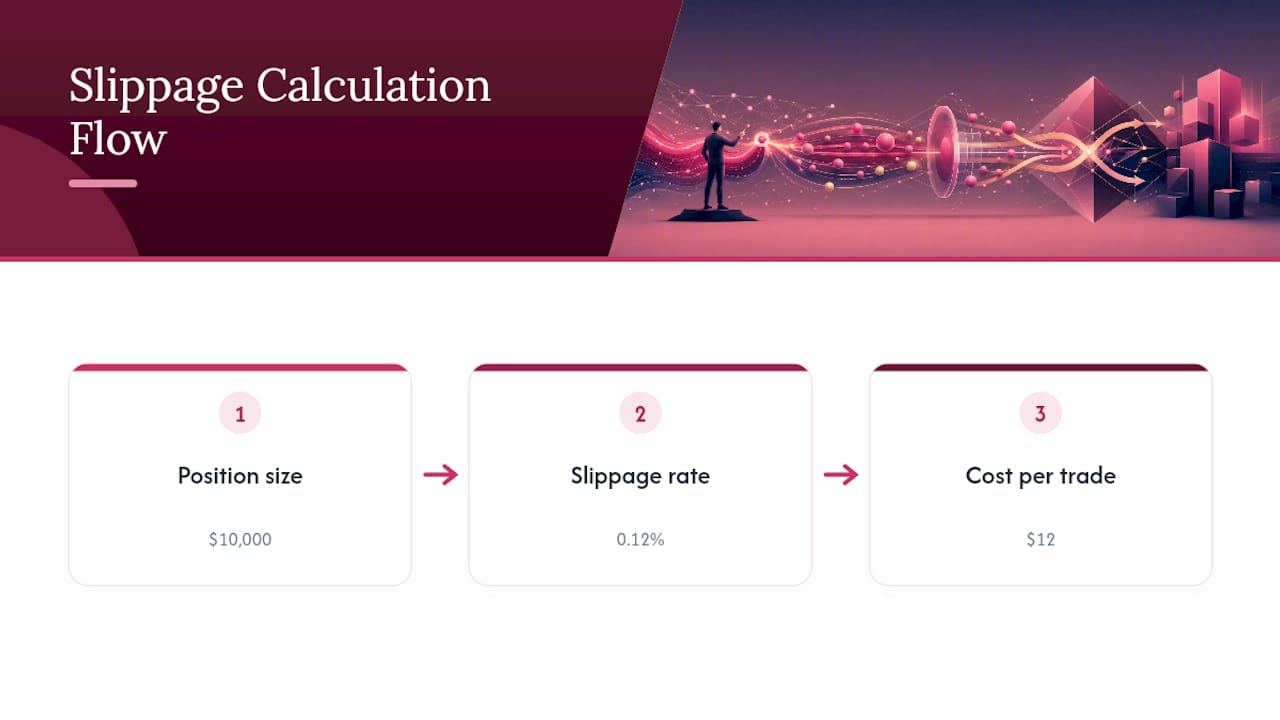
Here’s the math in action. A trader places a market buy on Bitcoin expecting a fill at $85,000. The order actually executes at $85,100. That’s $100 of absolute slippage, or roughly 0.12% of the intended price.
Slippage in numbers: on a $10,000 position, 0.12% slippage costs $12 per trade. Repeated trades can lead to significant cumulative costs, even though these do not appear as labeled fees on statements.
If you’re trading frequently, track slippage as a running average across your fills rather than judging it trade by trade. A single fill might show positive slippage; over 50 trades, the average almost always skews negative, and that average is what actually erodes your edge over a trading year.
Slippage vs. Spread: What’s the Difference?
The spread is the visible gap between the bid and ask price quoted right now. Slippage is the extra movement that happens between when you click and when you’re filled. One is a known cost you can see before you trade. The other is a variable cost you only discover after.
- Spread: fixed or floating, quoted upfront, part of the broker’s revenue model.
- Slippage: not quoted, driven by market conditions and order type, can be zero, positive, or negative.
- Combined cost example: a 0.8 pip spread plus 0.3 pips of slippage plus a small commission means your real execution cost is well above the quoted spread alone.
Scalpers and news traders feel slippage hardest because their entire edge is measured in fractions of a pip. A swing trader holding for days barely notices it.
How to Reduce Slippage in Forex and Other Markets
You control three levers: order type, timing, and size. Here’s how to use each one.
- Use limit orders when price matters more than speed. A limit order caps your entry or exit at a specific price, which prevents negative slippage. The trade-off, per Investopedia, is execution risk: the market can run away without filling you at all.
- Use guaranteed stop-loss orders around high-risk events. GSLOs, where your broker offers them, lock your exit price for a fee. They’re worth the cost heading into a central bank decision or earnings release when normal stops can gap straight through your level.
- Split large orders instead of firing one block trade. Breaking a big position into smaller slices, or using TWAP/VWAP style execution, reduces the price impact each individual slice creates.
- Trade during high-liquidity windows. The London/New York overlap in forex, or regular market hours in equities, gives you deeper books and tighter fills than thin overnight sessions.
- Set your slippage tolerance on AMMs before you swap. On decentralized exchanges, price impact grows with your trade size relative to pool liquidity, so check the pool depth and set a tolerance that protects you without blocking every swap.
- Review your execution reports regularly. Most platforms log requested price versus filled price. Pull that data monthly and calculate your average slippage instead of guessing.
Pro Tip: Don’t just check the spread before you trade. Pull up the order book depth (or pool liquidity on a DEX) and size your position against it. If your order is bigger than what’s resting within a few ticks of the current price, you’re buying slippage before you even click.
Does Slippage Work the Same Way on Every Trading Venue?
No, and knowing the mechanics of your specific venue changes how you defend against slippage.
- Forex and equities run on central limit order books, where depth at each price level determines your fill. Major forex pairs during liquid sessions tend to have deep books; small-cap stocks and exotic pairs do not.
- Centralized crypto exchanges can look liquid on the surface but thin out fast during volatility, since order books here are often shallower and more fragmented than major forex pairs.
- Decentralized exchanges (AMMs) don’t use order books at all. Price is set by a formula tied to pool reserves, so slippage rises predictably as your trade size grows relative to that pool.
- Practical check per venue: look at book depth in forex/equities, pool liquidity in DeFi, and exchange status or volume in crypto before you size a trade.
What Execution Quality Actually Means for Your Trades
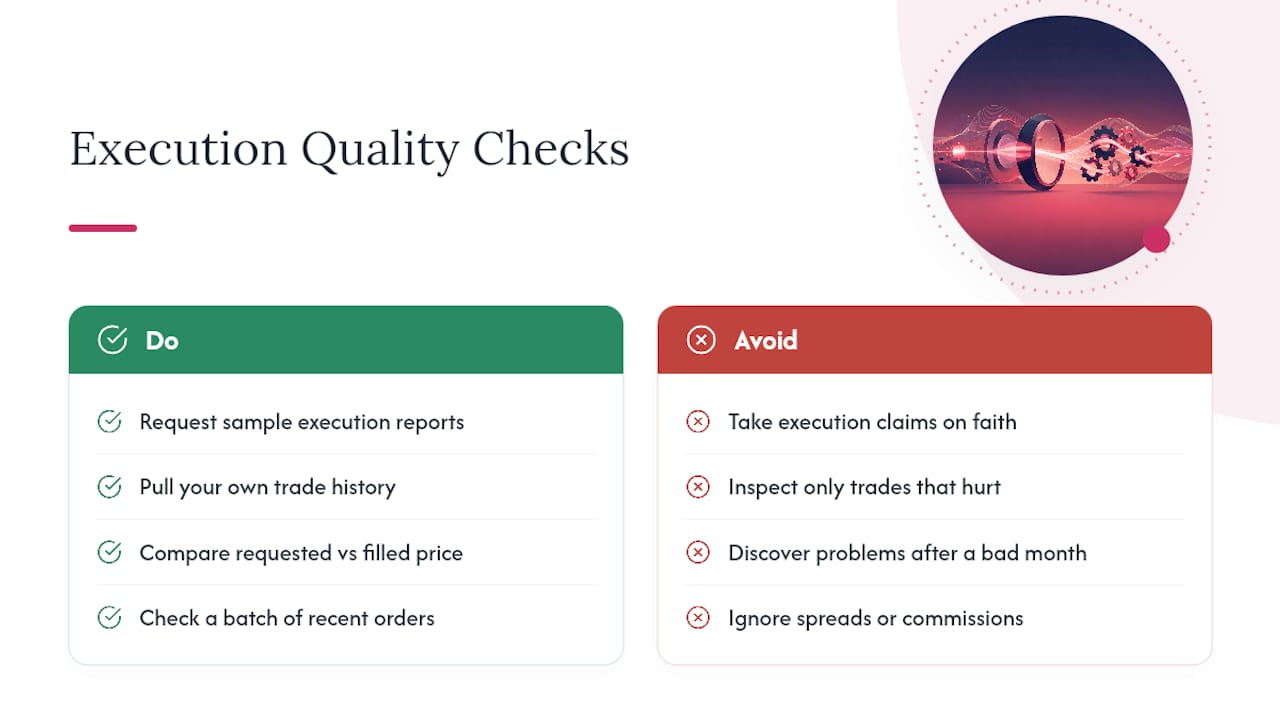
Execution speed and tight spreads aren’t marketing lines. They’re measurable, and you should measure them. Cubomarkets positions its execution around spreads starting at 0.0 pips with zero commission and has processed over 3 million executed orders, numbers worth checking against your own fill history rather than taking on faith.
The way to verify any broker’s execution claim is to request sample execution reports or pull your own trade history and compare requested price to filled price on a batch of recent orders. Real-time analytics, the kind Cubomarkets builds into its platform, let you see this pattern forming instead of discovering it after a bad month. Ask what your average realized slippage looks like across your last 50 trades, in both directions, not just the ones that hurt.
Why Most Traders Get Slippage Backwards
Most retail traders treat slippage as bad luck, something that happens to them rather than something they can budget for. That’s backwards. Institutional desks build slippage into their cost models before they ever place a trade, the same way they’d budget for commission. Retail traders who do the same, tracking average realized slippage the way they track win rate, tend to make better order-type decisions under pressure.
The bigger blind spot is assuming slippage only matters on entries. Exits during a stop-out are where slippage does the most damage, because that’s precisely when volatility is highest and liquidity is thinnest. A trader who’s disciplined about limit orders on entry but sloppy about exit protection during news events is solving half the problem.
— Cubo
Key Takeaways on Managing Trading Slippage
Slippage is a permanent feature of trading, not a glitch to eliminate. Control it through order type, trade timing, and position sizing instead.
| Lever | Action | What to check |
|---|---|---|
| Order type | Use limit orders or GSLOs near news | Fill risk vs. price certainty |
| Timing | Trade during high-liquidity hours | Session overlaps, news calendar |
| Sizing | Split large orders | Book depth or pool liquidity |
If you’re ready to put these fixes into practice, explore Cubomarkets trading accounts for forex, crypto, and commodities execution built around tight spreads and fast fills.
Sources
This article is general information, not a substitute for advice from a qualified financial advisor. Consult a qualified financial professional about your own circumstances before acting on anything here.