Skip to content
Overnight financing, also called a swap or rollover fee, is what a broker charges (or occasionally pays you) for holding a leveraged CFD position past its daily cut-off. It’s calculated on the full position size, not just your margin, and applies whenever you keep a trade open overnight. Whether you owe money or collect it depends on your direction (long or short) and where reference rates sit. The rest of this guide breaks down the formula, the per-asset differences, and how to cut the cost.
TL;DR:
- Overnight financing fees are calculated on the full notional value of a CFD position using reference rates plus a broker markup, affecting both longs and shorts.
- Asset class differences mean forex rates depend on currency interest-rate differentials, while shares may incur borrow fees on short positions, and crypto costs are often hidden in spreads.
- Brokers typically apply rollover charges at a daily cut-off time around 5:00 PM Eastern, with triple rollover charges on weekends and holidays to cover multiple days.
- Holding a $22,000 forex position at 7.5% annual rate costs about $4.52 daily, and triple rollover days can raise the cost to over $13.
- Traders can reduce fees by closing positions before cut-off, minimizing leverage, choosing long-term structures like ETFs, or verifying broker rates beforehand.
Table of Contents
- How does overnight financing on CFDs actually work?
- Why do fees differ across forex, indices, shares, and crypto?
- When exactly do overnight fees get applied?
- What do overnight fees look like in real numbers?
- How can you reduce or avoid overnight fees?
- Where can you check a broker’s published overnight rates?
- What we think about financing transparency at Cubomarkets
- See real overnight rates before you trade
- Sources
How does overnight financing on CFDs actually work?
CFDs let you control a position much larger than your deposit. That gap between your margin and the full trade size is effectively financed, and the broker charges for carrying it past one trading day. This is why the fee is calculated on notional value, not on the cash you put down.
The standard formula looks like this:
Daily financing = Notional value × (Reference rate ± broker markup) / 365
Long positions typically pay the reference rate plus the broker’s markup. Short positions sometimes receive a credit if the reference rate exceeds the markup, though many brokers still charge shorts a smaller fee depending on the instrument.
A few mechanics worth knowing:
- Brokers benchmark against overnight rates like ESTR (euro), SOFR (US dollar), and SONIA (British pound), depending on the currency the instrument is quoted in.
- On top of the benchmark, brokers add an annualized markup, commonly a small annual percentage markup, which is where most of the retail cost actually comes from.
- Share CFDs can carry an extra stock-borrow fee layered on top of standard financing, particularly on shorts.
That markup is the real lever. Two brokers referencing the same SOFR rate can charge noticeably different overnight costs purely based on how much they add on top.
Why do fees differ across forex, indices, shares, and crypto?
Not every asset class prices financing the same way, and the differences are bigger than most traders assume.
Forex funding runs on interest-rate differentials between the two currencies in the pair. If you’re long a currency with a higher rate against one with a lower rate, you may actually collect a credit rather than pay one.
Indices and commodities get funded off the interest rate tied to the currency the contract is quoted in, plus the broker’s markup. There’s no interest-rate differential here since you’re not trading one currency against another; it’s a single-sided cost layered onto the underlying rate.
Shares introduce a wrinkle: shorting a stock that’s expensive to borrow can trigger a borrow-fee surcharge on top of standard overnight financing. Heavily shorted stocks can carry meaningfully higher costs than a typical long position in the same name.
Crypto CFDs behave differently again. Funding sources aren’t a clean benchmark-plus-markup formula the way forex is. Costs often hide inside wider spreads and price impact rather than a clearly labeled swap line, which means funding can look asymmetric between long and short positions in ways that catch traders off guard.
- Forex: rate differential between the two currencies, can be a credit or a charge
- Indices/commodities: single-sided rate plus markup, tied to quote currency
- Shares: standard financing plus possible borrow-fee surcharge on shorts
- Crypto: costs often embedded in spread and price impact rather than a flat swap rate
When exactly do overnight fees get applied?
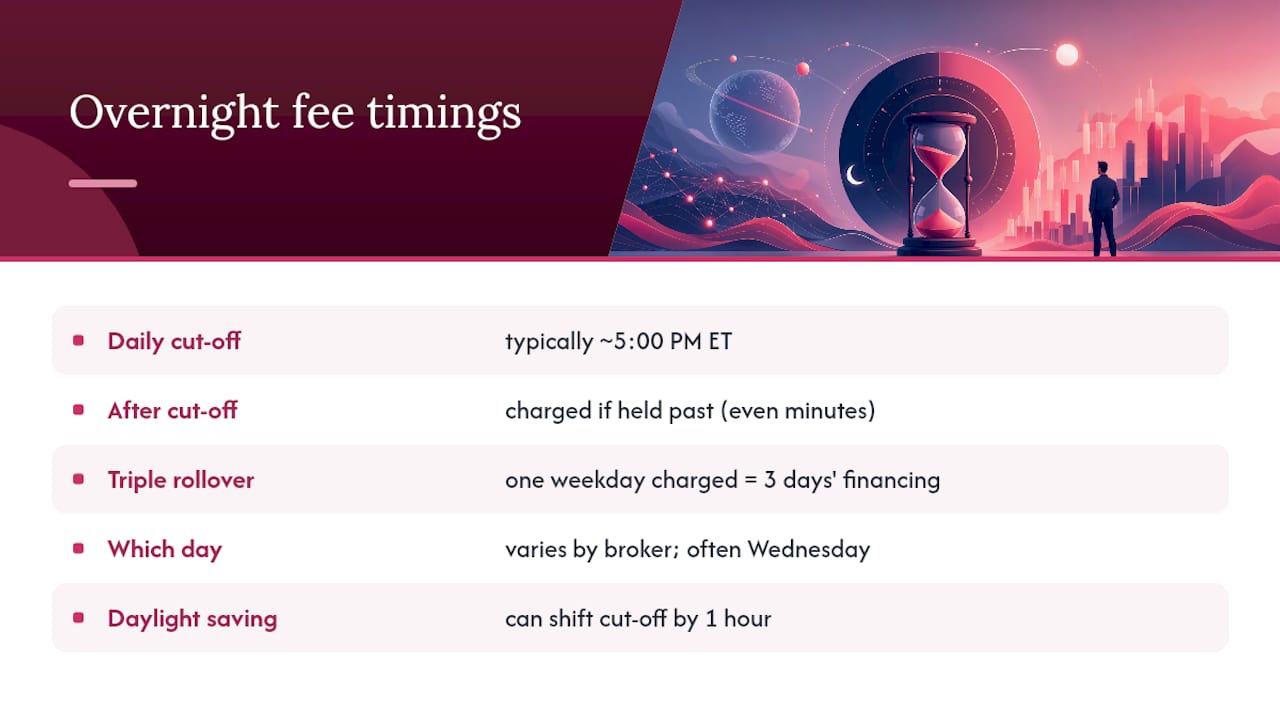
Every broker sets its own daily cut-off time, typically somewhere around 5:00 PM Eastern Time, though this varies by broker and by instrument. Hold a position past that moment and you’re charged for the night, even by a few minutes.
To account for weekends, most brokers apply a triple rollover on one weekday, charging three days’ worth of financing at once. Which day gets tripled varies. Some use Wednesday, but plenty don’t, so check your broker’s own schedule rather than assuming. Daylight saving shifts can also nudge the cut-off time by an hour depending on your broker’s home time zone, so it’s worth rechecking twice a year.
What do overnight fees look like in real numbers?
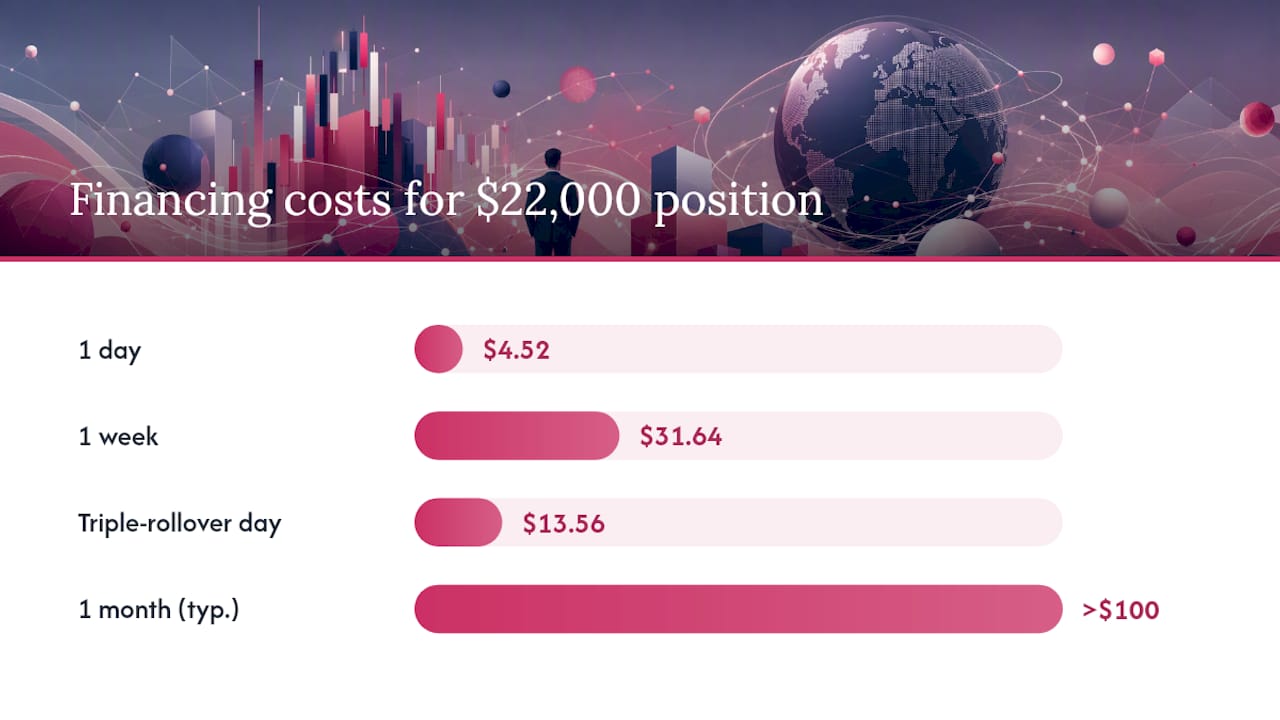
Numbers make this concrete fast. Take a forex position: a $22,000 notional long trade at an effective annualized funding rate of 7.5% costs roughly $4.52 per day. Hold it for a full week and the financing cost accumulates accordingly, before any price movement.
A share CFD short adds a borrow-fee wrinkle. The net effect flips what would have been a credit into a net charge of around $0.55 a day, or roughly $16.50 over 30 days.
Weekend triple rollover multiplies whatever your daily rate is by three on the charged day. On that same $22,000 forex position, the triple day alone runs about $13.56 instead of $4.52.
A $22,000 position at a 7.5% effective rate costs about $4.52 a day. Multiply that across a month of holding and financing alone can become a significant cost, often over a hundred dollars, which is why swing traders need to price this in before entering, not after.
How can you reduce or avoid overnight fees?
You have more control over this cost than most traders realize.
- Close before the cut-off if you’re day trading. No overnight hold means no financing charge at all.
- Reduce leverage or position size. Smaller notional means a smaller daily charge, even at the same rate.
- Use spot, ETFs, or futures for long-term holds. CFDs are built for short-to-medium-term positioning; multi-week or multi-month holds often cost less through other structures.
- Check swap-free accounts carefully. They remove the daily financing line but usually build the cost into spreads or add a flat administration fee instead.
- Verify the effective rate behind any “zero-fee” marketing claim. A fee that isn’t labeled financing can still be embedded in the spread.
Pro Tip: Before entering a multi-day swing trade, calculate the financing cost as a percentage of your margin, not your notional. A small daily charge can eat a large chunk of a modest expected return once leverage is factored in.
Where can you check a broker’s published overnight rates?
Every regulated broker publishes its financing figures somewhere, usually under labels like “swap rates,” “overnight financing,” or “funding rate,” typically listed as an annualized percentage per instrument.
To make sense of them:
- Divide the published annualized rate by 365 to get your daily charge, then apply it against your actual notional.
- Confirm the exact daily cut-off time listed on the broker’s help pages. This affects the practical value of the rate more than the rate itself in some cases.
- Compare the reference benchmark used, the markup added on top, and any separate stock-borrow line for shares.
- Convert annualized figures to daily terms before comparing two brokers side by side; a headline rate alone tells you very little.
Cubomarkets lists financing details on its trading accounts pages by instrument, and it’s worth reviewing them against your intended holding period before you size a position.
What we think about financing transparency at Cubomarkets
Financing costs shouldn’t be a surprise line item discovered a week into a trade. Cubomarkets publishes its rates by instrument so you can check the number before you’re exposed to it, not after. Our stance is simple: match your holding period to the right product, and price in funding before you open the position, not once it’s already running against you.
— Cubo
See real overnight rates before you trade
Reading the formula is one thing; seeing your actual numbers is another. Cubomarkets publishes swap and financing figures by instrument across forex, commodities, and crypto, so you can check the daily cost of a position before you open it rather than finding out after your statement updates.

If you want to see how these rates behave on live pricing without risking capital first, a Cubo Markets trading account gives you access to a demo environment where the published financing schedule updates in real time alongside spreads starting at 0.0 pips. Open one, pull up the instrument you’re watching, and run the math on your own position size before you commit to holding it past the cut-off.
Sources
- CFD Overnight Financing: How Daily Costs Accumulate — Derivatives Journal
- What Are Overnight Fees in CFD Trading? Examples Explained — TradingCritique
- What are swap fees? Network, provider and hidden costs explained — Trust Wallet
This article is general information, not a substitute for advice from a qualified financial advisor. Consult a qualified financial professional about your own circumstances before acting on anything here.