Skip to content
An index CFD is a contract that pays you the difference between an index’s opening and closing price, without you ever owning the underlying stocks. Traders use it to speculate intraday, hedge a portfolio, or take short-term directional bets on markets like the US 30 or Germany 40. The trade-off is leverage: it multiplies gains, but it multiplies losses just as fast, and spreads plus overnight financing quietly erode returns on positions held too long.
TL;DR:
- Carefully check the contract specification, including spread, overnight financing, point value, and margin requirements, before trading each index CFD.
- Spreads tend to widen significantly during major news events and at market open or close, increasing trading costs and slippage risk.
- Holding positions overnight can incur financing charges or adjustments for dividends, which vary based on broker policies and interest rate differentials.
- Use proper position sizing based on your stop distance and cash risk, especially when volatility spikes above its normal range, to prevent excessive losses.
- Prioritize testing your trade execution, slippage, and cost estimates using a demo account before risking real money to avoid surprises.
Table of Contents
- What Index CFDs Are and How They Work
- Trading Conditions: Spreads, Financing, Dividends, and Leverage
- How to Trade Index CFDs Step by Step
- Market Hours, Liquidity, and Where to Watch Live Prices
- Advantages and Risks of Index CFD Trading
- Practical Habits That Separate Consistent Traders From Everyone Else
- Why Most Beginners Get the Risk Backward
- Open a Cubo Markets Account and Start Trading Index CFDs
- Sources
What Index CFDs Are and How They Work
An index CFD tracks the value of a stock index, such as the US 500 or Italy 40, without giving you a claim on any of the underlying shares. You open a position, the price moves, and your account is credited or debited the difference between entry and exit. No dividends land in your account directly and no shareholder rights come attached, but the price still reflects what the index does.
Providers offer two structures. Cash (spot) CFDs mirror the index’s real-time value and typically carry a daily financing charge because there’s no fixed expiry. Futures-based CFDs track a quarterly futures contract and roll over to the next contract on a set schedule, which can mask true holding costs inside a “continuous” chart if you’re not watching the rollover date.
Before opening either type, pull up the contract specification. It matters more than most beginners assume, since it decides your actual cost per trade:
- Symbol and index name (confirm it matches the market you intend to trade)
- Point value (how much a one-point move is worth per lot)
- Minimum trade size and margin requirement
- Spread and whether commission applies on top
- Overnight financing rate and dividend adjustment policy
Dukascopy’s index CFD documentation walks through these overnight and dividend mechanics in detail, and it’s worth reading once before you place a real trade.
Trading Conditions: Spreads, Financing, Dividends, and Leverage
Cost drivers on index CFDs aren’t fixed. They shift by session, by news event, and by how long you hold a position, so treat this as an operational checklist rather than background reading.
- Spreads widen around news. Spreads on major indices are tightest during peak session overlap and can widen sharply in the seconds around a central bank decision or jobs report. Scalpers feel this first, since a spread that doubles for thirty seconds can wipe out a tight-target trade before it even breathes.
- Overnight financing runs both ways. Holding a long position past the daily cutoff usually means paying a financing charge; holding short can sometimes mean receiving one, depending on the underlying interest rate differential and the broker’s swap policy.
- Dividend adjustments hit on ex-dividend dates. When a constituent stock goes ex-dividend, index CFD providers apply a cash adjustment to open positions to reflect the index’s expected drop, which is a normal mechanic, not a fee.
- Margin and leverage set your exposure. A margin requirement means a small deposit controls a larger notional position, and if losses erode your margin past the broker’s maintenance level, a margin close-out liquidates the position automatically.
Pro Tip: Check the exact spread, financing rate, and margin percentage on your broker’s own contract spec page before every new index you trade. Generic numbers you saw in a forum post rarely match what you’ll actually pay.
How to Trade Index CFDs Step by Step
Trading an index CFD well is less about predicting direction and more about controlling the mechanics around your bet. Here’s the sequence experienced traders actually follow.
- Pick the index and the instrument type. Decide whether you want a cash CFD for tight intraday moves or a futures-based CFD for a multi-week swing trade with a known rollover date.
- Read the full contract spec. Confirm point value, minimum size, margin, spread, and financing before you type in a trade size, following the same discipline Audacity Capital’s trading guide recommends for beginners.
- Choose your order type. Use limit orders to enter at a specific level during calm conditions, and be cautious with market orders around scheduled news, since slippage on liquidity-sensitive indexes spikes exactly when volatility does.
- Size the position from your stop distance. A simple formula: divide your maximum acceptable dollar risk by (stop distance in points multiplied by point value) to get your position size in lots.
- Run the execution checklist before going live:
- Rehearse the exact setup on a demo account first
- Measure your realized slippage on a handful of test entries
- Avoid opening new positions in the ten minutes around major scheduled releases
- Confirm your stop and target are set before, not after, you click confirm
Market Hours, Liquidity, and Where to Watch Live Prices
Cash indices generally trade during their underlying exchange’s hours, while futures-based CFDs on the same index often quote almost around the clock, since the futures market itself never fully closes overnight. That difference explains why you’ll sometimes see a futures-based quote move overnight while the cash version sits flat until the exchange reopens.
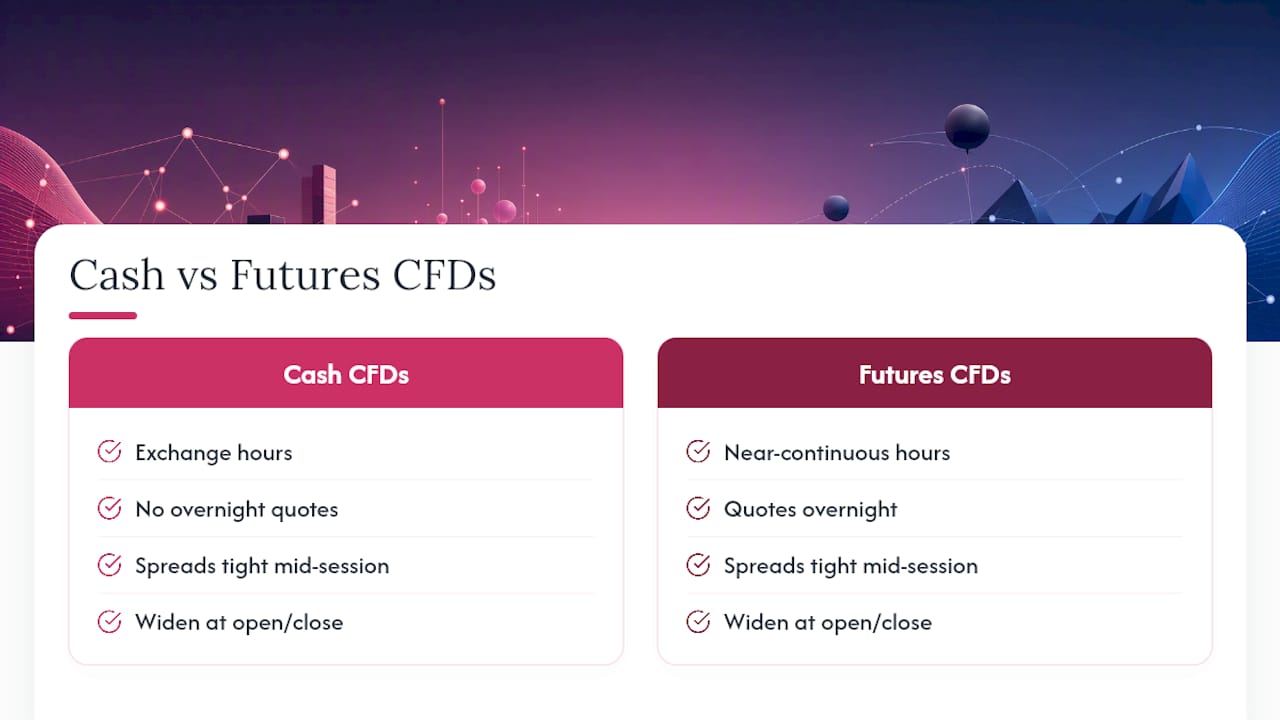
Liquidity isn’t constant even within a single session. Spreads tend to be tightest mid-session, widen at the open and close as order flow surges, and widen further overnight or during low-volume holiday periods when fewer market makers are quoting actively.
For live pricing, Investing.com’s index CFD data streams last price, daily high and low, percentage change, and a timestamp for major indices like the US 30 and Germany 40, which is a fast way to sanity-check your broker’s quote against the broader market. When you look at continuous charts around a futures rollover date, remember the price series can show an artificial jump that has nothing to do with market direction.
Pro Tip: Track your realized slippage across the last 10 to 12 similar news events on the specific index you trade, then cut your position size whenever current volatility runs above where it usually sits historically. That single habit catches more damage than any indicator ever will.
Advantages and Risks of Index CFD Trading
Index CFDs give you broad market exposure through a single position instead of buying dozens of individual stocks, and you can go short just as easily as long, which matters when an index is trending down. Margin trading also means your capital goes further per position than buying the underlying shares outright would.
The risks sit on the other side of that same leverage. A common industry rule of thumb is to reduce position size once realized volatility on your index climbs past its own historical 75th percentile, since that’s usually when spread widening and slippage do the most damage to a plan built on calmer assumptions.
Three risks deserve specific mitigations:
- Leverage risk: size positions by cash risk and stop distance, never by “how many lots feels right”
- Broker/counterparty risk: trade with a regulated provider and read its AML and client-fund policies before funding an account
- Financing and rollover surprises: check the overnight rate and rollover schedule before holding any position past a single session
A written trading plan with a daily drawdown limit stops one bad session from turning into a blown account, and a demo account lets you test all of this before a single dollar is at risk.
Practical Habits That Separate Consistent Traders From Everyone Else
The traders who last are the ones who treat execution as a skill, not an afterthought. A written plan you actually follow beats a brilliant idea you abandon under pressure, and measuring your own slippage tells you more about your real edge than any backtest.
- Lock a trading plan with entry, stop, and target defined before you place the order, not after
- Test new setups on a demo account during live news before risking real capital on them
- Reduce size the moment realized volatility on your index breaks above its usual historical range
- Reconcile your actual fill price against the quote you saw, every single time, until it becomes automatic
A platform’s execution speed and spread quality only matter if you’re disciplined enough to use them well. Cubo Markets built its offering around fast order execution and spreads starting at 0.0 pips specifically because slippage and delayed fills are what quietly punish traders who otherwise have a sound plan, and its demo accounts plus AML policy give newer traders a way to build that discipline before funding a live account.
Pro Tip: Keep a simple log of your intended entry price versus your actual fill for your first twenty trades. If the gap is consistently more than a point or two on a liquid index, the problem is your execution setup, not your strategy.
Why Most Beginners Get the Risk Backward
Most new traders obsess over which direction an index will move and barely glance at the contract spec that determines what they’re actually paying to be wrong or right. That’s backward. The research on index CFDs consistently points to cost mechanics, financing rates, dividend adjustments, rollover timing, as the quiet drag that turns a directionally correct trade into a losing one.
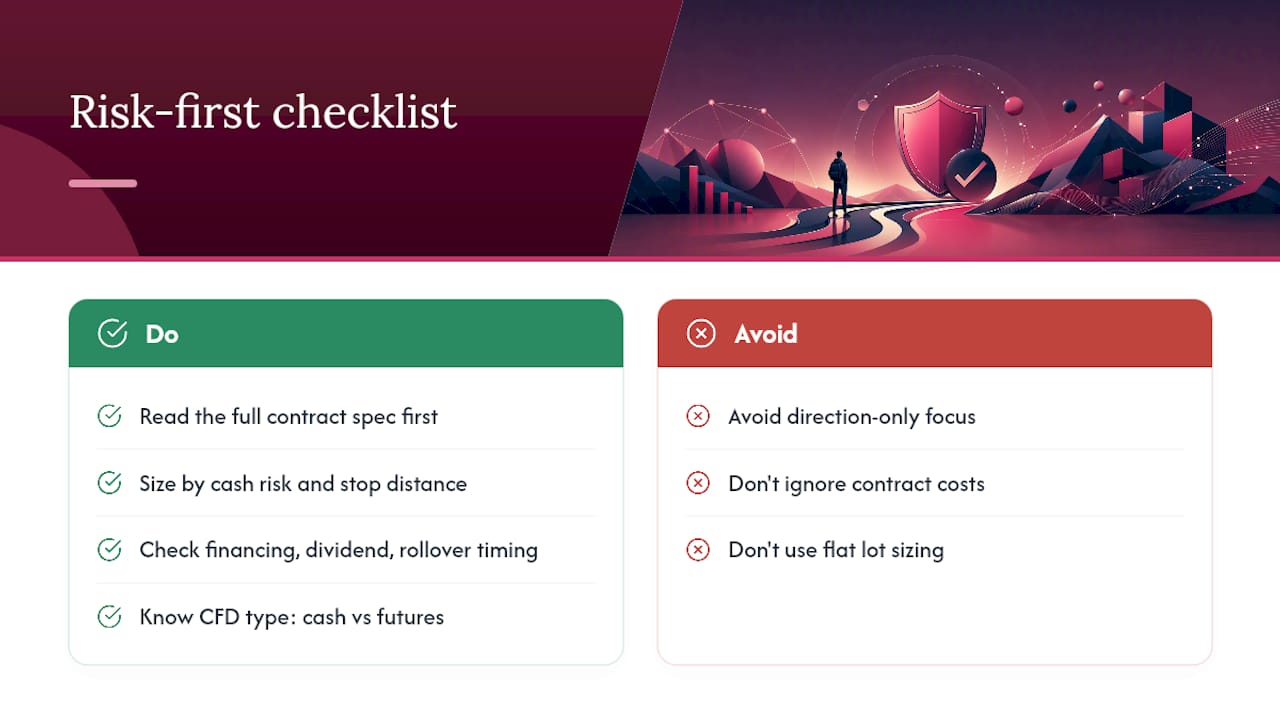
The conventional advice to “manage your risk” is true but useless without a number attached. Sizing by cash risk and stop distance, not by a flat lot size that feels comfortable, is the actual skill. So is knowing whether you’re holding a cash CFD accumulating daily financing or a futures-based CFD approaching a rollover date, because those two instruments have different cost profiles even when they track the same index.
If there’s one thing to prioritize before anything else, it’s this: read the full contract spec before you read the chart. The chart tells you what might happen. The spec tells you what it costs to be there when it does.
— Cubo
Open a Cubo Markets Account and Start Trading Index CFDs
Ready to put the contract-spec checklist into practice? Cubo Markets gives you a direct path: open a free demo account, run your execution checklist against live index prices with zero financial risk, then move to a live account once your fills and slippage numbers look the way you expect.

The platform supports MetaTrader 5 alongside its own WebTrader, with spreads starting at 0.0 pips and zero commission on index CFDs, so the cost side of your plan stays predictable instead of eating into a trade you got right. Every account opening runs through Cubo Markets’s AML and customer due diligence policies, so fund conservatively at first and treat your opening deposit as tuition for learning the platform, not your full trading stake.
When you’re ready, open a trading account and start with the demo mode before committing real capital to your first index position.
This article is general information, not a substitute for advice from a qualified financial advisor. Consult a qualified financial professional about your own circumstances before acting on anything here.