Skip to content
News trading means using scheduled or unscheduled market-moving announcements to build short-duration trades, and it works only when you define entry, exit, and risk before the event fires. It fits high-impact scheduled releases like Nonfarm Payrolls, CPI prints, earnings, and central-bank statements, where the gap between what the market expects and what actually gets printed drives the move. The catch is real: volatility spikes, spreads widen, and whipsaws punish anyone without a pre-set plan.
TL;DR:
- Spreads can widen significantly and liquidity drops for seconds after major releases, increasing slippage and requiring quick, pre-planned exits.
- Using pending orders like buy-stop and sell-stop is essential, with tight stop-loss and profit targets set before the event to manage rapid price swings.
- Strategies such as straddles, fades, and directional trades depend on market conditions, with risks including whipsaws and execution delays that can erode gains.
- Broker execution speed plays a crucial role in timely fills; testing platforms with low-impact trades beforehand helps assess real-time performance.
- Asset class differences mean forex favors tight straddles, while stocks, commodities, and crypto respond differently to news, demanding tailored approaches.
Table of Contents
- What Is a News Trading Strategy and How Does the Market React?
- How Do You Prepare to Trade a News Event?
- Which Core News Trading Strategies Actually Work?
- How Do You Execute a News Trade in Real Time?
- What Risk Management Rules Protect You From Whipsaws?
- Do Forex, Stocks, Commodities, and Crypto Trade News the Same Way?
- What Do Historical News Trades Teach New Traders?
- Why Does Your Broker’s Execution Speed Matter During News Events?
- How Much Does News Reliability Affect Your Trading Decisions?
- How Are Technology and Automation Changing News Trading?
- Should You Trade News Short-Term or Build a Longer Position?
- A Realistic Take on Skill and Returns
- Get Started Trading News With Cubo Markets
- Sources
What Is a News Trading Strategy and How Does the Market React?
News trading tries to capture the price move that happens when an economic release or announcement differs from what the market already priced in. The number itself matters less than the gap between consensus and the actual print. A Nonfarm Payrolls report that meets expectations often produces a shrug. One that misses by a wide margin can send a currency pair through fifty pips in under a minute.
Scheduled events behave differently from unscheduled ones. A Federal Reserve statement has a known release time, so liquidity providers pull back their quotes in the seconds before it drops, then flood back in once the headline number hits the wire. Unscheduled shocks, like a surprise geopolitical event or a flash crash, don’t give you that warning, which is why reaction speed matters more there than positioning ahead of time.
Three things change the moment a major release hits:
- Spreads widen, sometimes dramatically, as market makers protect themselves from being run over.
- Liquidity thins out for a few seconds even on major pairs, so slippage on market orders gets worse.
- Broker execution policies shift, and some platforms briefly freeze quotes or requote orders during the highest-volatility window.
How Do You Prepare to Trade a News Event?
Preparation separates a repeatable strategy from a coin flip. Start with an economic calendar and read the consensus estimate next to the previous reading, not just the headline forecast. The gap between consensus and actual is what moves price, and checking market liquidity and broker execution policy ahead of the event tells you whether your plan is even executable at the speed you need.
Run this checklist before every high-impact release:
- Confirm the exact release time and time zone, and note the consensus, previous, and range of analyst estimates.
- Check your broker’s historical spread behavior around similar past releases, not just the current spread.
- Decide your timeframe (scalp the first minute, or hold through the first 15 minutes) before the number drops.
- Set your maximum capital at risk for the trade as a fixed percentage of your account, written down, not decided in the moment.
- Write your exit rules, both profit target and stop loss, on paper or in a trade log before you place any order.
Pro Tip: Test your broker’s real-world spread widening on a low-impact release first, like a minor regional PMI, before you risk capital on a Nonfarm Payrolls or CPI print.
Which Core News Trading Strategies Actually Work?
Most repeatable news trading strategies fall into four buckets, and the right one depends on whether you have a directional view or want to stay neutral until the market shows its hand.
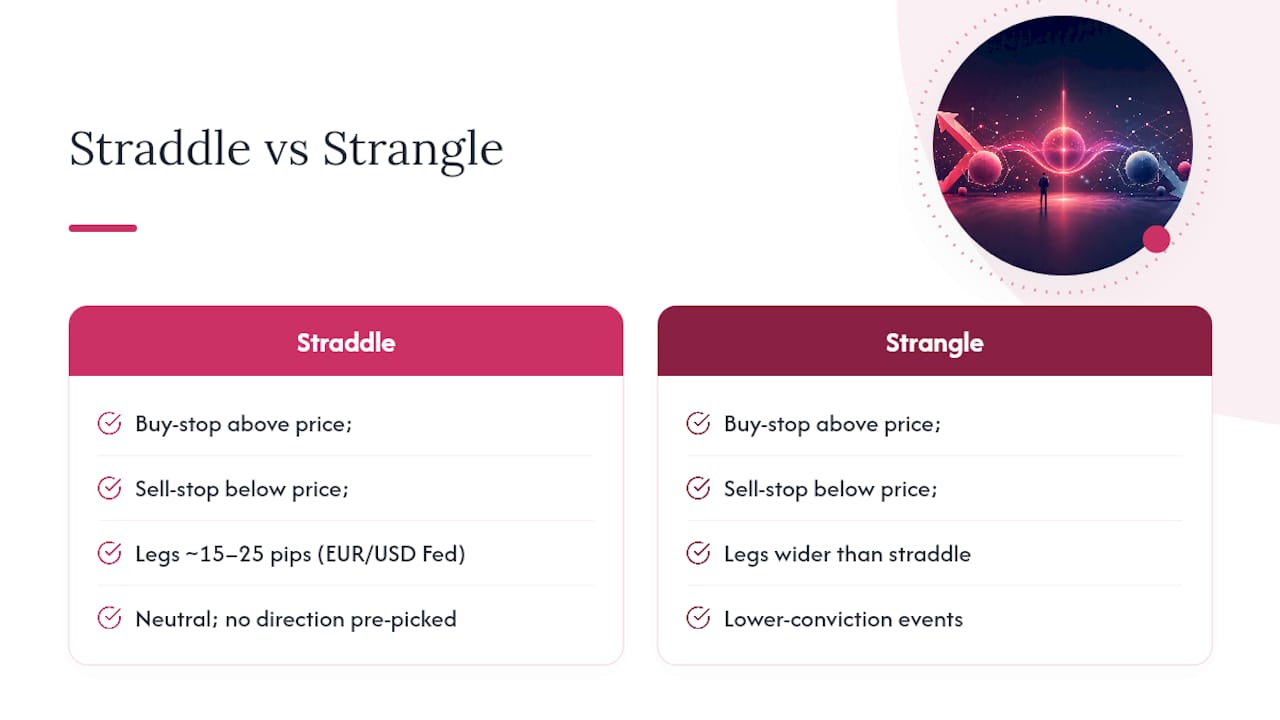
The straddle and strangle. This is the classic neutral approach for trading news events without picking a direction. You place a buy-stop order above current price and a sell-stop order below it a few minutes before the release, then cancel the leg that didn’t trigger once the other one fires. Leg distance depends on the instrument’s typical pre-release range. On EUR/USD around a Fed decision, traders often set legs 15 to 25 pips from market price. Too tight and normal pre-release noise triggers both legs; too wide and you miss smaller but tradeable moves. A strangle uses a similar structure with wider, more conservative spacing for lower-conviction events.
The fade. Fading the initial spike works when the first move is a headline-driven overreaction with no fundamental follow-through. This shows up often after earnings calls, when algorithms react to a single beat-or-miss line before anyone reads the guidance section. You wait for the initial spike to stall, look for a reversal candle on a short timeframe, and enter against the exhausted move with a tight stop just past the spike’s high or low.
Directional bias trades. If you have a defensible view, say you think a central bank is under-pricing a hawkish shift, you position ahead of the release with a wider stop and let the trade run through the volatility instead of scalping it. This carries more risk because you’re wrong-footed if the print surprises against your thesis, so size down accordingly.
Spike and momentum plays. Once the initial direction confirms, quick momentum entries with tight targets can ride the second leg of the move. These are fast trades, often closed within a few minutes, built for traders who prefer many small wins over one large position.
Straddle setups can suffer whipsaw when both legs trigger during indecisive, choppy price action right at the release, which is one of the most common failure modes in news trading.
If your broker prohibits hedging or enforces FIFO order rules, you can’t hold two opposing pending orders at once. The workaround is a close-and-cancel method: place a limit order in one direction, and if price moves against your expected direction, close that position and immediately open a reverse order rather than holding both simultaneously.
How Do You Execute a News Trade in Real Time?
Execution is where most news trading strategies fall apart, not in the planning. Order type choice matters as much as direction.
- Use buy-stop and sell-stop pending orders for straddles, never market orders, since market orders during the release window can fill you far from your intended price.
- Set your stop-loss on the triggered leg immediately, calculated as a fixed distance or percentage of account equity, and place it before you do anything else.
- Cancel the untouched leg the moment the first order fills, using a one-cancels-other setup if your platform supports it.
- Set a take-profit target based on the instrument’s typical post-release range, not a round number pulled from habit.
- Watch the spread for the first 10 to 15 seconds after the release before adding to a position; entering during the widest spread window erodes your edge before the trade even starts.
Sample template: On a 5-minute EUR/USD straddle around a CPI release, legs at 20 pips from market price, stop-loss 10 pips beyond each entry, take-profit at 30 pips, cancel the unfilled leg on trigger.
Pro Tip: Slippage during the first few seconds after a major release is often worse than the spread itself. Building a small buffer into your stop-loss distance, rather than placing it at the exact technical level, keeps normal post-release noise from stopping you out early.
What Risk Management Rules Protect You From Whipsaws?
Position sizing is the first line of defense.
Whipsaw, where both legs of a straddle trigger because price whips through both entries before settling, is the single biggest source of unplanned loss in this style of trading. A two-stop approach helps: set a tight profit target on the triggered leg so it can lock in a small gain even if the market immediately reverses, rather than holding out for a bigger move that may never arrive.
Know when to sit out entirely:
- Skip any event where analyst estimates are unusually scattered, since a wide range of forecasts signals genuine uncertainty rather than a clean surprise setup.
- Avoid trading through events where your broker has a history of freezing quotes, since you can’t manage a position you can’t execute against.
- Reduce or skip size around overlapping high-impact releases, where two data points hitting minutes apart make the source of any move impossible to isolate.
Do Forex, Stocks, Commodities, and Crypto Trade News the Same Way?
The underlying logic holds across asset classes, but execution details shift enough that copying a forex setup onto crypto will get you burned.
- Forex rewards tight straddle leg distances and is where the straddle/strangle approach is most established, though spreads on major pairs can still double or triple for a few seconds around a release.
- Equities react to earnings and forward guidance more than the headline beat or miss, and options implied volatility often tells you more about expected move size than the stock chart does.
- Commodities digest news slower, particularly inventory reports and geopolitical shocks, since supply chain effects take hours or days to fully price in rather than seconds.
- Crypto trades 24/7 with a higher baseline volatility even without news, so exchange-specific liquidity gaps can turn an ordinary release into an outsized move on thinner venues.
What Do Historical News Trades Teach New Traders?
A Federal Reserve speech in past cycles has repeatedly triggered exactly the kind of cross-asset repositioning that makes a poorly-timed straddle dangerous: both legs can trigger within seconds as algorithms parse hawkish versus dovish phrasing in real time.
- Central-bank speech example: rapid two-sided moves around policy remarks show why a straddle needs a tight secondary stop, not just a wide initial one.
- Earnings spike example: a strong headline earnings beat followed by cautious guidance often produces an initial spike that fades within minutes, rewarding a patient fade over a chase.
- Takeaway: the first candle after a release rarely tells the full story; rules built around the second and third candle tend to hold up better across events.
Why Does Your Broker’s Execution Speed Matter During News Events?
Execution speed decides whether your carefully planned entry actually happens at the price you calculated. A platform with slow order routing turns a well-designed straddle into a guessing game the instant volatility spikes.

Cubomarkets is built around this exact problem: spreads starting at 0.0 pips, zero commission, and execution engineered to reduce the slippage and delayed fills that quietly wreck news trading strategies. The platform has processed more than 3 million executed orders, which matters here specifically because news trading punishes any broker whose infrastructure slows down right when speed matters most.
Test any broker, Cubomarkets included, the same way:
- Place a handful of small trades around a low-impact release and time the fill against the quoted price.
- Compare the spread at rest versus the spread in the ten seconds after the number drops.
- Check whether pending orders trigger at your set price or slip noticeably beyond it.
How Much Does News Reliability Affect Your Trading Decisions?
Not every headline deserves a trade. The source of the news matters as much as the content, because a rumor from an unverified social account moves price differently than a confirmed print from a statistical agency.
Primary sources, the actual central bank release, the government statistics office, the exchange filing, carry no editorial lag and no interpretation layer. Secondary sources, financial news wires and TV tickers, add speed but sometimes trade accuracy for being first. A headline that gets walked back twenty minutes later can trap traders who acted on the first version.
Build a habit of ranking your sources before you ever need to act on one. Treat a central bank’s own press release as ground truth, treat a major wire service as fast but occasionally rough, and treat social media chatter as a signal to watch, not a signal to trade. The 2023 UK gilt market reaction to unconfirmed reports, later corrected, is a reminder that acting on unverified news can cost more than waiting three extra seconds for confirmation.
This matters more in thinner markets. Calibrate your reaction speed to how reliable the source has proven over time, not to how urgent the headline feels in the moment.
How Are Technology and Automation Changing News Trading?
Automation has moved from a professional-only edge to something retail traders can access directly. News-parsing algorithms now scan headlines and release data in milliseconds, which is part of why the first few seconds after a major print often show the sharpest move: machines react before most humans finish reading the number.
For an individual trader, this shows up in a few practical ways. Economic calendar apps push real-time consensus and actual figures straight to your phone, removing the need to refresh a browser tab. Trading platforms increasingly support one-cancels-other order structures natively, which used to require manual cancellation of the losing straddle leg. Alert systems can flag when a print deviates from consensus by a set margin, giving you a faster read than scanning a headline yourself.
The risk with automation is treating it as a replacement for judgment rather than a speed advantage. An algorithm executes your rules faster than you can click, but it still runs the rules you gave it. If your straddle leg distance is wrong for the instrument, automation just helps you lose money faster. The traders who benefit most from automation are the ones who already backtested their rules manually and use technology to remove execution lag, not to skip the thinking stage entirely.
Should You Trade News Short-Term or Build a Longer Position?
Short-term news trading, the scalps and same-day straddles this guide focuses on, aims to capture the immediate volatility spike and close the position within minutes to a few hours. It demands fast execution, tight risk control, and the willingness to sit through several small losses while waiting for the setups that actually work.
Longer-term approaches use news differently. Instead of trading the spike itself, you use the release as confirmation or invalidation of a thesis you already hold, then hold the position for days or weeks. An earnings report that confirms a company’s guidance trend might reinforce a swing position rather than trigger a new scalp. A central bank signaling a sustained policy shift matters less for the next five minutes of price action and more for the next several months of trend direction.
The trade-offs run in opposite directions. Short-term news trading needs less capital tied up per trade but demands constant attention and fast decision-making under pressure. Longer-term positioning around news needs patience and a wider stop to survive the same volatility that a short-term trader is trying to exploit directly, but it doesn’t require you to be at your screen the second a release drops.
Most traders end up doing both, using short-term news trades for scheduled high-impact events and letting unscheduled news simply confirm or challenge positions already built around a longer thesis.
A Realistic Take on Skill and Returns
News trading is a repeatable skill, not a lottery ticket, but only if you size small early and treat every trade as data. Keep a journal, backtest your setups across past events, and scale up only once your edge survives dozens of trades. Go demo first, then small live, then bigger, in that order.
— Cubo
Get Started Trading News With Cubo Markets
Speed is the one variable in this whole strategy you can’t fix with better rules, and it’s exactly where Cubomarkets is built to help: spreads from 0.0 pips, zero commission, and order execution engineered for the exact moment volatility spikes matter most. That combination is what separates a straddle that fills where you planned from one that slips past your entry before you can blink.

The platform runs on MetaTrader 5 and WebTrader, giving you the charting and order-type flexibility a proper straddle or fade setup needs across forex, commodities, and crypto instruments. If you want to test the execution templates in this guide without risking capital first, open a demo trading account and run a predefined straddle setup against the next scheduled release on your calendar.
Sources
Follow a primary economic calendar for release times and consensus data, and check central-bank and statistical-agency sites directly for raw policy statements rather than relying only on wire-service summaries.
This article is general information, not a substitute for advice from a qualified financial advisor. Consult a qualified financial professional about your own circumstances before acting on anything here.
- News Trading Strategies | How To Trade The News
- Straddle Trading Forex Strategy To Trade Forex News – ForexCracked
- The Straddle Trade: How to Trade Breakouts with Limited Downside
- Stock indexes gain as Nvidia boost offsets caution on Fed event – CNA