Skip to content
Scalping can work as a retail Forex strategy, but only under three conditions that most beginners skip past: ultra-low trading costs, execution fast enough that your fills match your charts, and risk rules you follow even when a losing streak makes you want to break them. Miss any one of the three and the math turns against you before you place your first trade.
Here’s what has to be true before you go live:
- Execution: raw spreads (often near 0.0 pips) plus low latency, ideally under 50 milliseconds round-trip
- Timing: trading during the London/New York overlap on a timeframe that matches your reaction speed, usually 1-minute or 5-minute charts
- Risk control: a fixed per-trade risk (0.5% to 1% of account equity) and a hard daily stop-loss you don’t override
If you want one setup to demo before anything else, start with the 5-EMA session-open scalp on a 5-minute chart. It’s simple enough to grade honestly against your own results, and it forces you to wait for confirmation instead of chasing the first candle out of the gate.
Key Takeaways
Scalping works as a retail strategy only when raw-spread execution, session-timed entries, and fixed risk rules operate together, not in isolation.
| Point | Details |
|---|---|
| Execution comes first | Raw spreads and sub-50ms latency determine whether your setup’s math survives real trading. |
| Trade the overlap | The London/New York overlap (roughly 12:00 to 15:00 UTC) offers the liquidity small targets need to fill cleanly. |
| Align your timeframes | Stack timeframes at a 1:4 to 1:6 ratio and skip or halve size when they disagree. |
| Model costs before sizing | Subtract spread plus commission from your pip target before calculating position size. |
| Cubomarkets fits execution-first scalping | Spreads from 0.0 pips, zero commission, MT5/WebTrader support, and over 3 million executed orders support the setups covered here. |
Table of Contents
- What Scalping Strategies in Forex Actually Involve
- Scalping Strategies Forex Traders Can Test Today
- Best Sessions and Timeframes to Scalp
- Indicators and Tools That Actually Earn Their Place
- Risk Management and Position Sizing for Scalping
- Broker and Execution Requirements That Make or Break a Scalp
- A Session Workflow You Can Repeat Every Day
- What the Data Actually Says About Scalping, Beyond the Hype
- Trade the Setups Above With Execution Built for Scalping
- Sources
What Scalping Strategies in Forex Actually Involve
Scalping means holding a trade for seconds to a few minutes, targeting small price movements per trade, and doing it dozens of times a session. That’s the entire definition. Everything else, indicators, session timing, risk math, exists to make that repeatable without bleeding out on costs.
The difference between scalping and day trading comes down to three things:
- Frequency. A day trader might take 2 to 5 trades a day; a scalper can take 20 to 50.
- Infrastructure. Scalping demands tighter spreads, faster execution, and often a VPS. Day trading tolerates more slack.
- Cost sensitivity. A day trade targeting 50 pips barely notices a 1 pip spread. A scalp targeting 5 pips loses 20% of its target to that same spread.
That third point is where most new scalpers get it wrong. TradeOlogy’s comparison of scalping and day trading makes the point directly: scalping carries a much heavier infrastructure and cost burden, and without raw-spread or ECN-style conditions, the edge many retail scalpers think they have simply doesn’t survive contact with real trading costs. Run the numbers before you run the strategy.
Scalping Strategies Forex Traders Can Test Today
These four setups give you exact rules, not vague suggestions. Demo each one for at least two weeks before risking real capital, and track your fill quality against the entry rules below, not just your win rate.
1. The 5-EMA session-open scalp. Plot a 5-period EMA on a 5-minute chart. At the London or New York open, wait for price to close on one side of the EMA, then wait for a second candle to close in the same direction before entering. That second-candle rule filters out the whipsaw that hits in the first few minutes of a session. Stop goes 3 to 4 pips beyond the recent swing low or high; target sits at 6 to 8 pips, giving you roughly a 1:2 risk-reward ratio. Skip the trade if the first candle is a doji or if the range is unusually tight, both signal indecision, not direction.
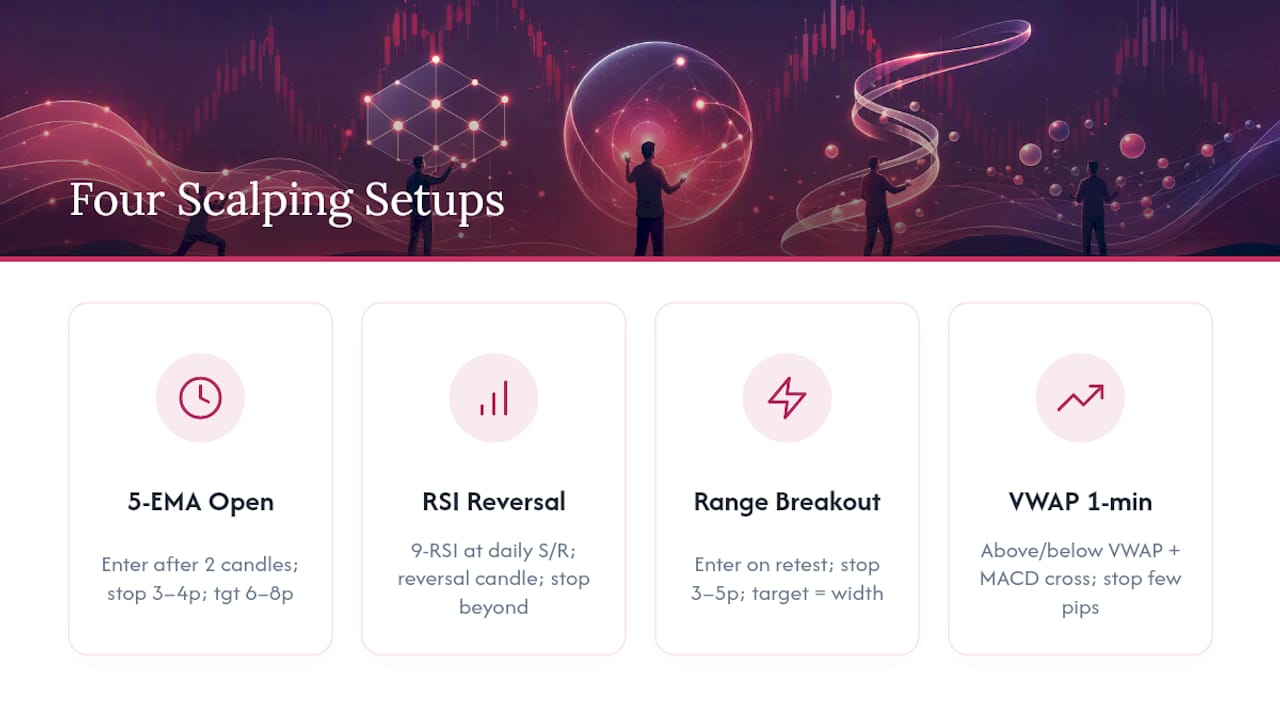
2. RSI reversal scalp against daily support/resistance. On a 5-minute chart, use a 9-period RSI. Look for RSI above 70 or below 30 only when price is also sitting at a daily support or resistance level, not RSI extremes in the middle of nowhere. Confirmation comes from a reversal candle (pin bar or engulfing pattern) at that level. Stop goes just beyond the level itself by a small margin; target is the next minor structure point further away. This setup fires less often than the others, but the win rate tends to be higher because you’re stacking two conditions instead of trading RSI alone.
3. Tight-range breakout with retest. Identify a consolidation range on the 5-minute chart that’s compressed to a narrow width over an extended period. When price breaks the range with a full candle close outside it, wait for a retest of the broken level rather than chasing the breakout candle. Enter on the retest with a stop 3 to 5 pips beyond the range boundary and a target equal to the range’s width, measured from the breakout point. This setup works best when volume or momentum visibly picks up on the breakout candle itself.
4. VWAP plus momentum for 1-minute scalps. On a 1-minute chart, plot VWAP alongside a 12/26/9 MACD. Enter long when price is above VWAP and MACD crosses bullish; enter short when price is below VWAP and MACD crosses bearish. Stop sits a few pips beyond the most recent 1-minute swing; target is a small multiple of that distance. FXOpen documents several practical 1-minute templates built around this same VWAP-plus-momentum logic, along with variations using Keltner Channels with RSI and ALMA with Stochastic. Favor VWAP over a simple moving average here because it weights price by volume, which matters more on a 1-minute chart where a handful of large orders can distort a plain average.
Pro Tip: Run the 5-EMA and VWAP setups side by side on demo for two weeks and log which one gives you cleaner fills relative to your charted entry price. That gap, not your win rate, is usually what separates a profitable scalp plan from a losing one.
One tradeoff worth settling early: 1-minute charts give you more trade opportunities, but a lot more of those signals are noise. Five-minute charts fire less often, but each signal tends to carry more weight. FXOpen’s own research notes that 1-minute setups demand tighter discipline and sharper execution, and that many retail traders find the 5-minute chart a more forgiving place to build consistency before dropping to 1-minute. Start there. Drop to 1-minute only once you’re already sizing and executing the 5-minute setups without hesitation.
Best Sessions and Timeframes to Scalp
Liquidity decides whether your 5-pip target fills before the market reverses on you, and liquidity peaks during the London/New York overlap, roughly 12:00 to 15:00 UTC. Volume during that window helps small targets get hit cleanly instead of stalling half a pip short while spreads widen around you.
Outside the overlap, spreads tend to creep and price can drift in ways that don’t respect your stop or target cleanly. Scalping the Asian session on EUR/USD, for instance, usually means fighting a tighter range for a smaller reward, not a better one.
Multi-timeframe alignment matters just as much as session timing. Investopedia’s guide to timeframe analysis recommends spacing your timeframes at roughly a 1:4 to 1:6 ratio, using a higher timeframe to set trend and a lower one to time entries. For scalping, that typically looks like:
- Aggressive 1-minute scalping: 15-minute chart for trend, 1-minute for entry
- Standard 5-minute scalping: 1-hour chart for trend, 5-minute for entry
- Session-swing scalps: 4-hour chart for bias, 15-minute for structure, 5-minute for entry
BabyPips frames this as a top-down process: check the higher timeframe first to set your bias, then only take lower-timeframe signals that agree with it. When your timeframes disagree, the fix isn’t to force a trade. TraderNest’s guide to multi-timeframe analysis suggests cutting your size in half or skipping the trade entirely, since persistent disagreement across frames usually signals regime noise rather than a real edge.
Indicators and Tools That Actually Earn Their Place
Most scalping charts get cluttered fast, and clutter costs you the half-second of clarity you need to pull the trigger. Keep your indicator list short and purposeful.
For 1-minute and 5-minute charts, a workable shortlist looks like this:
- VWAP as your intraday fair-value anchor, especially useful for the VWAP-plus-momentum setup above
- 9 or 21-period EMA for fast trend direction on 1-minute and 5-minute charts
- 9-period RSI for overbought/oversold reads at key levels, not standalone signals
- Bollinger Bands (20, 2) for range compression before breakout setups
- MACD (12, 26, 9) as momentum confirmation, not a standalone entry trigger
On 15-minute charts, the same tools work with slightly longer periods (a 50-period EMA instead of 9 or 21) since you’re reading structure rather than triggering entries.
Indicators only confirm what price is already doing. Order flow and price action, the shape of candles at a level, how fast price moves through a zone, tell you what’s happening before an indicator catches up. Treat indicators as a filter for price-action signals, not a replacement for them.
Platform tools matter as much as the indicators sitting on your chart. Tick charts show you real transaction flow instead of arbitrary time intervals. A DOM or level-2 window shows resting orders stacking up before a move. Hotkeys cut your execution time from a full click sequence to a single keystroke, which matters when a fill is decided in under a second. A VPS keeps your platform running with a stable connection close to your broker’s servers, removing your home internet as a point of failure.
Pro Tip: If your chart has more than four indicators on it, you’re probably hesitating rather than deciding. Strip it back to two and see if your entries actually get worse. Most traders find they don’t.
Risk Management and Position Sizing for Scalping
Scalping’s math punishes sloppy risk rules faster than any other style, because you’re taking more trades, and more trades mean more chances for a bad rule to compound.
Layer daily controls on top of per-trade risk:
- Set a daily loss limit of 2% to 3% of account equity and stop trading entirely once you hit it.
- Cut your position size in half after two consecutive losses; a losing streak often means your read on the session is off, not that the next trade will fix it.
- Walk away after three losses in a row for the rest of the session, full stop.
Cost modeling belongs inside your sizing decision, not as an afterthought. If your average round-trip cost (spread plus commission) runs 0.6 pips and your target is 5 pips, your real net target is 4.4 pips, a distinction that materially changes your expectancy calculation. A separate practitioner analysis of live scalping methods makes the same point bluntly: on a higher-commission account, a 5-pip scalp can turn unprofitable before you even account for a losing trade. Model the cost first, then size the position, not the other way around.
Broker and Execution Requirements That Make or Break a Scalp
None of the setups above matter if your broker can’t fill them the way your chart shows them. Execution is the invisible half of every scalping strategy, and it’s the half most beginners never test before going live.
Run through this checklist before committing real capital:
- Raw spreads, ideally starting near 0.0 pips on major pairs, since a 1 to 2 pip spread can wipe out a third of a typical scalp target
- Transparent commission structure you can model precisely per lot, not a vague “competitive” claim
- Low latency execution, ideally under 50 milliseconds round-trip from order click to fill confirmation
- An explicit no-restriction scalping policy, since some brokers quietly throttle or requote accounts that trade too frequently
- VPS availability so your platform stays connected and synced with the broker’s server regardless of your home connection
To measure a broker honestly, take spread snapshots during your actual trading session (not the marketing-page average), track your realized slippage against your intended entry price over 20 to 30 trades, and time your average round-trip execution speed. Execution quality, measured in latency, re-quotes, and slippage, matters as much as the setup itself, and it’s the variable most new scalpers never actually measure.
This is the checklist Cubomarkets was built to satisfy. The platform offers spreads starting at 0.0 pips with zero commission, fast order execution designed specifically to reduce slippage, and support for MetaTrader 5 and WebTrader so you can run tick charts, hotkeys, and custom templates without fighting your platform. Cubomarkets has processed over 3 million executed orders, a track record that speaks to consistent fill reliability rather than occasional good luck on a demo server.

Pro Tip: Before funding a live account anywhere, pull spread data during your actual trading window for a full week. A broker that looks tight at 2 PM UTC on a Tuesday can widen considerably during your session.
A Session Workflow You Can Repeat Every Day
Consistency in scalping comes from routine, not inspiration. Run the same sequence every session so the only variable left is the market itself.
Before the session opens:
- Check the economic calendar for high-impact releases that could spike spreads or trigger stop-hunts.
- Take a spread snapshot on your main pair to confirm conditions match what you expect.
- Confirm your VPS or connection is stable and your platform is synced.
- Load your chart template: timeframes, indicators, and drawn levels from the prior session’s close.
During the session:
- Use hotkeys and preset order templates so your entry and stop go in simultaneously, not sequentially.
- Recalculate position size for every trade rather than reusing yesterday’s lot size.
- Wait for full confirmation candles before entering; a rushed entry is usually a size-managed loss waiting to happen.
After the session, log every trade: entry price, exit price, pips gained or lost, and which setup you used. Track your fill quality against your charted entry, your win rate by setup type, and your average risk-reward realized versus planned. That last number often reveals more than your win rate ever will.
What the Data Actually Says About Scalping, Beyond the Hype
The conventional advice on scalping treats it like a personality trait, either you’re wired for fast trading or you’re not. That framing misses the point entirely. Scalping is a cost-and-execution problem dressed up as a psychology problem. Two traders running the identical 5-EMA setup will get wildly different results if one has a 0.2 pip average spread and 30 millisecond fills while the other has a 1.5 pip spread and 200 millisecond lag. The strategy didn’t change. The infrastructure did.
Where most guides fall short is treating indicators as the differentiator. They aren’t. RSI, VWAP, and MACD are widely available and largely interchangeable once you understand what each one is actually measuring. What separates a profitable scalper from a losing one is almost always the unglamorous stuff: whether they modeled round-trip costs before sizing, whether they measured their broker’s real execution speed instead of trusting the marketing page, and whether they had a daily stop-loss they actually respected on the day it mattered most.
If you take one thing from this guide, prioritize execution testing over strategy hunting. Get the infrastructure right first.
— Cubo
Trade the Setups Above With Execution Built for Scalping
A scalping strategy is only as good as the fills it gets, and that’s exactly where Cubomarkets is built to perform. With spreads starting at 0.0 pips, zero commission, and execution speed designed to minimize slippage, the platform removes the exact cost and latency drag that turns a solid 5-EMA or VWAP setup into a losing one on paper alone.

Cubomarkets supports MetaTrader 5 and WebTrader, so you can run the exact chart templates, tick data, and hotkey setups described throughout this guide without fighting your platform for speed. Whether you’re testing the session-open scalp on EUR/USD or running VWAP-plus-momentum on a 1-minute chart, the execution infrastructure behind you matters as much as the rules in front of you. Cubomarkets has processed over 3 million executed orders, and instant deposits and withdrawals mean you’re not waiting days to access funds after a strong session.
If you’re ready to test these setups with real execution conditions instead of a demo server with artificial fills, open a trading account and start on a demo before scaling into live size.
This article is general information, not a substitute for advice from a qualified financial advisor. Consult a qualified financial professional about your own circumstances before acting on anything here.
Sources
- Time frame analysis — Investopedia
- What Is Multiple Time Frame Analysis? – BabyPips
- Scalping vs Day Trading – TradeOlogy Academy
- Multi Timeframe Analysis: Step-by-Step Guide | TraderNest